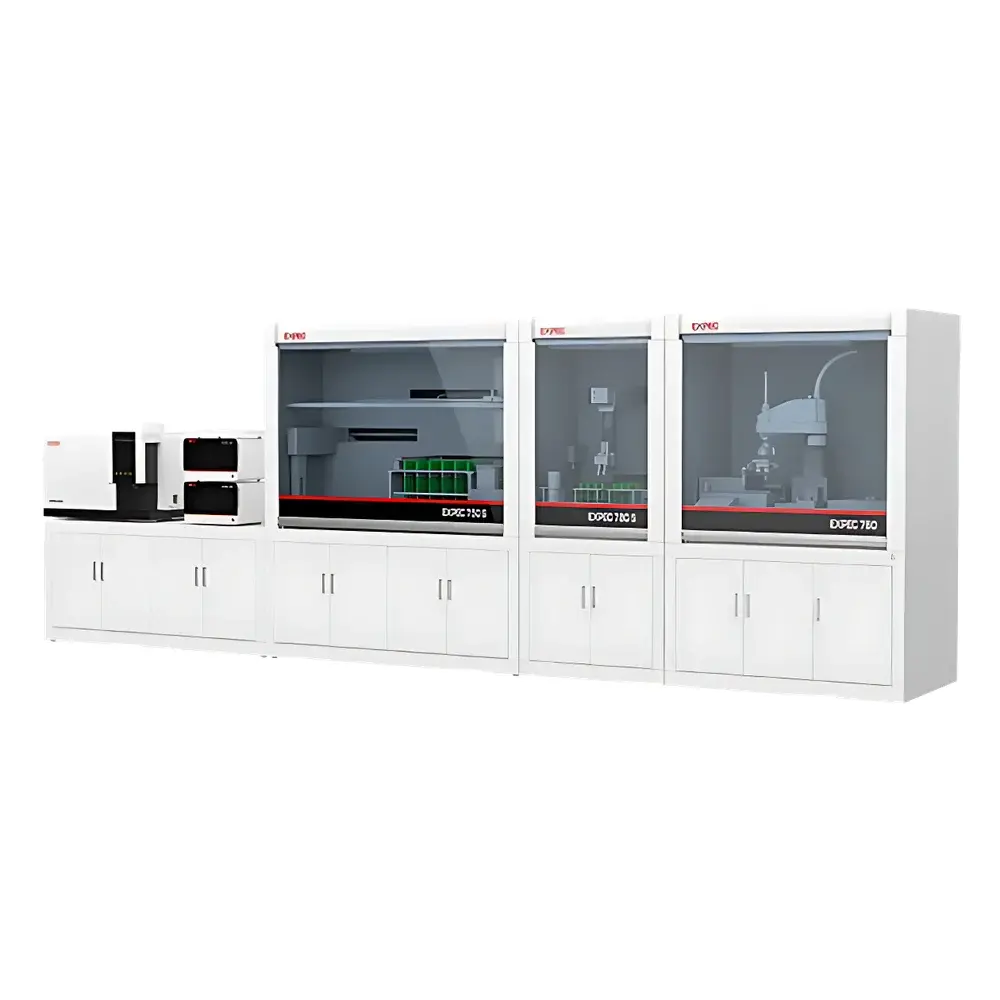
SUPEC 6060/7070 Customizable Automated Analytical System for ICP-MS/ICP-OES Integration
| Brand | EXPEC |
|---|---|
| Origin | Zhejiang, China |
| Manufacturer Type | Authorized Distributor |
| Product Origin | Domestic (China) |
| Model | SUPEC 6060/7070 |
| Pricing | Upon Request |
Overview
The SUPEC 6060/7070 Customizable Automated Analytical System is an integrated laboratory automation platform engineered for high-throughput elemental analysis using inductively coupled plasma mass spectrometry (ICP-MS) and optical emission spectrometry (ICP-OES). Designed by EXPEC Technology, this system implements a closed-loop, software-coordinated workflow spanning sample weighing, acid digestion, ion exchange purification, and instrument-integrated analysis. It operates on a modular architecture where each functional unit—precision balance module, graphite block digestion station, programmable liquid handling manifold for column-based separation, and ICP-MS/OES interface controller—is synchronized via a unified control environment. The system adheres to core principles of analytical traceability and procedural reproducibility, minimizing manual intervention while maintaining full compliance with GLP-aligned operational protocols. Its architecture supports method-defined sequence execution, real-time status monitoring, and hardware-level interlock logic to prevent cross-contamination or procedural deviation.
Key Features
- Automated gravimetric sampling: Integrated high-resolution analytical balance with motorized draft shield control, robotic lid actuation, barcode-scanned sample tube recognition, and anthropomorphic tilt-pour dispensing mechanism for consistent solid sample transfer.
- Programmable graphite digestion: Fully automated acid addition (HNO₃, HF, HCl, H₂O₂), temperature-ramped heating profiles (up to 230 °C), pressure-regulated vessel sealing/unsealing, post-digestion cooling, and volumetric final dilution to 10–50 mL with ±0.5% volumetric accuracy.
- Configurable ion exchange module: Supports user-defined resin columns (e.g., AG MP-1, TRU Spec, UTEVA); controlled by dual-syringe high-precision pumps (0.1–10 mL/min flow range) enabling sequential activation, loading, washing, and elution steps with fraction collection into standardized vials.
- ICP-MS/OES orchestration: Native integration with Thermo Fisher iCAP RQ/QQQ, Agilent 8900/7900, or PerkinElmer NexION platforms; automatic instrument power-up, plasma ignition, tune parameter loading, calibration curve generation (multi-point, weighted linear/non-linear), QC acceptance criteria evaluation (R² ≥ 0.999, %RSD ≤ 2%), and post-run report generation in PDF/CSV/XLSX formats.
- Unified control software: Windows-based EXPEC AutoLab Suite with drag-and-drop method builder, audit-trail-enabled user access logging, electronic signature support per FDA 21 CFR Part 11 requirements (when configured), and optional LIMS connectivity via ASTM E1482-compliant HL7 or custom REST API interfaces.
Sample Compatibility & Compliance
The system accommodates solid matrices including geological digests (soils, sediments, ores), nuclear fuel cycle samples (U/Pu oxides, cladding alloys), environmental filters, and biological tissues (after freeze-drying). Liquid samples (aqueous standards, leachates, acid extracts) are directly compatible with the ion exchange and injection modules. All wet chemistry modules comply with ISO/IEC 17025:2017 clause 5.4.2 (equipment validation) and support traceable calibration using NIST SRM-certified reference materials (e.g., SRM 2710a, 2709a). Digestion vessels meet ASTM D5174-18 specifications for microwave-assisted and hot-block digestion systems. Software design incorporates ALCOA+ data integrity principles, with immutable timestamped logs, version-controlled method storage, and role-based permission tiers.
Software & Data Management
EXPEC AutoLab Suite provides centralized configuration of all hardware modules through a single GUI. Each step—weighing protocol, digestion ramp profile, column elution gradient, and ICP acquisition parameters—is stored as a reusable method template with metadata tagging (operator ID, date/time, instrument serial number). Raw data files (balance logs, temperature curves, pump event timestamps, spectral raw counts) are archived in vendor-neutral HDF5 format with embedded MD5 checksums. Database backend utilizes SQLite (local deployment) or Microsoft SQL Server (enterprise deployment), supporting SQL queries for QA/QC trending, outlier detection, and regulatory reporting. Export modules generate compliant reports aligned with ISO 17025 Annex A3 and USP / heavy metal testing documentation requirements.
Applications
This system is deployed in nuclear safeguards laboratories for isotopic uranium/plutonium quantification in spent fuel reprocessing streams; in geochemical survey labs for multi-element mapping of rare earth elements (REEs) and high-field-strength elements (HFSEs) in soil and rock digests; and in environmental monitoring agencies conducting EPA Method 200.8/6020B-compliant analysis of As, Cd, Pb, and U in contaminated site soils. Its modularity allows adaptation to CLIA-certified clinical toxicology workflows requiring ultra-trace metal analysis in whole blood or urine, as well as semiconductor-grade material purity screening per SEMI F57 standards.
FAQ
Can the system be validated for GMP environments?
Yes—when deployed with 21 CFR Part 11-compliant configuration (electronic signatures, audit trail, secure login), it meets FDA expectations for computerized system validation (CSV) under Annex 11 and ICH GCP guidelines.
Is remote monitoring supported?
The control software includes OPC UA server capability for real-time telemetry export to SCADA or MES platforms; optional VPN-secured web dashboard enables off-site status viewing and alarm notification via SMTP/SNMP.
What maintenance intervals are recommended?
Balance recalibration every 72 hours of operation; graphite block thermal profiling quarterly; syringe pump seal replacement every 6 months or 5,000 cycles; ICP interface optics inspection per manufacturer’s schedule.
Does the system support method development for novel resins or digestion matrices?
Yes—the software permits full parameter override at each module level, enabling R&D teams to define non-standard heating ramps, custom elution gradients, or hybrid digestion protocols without firmware modification.
How is cross-contamination prevented between samples?
Hardware-level safeguards include positive-pressure purge between vial handling steps, disposable tip usage in liquid modules, acid-wash cycles between batches, and real-time ICP background monitoring with auto-rejection of elevated blank signals.