
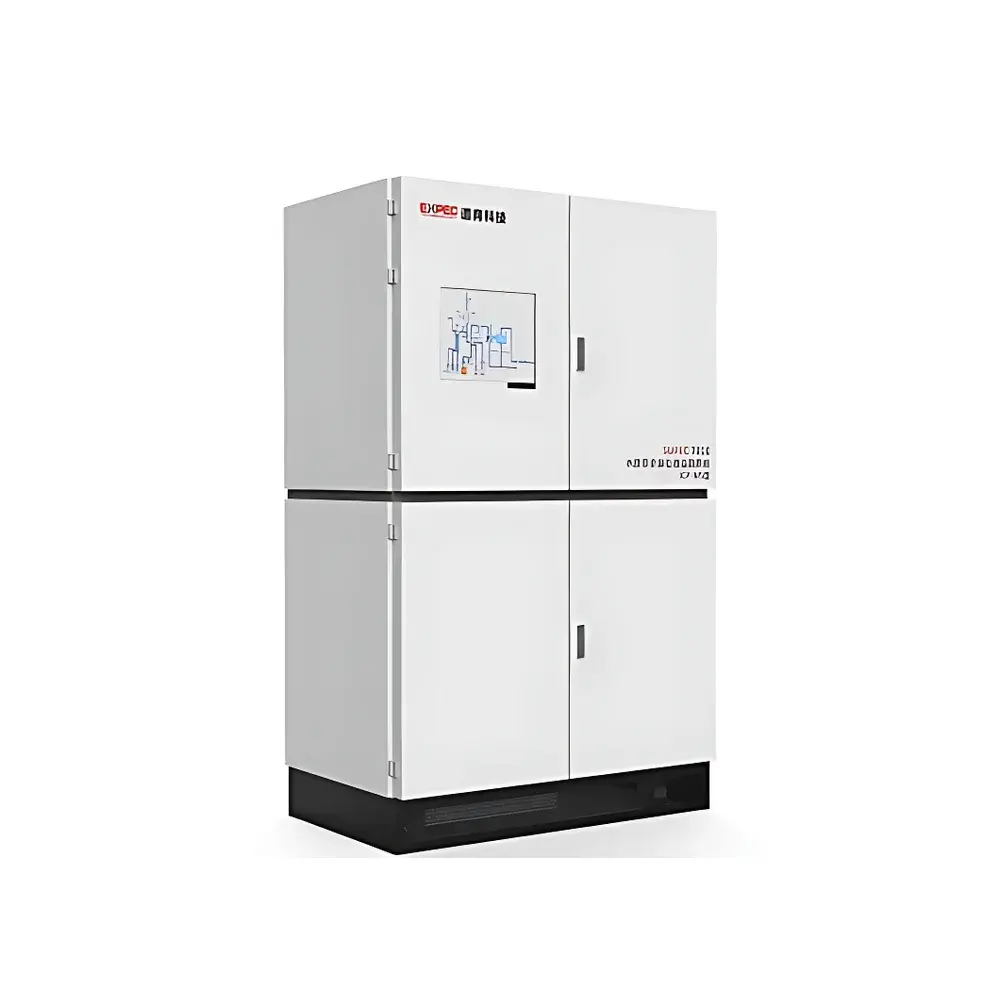
SUPEC 7010 Online ICP-MS System for Heavy Metal Monitoring in Surface Water
| Brand | EXPEC |
|---|---|
| Origin | Zhejiang, China |
| Model | SUPEC 7010 |
| Instrument Type | Quadrupole ICP-MS |
| Application Domain | Laboratory & Environmental Monitoring |
| Compliance | HJ 700–2014 |
| Automation Level | Fully Automated Sample Intake, Filtration, Pre-treatment, Analysis, QC, and Data Transmission |
| Detection Scope | Multi-element (As, Cd, Cr, Cu, Hg, Ni, Pb, Zn, etc.) in Surface Water, Groundwater, Drinking Water, and Seawater |
| Measurement Time per Sample | <5 min |
| Interference Resistance | High (immune to color, turbidity, matrix-induced polyatomic interferences via collision/reaction cell technology) |
| Environmental Profile | Low reagent consumption, no electrode wear, near-zero liquid waste generation |
| Regulatory Alignment | Designed for GLP-compliant operation |
Overview
The SUPEC 7010 Online ICP-MS System is an integrated, laboratory-grade inductively coupled plasma mass spectrometer engineered for continuous, unattended heavy metal monitoring in natural and potable water matrices. It employs quadrupole-based mass filtering coupled with high-efficiency sample introduction—via automated peristaltic pumping, inline filtration (0.45 µm), acid digestion (optional HNO₃-based), and online dilution—to deliver trace-level elemental quantification directly from raw surface water, groundwater, drinking water, or seawater. Unlike conventional batch-mode ICP-MS instruments, the SUPEC 7010 embeds real-time analytical workflows within a sealed, climate-controlled cabinet, enabling deployment at remote monitoring stations while maintaining metrological traceability to NIST-traceable standards. Its core architecture follows the fundamental principles of ICP-MS: aqueous samples are nebulized into fine aerosols, desolvated, ionized at ~7,000 K in an argon plasma, and subsequently separated by mass-to-charge ratio (m/z) in a radiofrequency-driven quadrupole mass filter before detection by a discrete-dynode electron multiplier. This enables simultaneous multi-element detection across the full biologically and environmentally relevant spectrum—from Li (m/z 7) to U (m/z 238)—with inherent isotopic specificity critical for distinguishing anthropogenic contamination sources.
Key Features
- Fully automated end-to-end workflow: integrated sampling, particulate removal, online acidification, internal standard addition (e.g., Rh, In, Bi), and plasma stabilization—requiring no manual intervention between scheduled analyses.
- Regulatory method compliance: pre-configured analytical protocols aligned with HJ 700–2014 (“Determination of 65 Elements in Water by Inductively Coupled Plasma Mass Spectrometry”), including calibration verification, continuing calibration verification (CCV), laboratory control samples (LCS), and duplicate analysis routines.
- Robust interference management: dual-gas collision/reaction cell (CRC) technology mitigates common polyatomic interferences (e.g., 40Ar16O⁺ on 56Fe⁺, 40Ar35Cl⁺ on 75As⁺) through kinetic energy discrimination or reactive gas chemistry (e.g., NH₃, He).
- Low operational footprint: compact cabinet design (W × D × H ≈ 800 × 700 × 1800 mm) suitable for field laboratories or mobile monitoring units; average reagent consumption <2 mL per analysis cycle.
- Data integrity architecture: built-in audit trail logging, user role-based access control, and electronic signature support compliant with FDA 21 CFR Part 11 and ISO/IEC 17025 documentation requirements.
Sample Compatibility & Compliance
The SUPEC 7010 accepts untreated water samples conforming to GB 3838 (Surface Water Quality Standards), GB/T 14848 (Groundwater Quality), GB 5749 (Drinking Water Hygiene Standard), and marine environmental monitoring guidelines. It accommodates total dissolved solids (TDS) up to 0.2% w/v without clogging or signal drift. All analytical procedures satisfy ISO/IEC 17025 accreditation criteria for testing laboratories, with documented uncertainty budgets per element and certified reference material (CRM) validation using NIST SRM 1640a (Trace Elements in Natural Water) and EPA MO 200.9. Method validation reports—including spike recovery (85–115%), method detection limits (MDLs), and precision (RSD <8% for triplicate injections)—are generated automatically and exportable in PDF or CSV format.
Software & Data Management
EXPEC Analytical Suite v3.2 provides centralized instrument control, real-time spectral visualization, dynamic background subtraction, isotope ratio calculation, and auto-quantitation against multi-point calibration curves. The software supports LIMS integration via ASTM E1482-compliant XML data exchange and OPC UA protocol for SCADA system interoperability. Raw data (.raw), processed results (.csv), QC logs, and maintenance records are stored in encrypted SQLite databases with daily automated backup to network-attached storage (NAS) or cloud repositories. All data modifications are timestamped and attributed to authenticated users, fulfilling ALCOA+ (Attributable, Legible, Contemporaneous, Original, Accurate, Complete, Consistent, Enduring, Available) principles for regulatory audits.
Applications
- Real-time surveillance of source water intakes for municipal drinking water treatment plants, ensuring early warning of As, Pb, or Cd contamination events.
- Long-term trend analysis of heavy metal fluxes in transboundary river basins (e.g., Yangtze River, Taihu Lake watershed) under national ecological monitoring programs.
- Compliance monitoring for industrial discharge permits requiring sub-ppt level reporting of regulated elements (e.g., Hg, Tl, U) per local environmental protection bureau directives.
- Emergency response deployments during chemical spills or mining-related leaching incidents, leveraging rapid screening mode for qualitative/semi-quantitative identification within minutes.
- Research-grade speciation studies when interfaced with HPLC-ICP-MS modules for As(III)/As(V), Cr(III)/Cr(VI), or methylmercury analysis.
FAQ
Does the SUPEC 7010 meet international regulatory standards for environmental monitoring?
Yes—it is validated against HJ 700–2014 and supports method transfer to ISO 17294-2 and EPA Method 6020B frameworks through configurable acquisition parameters and QC templates.
Can it operate unattended for extended periods?
Yes—designed for 30-day continuous operation with automated recalibration every 8 hours and remote diagnostics via secure SSH or TLS-enabled web interface.
Is sample pretreatment fully automated?
Yes—integrated filtration, UV digestion (optional), online pH adjustment, and internal standard spiking eliminate manual preparation steps.
What data security measures are implemented?
Role-based authentication, AES-256 encryption for stored data, immutable audit logs, and electronic signature enforcement align with FDA 21 CFR Part 11 and EU Annex 11 requirements.
How is system performance verified during routine use?
Automated daily QC includes bracketing standards, continuing calibration verification (CCV), and matrix spike duplicates—all reported with pass/fail status and corrective action triggers.




