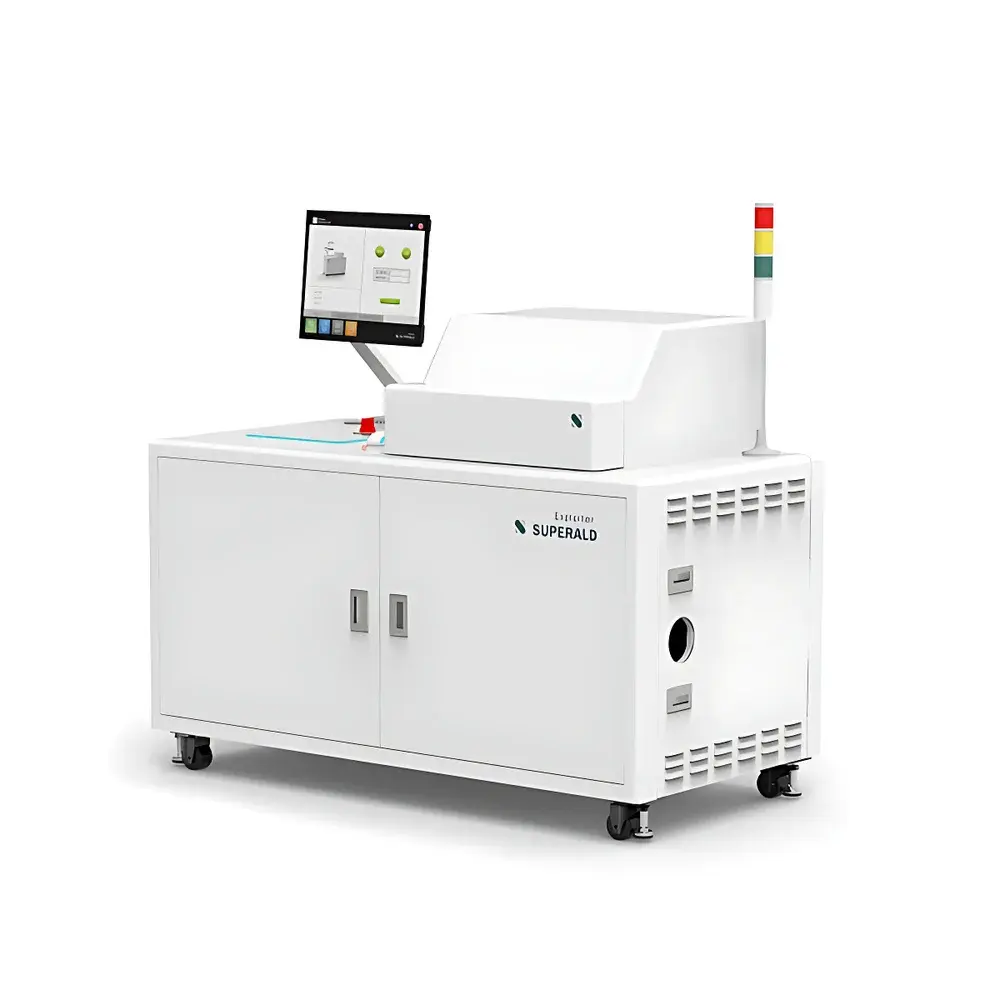
SUPERALD Thermal-ALD E300S Large-Area Atomic Layer Deposition System
| Brand | SUPERALD |
|---|---|
| Origin | Guangdong, China |
| Manufacturer Type | Authorized Distributor |
| Country of Origin | China |
| Model | Thermal-ALD E300S |
| Substrate Size | 300 mm (12 inch) diameter (customizable) |
| Process Temperature Range | RT to 500 °C |
| Temperature Uniformity | ±1 °C (customizable) |
| Precursor Channels | Up to 6 independent, supporting solid & liquid precursors with heated source bottles |
| Reactant Channels | 2 (customizable) |
| Carrier Gas | N₂ with MFC flow control (customizable) |
| Pressure Range | 0.005–1000 Torr (dual corrosion-resistant capacitance manometers) |
| Base Pressure | <5 × 10⁻³ Torr |
| Vacuum System | Standard oil-sealed rotary vane pump |
| Control System | 19-inch industrial touchscreen HMI, embedded IPC running Windows 7, PLC-based real-time logic control with fieldbus support |
Overview
The SUPERALD Thermal-ALD E300S is a high-precision, large-area atomic layer deposition system engineered for reproducible, self-limiting surface reactions on 300 mm (12-inch) wafers and other planar substrates. Based on thermal ALD chemistry—where sequential, saturative surface reactions between gaseous precursors and substrate functional groups occur at elevated temperatures—the system delivers monolayer-level thickness control, exceptional conformality (>95% step coverage in high-aspect-ratio features), and sub-nanometer film uniformity across full-diameter substrates. Designed for semiconductor front-end-of-line (FEOL) and back-end-of-line (BEOL) integration, the E300S supports both research-scale process development and pilot-line manufacturing environments requiring strict adherence to material purity, interface integrity, and cycle-to-cycle repeatability. Its modular architecture enables seamless adaptation to evolving process requirements—including low-temperature ALD for temperature-sensitive layers—and complies with foundational cleanroom infrastructure standards (ISO Class 5 compatible footprint, ESD-safe construction, and leak-tight gas delivery pathways).
Key Features
- 300 mm wafer-compatible chamber with optimized showerhead design and uniform thermal zoning for radial temperature stability ±1 °C across the substrate surface
- Up to six independently heated and pressure-regulated precursor lines—compatible with volatile solids (e.g., metal halides), liquids (e.g., alkylamides, β-diketonates), and reactive gases—each equipped with dedicated vaporization zones and temperature control up to 150 °C
- Dual-reactant capability with programmable pulsing sequences, enabling co-injection or alternating chemistries for ternary oxide, nitride, or sulfide synthesis
- Corrosion-resistant dual capacitance manometer suite (0.005–1000 Torr range) for dynamic pressure profiling during purge, pulse, and reaction phases—critical for optimizing purge efficiency and minimizing cross-contamination
- Integrated vacuum architecture featuring base pressure <5 × 10⁻³ Torr, supported by oil-sealed rotary vane pump and optional cryo-trap for hydrocarbon and moisture suppression
- Industrial-grade control stack: PLC-based real-time sequencing engine synchronized with Windows 7 HMI via Ethernet; supports deterministic timing resolution ≤100 ms per step, audit-trail-enabled recipe execution, and full I/O interlock mapping
- Ergonomic 19-inch touch-enabled display with 360° articulating mount, facilitating operator access in constrained cleanroom bays
Sample Compatibility & Compliance
The E300S accommodates standard 300 mm silicon wafers, quartz, sapphire, glass, flexible polymer substrates (e.g., PI, PET), and MEMS devices with topography up to 10 µm depth. It supports deposition on high-aspect-ratio trenches (≥20:1), nanowires, porous anodic alumina (PAA), and microfluidic channel walls. All wetted components—including stainless-steel gas lines, VCR fittings, and alumina-coated chamber walls—meet SEMI F57 specifications for metallic contamination control. The system’s software architecture implements role-based user permissions, electronic signature logging, and configurable alarm thresholds aligned with ISO 9001 and GLP documentation practices. While not certified to FDA 21 CFR Part 11 out-of-the-box, the control system provides the foundational data integrity framework—including immutable audit trails, recipe versioning, and exportable CSV/Excel logs—for validation under GMP or medical device manufacturing protocols.
Software & Data Management
The proprietary SUPERALD Control Suite runs natively on the embedded industrial PC and offers three operational modes: Auto-Run (fully automated “one-click” deposition), Manual Mode (granular valve-by-valve actuation with real-time feedback), and Script Editor (Python-based macro scripting for custom pulse trains and conditional logic). All process parameters—including precursor dose time, purge duration, temperature ramp rates, and pressure setpoints—are stored in encrypted XML recipe files with metadata tagging (operator ID, timestamp, chamber history). Historical run data—including chamber pressure traces, thermocouple readings, and MFC flow profiles—is archived locally with automatic rollover and export to network shares. The system supports OPC UA server integration for MES connectivity and includes built-in diagnostics for precursor depletion alerts, vacuum leak detection, and heater fault correlation.
Applications
The E300S serves as a platform for developing and scaling ALD processes across multiple advanced technology domains. In semiconductor manufacturing, it enables deposition of high-κ dielectrics (Al₂O₃, HfO₂, ZrO₂), metal gates (TiN, TaN, WN), diffusion barriers (Ru, Co), and ferroelectric oxides (Hf₀.₅Zr₀.₅O₂) with atomic-scale thickness control required for sub-3 nm node logic and DRAM capacitor stacks. In energy storage, it applies conformal LiCoO₂, Al₂O₃, and Li₃PO₄ coatings on cathode particles and separator membranes to suppress side reactions and dendrite nucleation. For photonics and optoelectronics, it fabricates low-defect ZnO, AlN, and TiO₂ layers for waveguide claddings, AR coatings, and OLED encapsulation—achieving water vapor transmission rates (WVTR) <10⁻⁶ g/m²/day. In biomedical engineering, it deposits cytocompatible TiN, ZrN, and SiO₂ films on stents, neural probes, and lab-on-chip sensors—validated per ISO 10993-5 for in vitro cytotoxicity. Catalysis researchers utilize its precise stoichiometric control to synthesize single-atom catalysts (e.g., Pt₁/Al₂O₃) and core-shell nanoparticles (e.g., Pd@CeO₂) with defined coordination environments.
FAQ
What substrate sizes does the E300S support?
Standard configuration accommodates 300 mm (12-inch) wafers; custom chambers are available for 200 mm, 150 mm, or non-circular substrates including flexible foils and MEMS carriers.
Can the system deposit both oxides and nitrides?
Yes—by selecting appropriate precursor pairs (e.g., TMA + H₂O for Al₂O₃; TMA + NH₃ for AlN) and configuring reactant gas lines accordingly. Optional plasma upgrade enables radical-assisted nitridation for lower-temperature processing.
Is remote monitoring and troubleshooting supported?
The system includes integrated VNC server and SNMP-enabled network diagnostics, allowing secure remote access for technical support and real-time performance review without compromising local firewall policies.
How is precursor consumption tracked and managed?
Each precursor line integrates mass flow telemetry and optional load-cell monitoring on source bottles; software calculates estimated remaining volume per cycle and triggers low-level alerts prior to depletion.
Does the E300S meet semiconductor industry safety standards?
It conforms to SEMI S2-0215 (safety guidelines for semiconductor manufacturing equipment) and includes redundant overpressure relief, emergency stop circuitry, and gas leak detection interlocks compliant with IEC 61508 SIL2 requirements.