
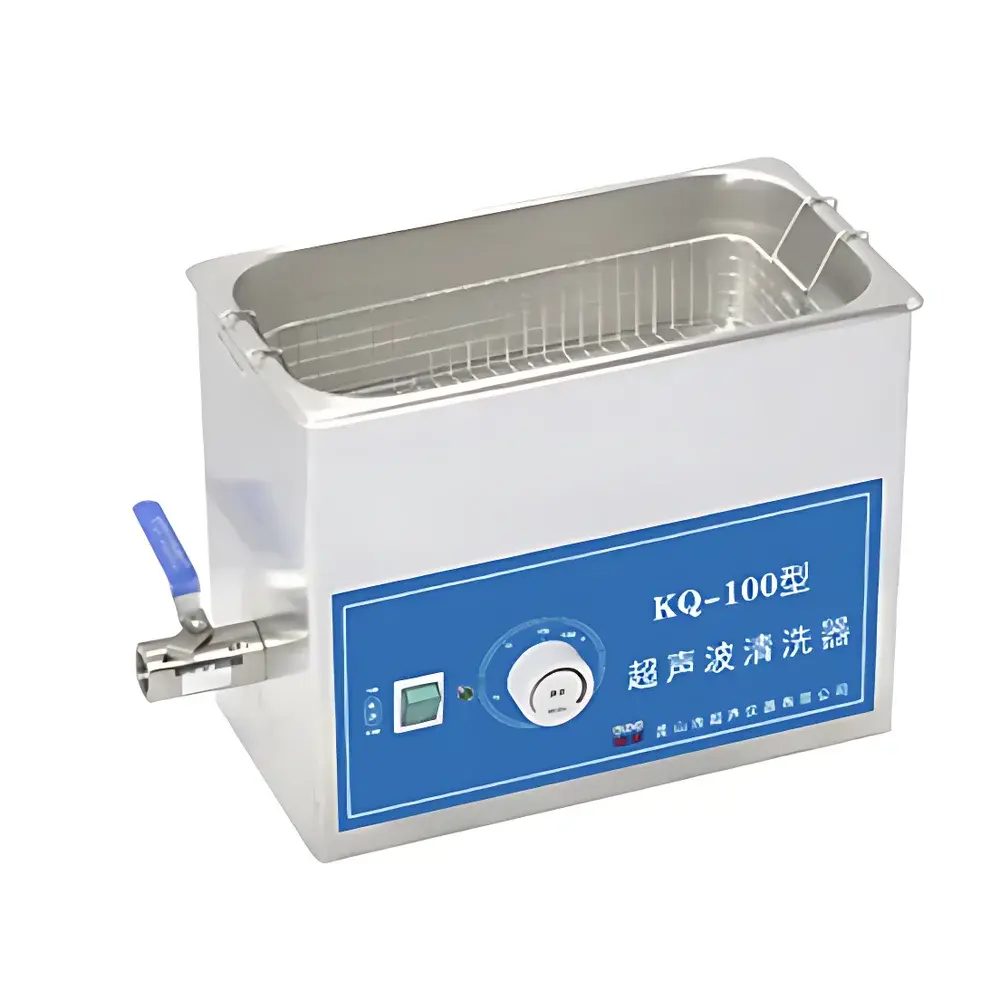
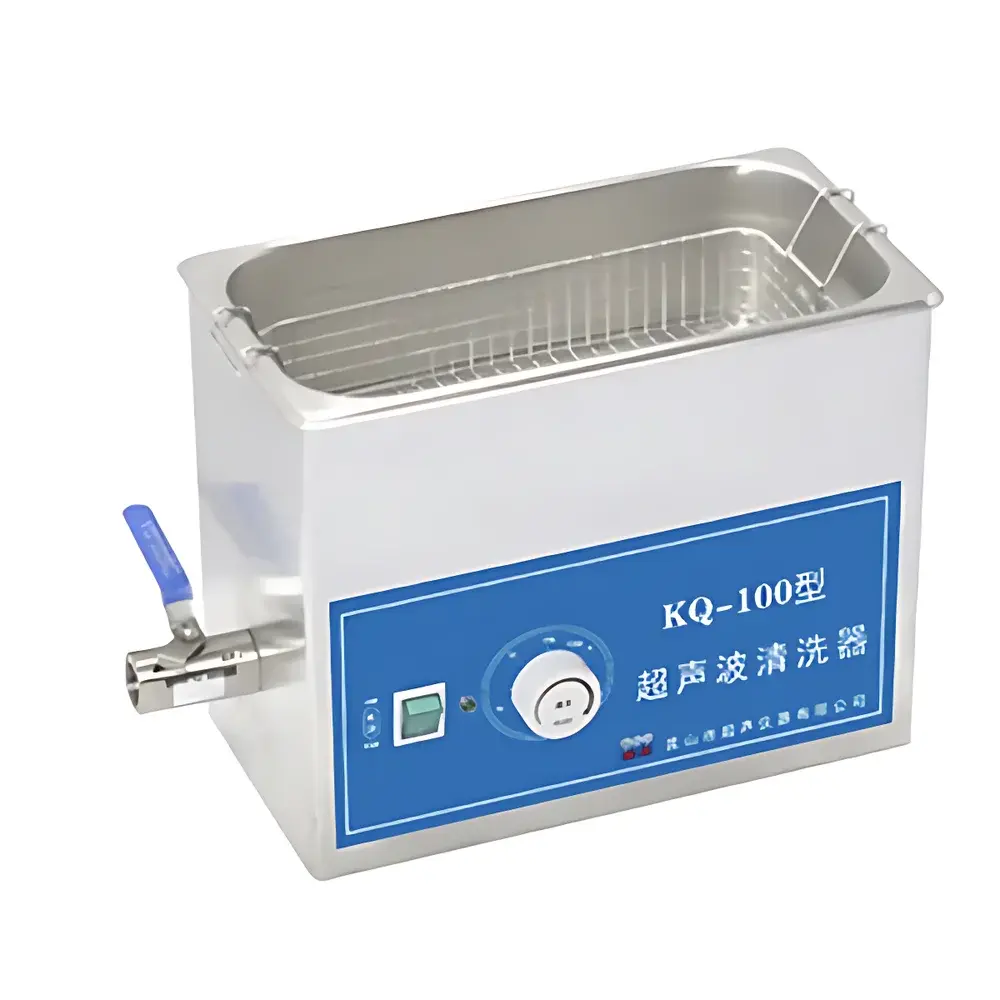
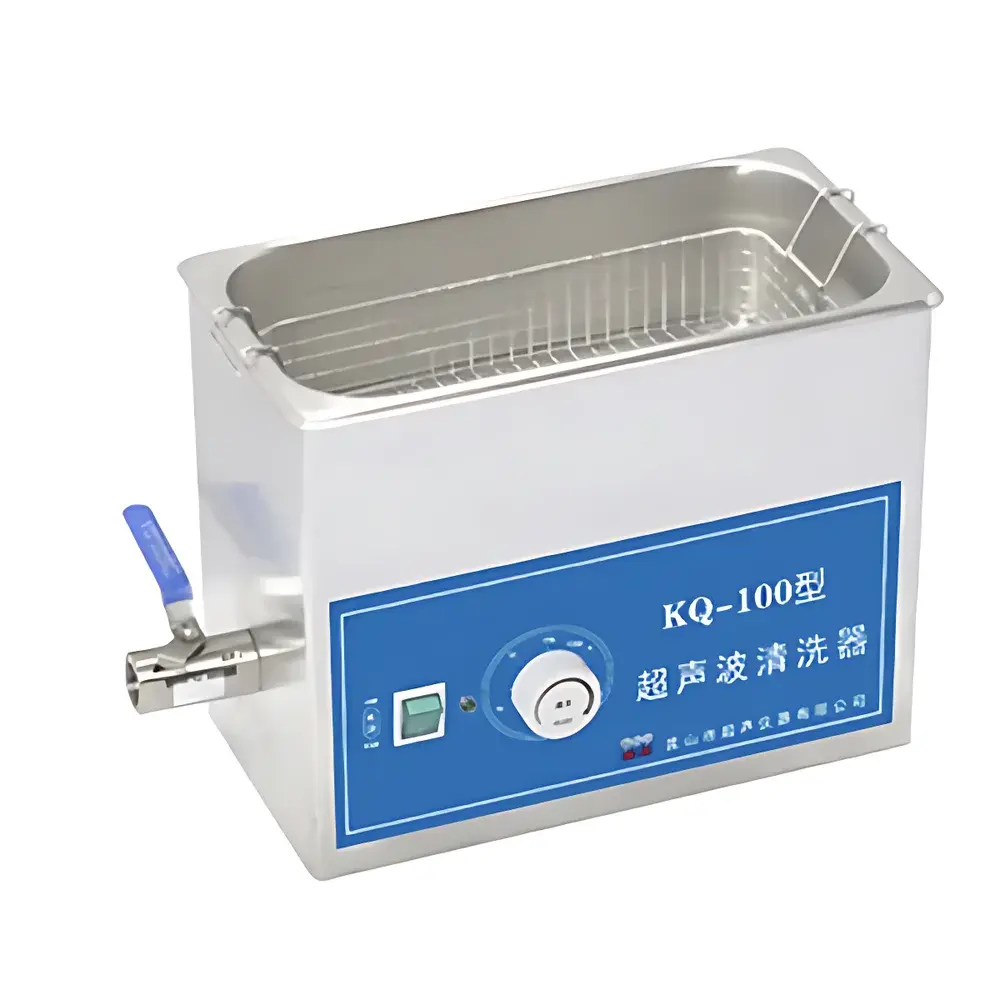
Supmile KQ-100 Benchtop Ultrasonic Cleaner
| Brand | Supmile |
|---|---|
| Origin | Jiangsu, China |
| Manufacturer Type | Authorized Distributor |
| Instrument Type | General-Purpose Ultrasonic Cleaner |
| Capacity | 4 L |
| Ultrasonic Frequency | 40 kHz |
| Ultrasonic Power Output | 100 W |
| Timer Range | 1–20 min (mechanically adjustable) |
| Lid | None (open-top design) |
| Drain/Inlet | Manual valve control |
| Tank Material | 304 Stainless Steel |
| Internal Dimensions | 300 × 150 × 100 mm |
| External Dimensions | 320 × 174 × 280 mm |
| Power Supply | 220 V AC, 50 Hz |
| Standard Accessories | Stainless steel mesh basket, drain plug, fill spout |
Overview
The Supmile KQ-100 is a compact, general-purpose benchtop ultrasonic cleaner engineered for precision cleaning, degassing, and sample preparation in academic laboratories, quality control environments, and R&D facilities. It operates on the principle of ultrasonic cavitation—where high-frequency sound waves (40 kHz) generate microscopic vacuum bubbles in the cleaning liquid that rapidly collapse, producing localized shockwaves and microstreaming effects. This physical mechanism effectively dislodges particulate contaminants, organic residues, and loosely adhered biofilms from surfaces without mechanical abrasion or chemical aggression. Designed for routine use with low operational complexity, the KQ-100 integrates the ultrasonic generator and stainless-steel tank into a single monolithic unit, minimizing footprint and eliminating external transducer cabling. Its 4 L capacity and open-top configuration support immersion of small-to-medium components—including optical lenses, surgical instruments, PCBs, glassware, and analytical sample vials—while maintaining accessibility for manual loading and visual monitoring.
Key Features
- Monolithic construction with integrated ultrasonic generator and 304 stainless-steel tank ensures structural rigidity, corrosion resistance, and long-term thermal stability.
- Fixed-frequency operation at 40 kHz delivers consistent cavitation intensity across the entire tank volume, optimized for broad-spectrum contaminant removal in aqueous and mild solvent-based media.
- Mechanical timer with 1–20 minute range provides repeatable exposure control; no software dependency or firmware updates required—ideal for GLP-compliant workflows where traceability relies on procedural documentation rather than digital logs.
- 100 W total ultrasonic power output distributed via dual 50 W piezoelectric transducers mounted directly to the tank base, ensuring uniform energy coupling and minimizing standing-wave dead zones.
- Manual inlet and drain valves allow precise fluid management without reliance on plumbing infrastructure—suitable for temporary setups, mobile labs, or facilities with restricted utility access.
- Open-top design facilitates rapid insertion/removal of parts and compatibility with auxiliary fixtures (e.g., beaker holders, rack supports), though acoustic emission mitigation requires placement in low-ambient-noise zones per ISO 9614-1 guidelines.
Sample Compatibility & Compliance
The KQ-100 accommodates a wide range of substrates including metals (stainless steel, aluminum, titanium), borosilicate glass, quartz, ceramics, and certain thermoplastics (e.g., PTFE, polypropylene). It is not recommended for use with highly volatile solvents (e.g., acetone, ether) unless operated within certified fume hoods meeting EN 14175 standards. While the device itself carries no CE or UL certification, its electrical architecture complies with IEC 61010-1:2010 safety requirements for laboratory equipment when used with properly grounded 220 V / 50 Hz supply. The 304 stainless-steel tank meets ASTM A240 specifications for corrosion resistance in neutral pH aqueous environments. For regulated applications (e.g., pharmaceutical component cleaning per USP ), users must validate cleaning efficacy per internal SOPs and document parameters (time, temperature, solution composition) as part of process validation records.
Software & Data Management
The KQ-100 operates exclusively via analog controls and does not incorporate embedded microprocessors, USB interfaces, or data logging capabilities. All operational parameters—including timer setting, power activation, and manual fluid handling—are recorded manually by the operator. This architecture eliminates cybersecurity risks associated with connected devices and simplifies audit readiness under FDA 21 CFR Part 11 Annex 11 frameworks, where electronic records are not generated. Users requiring time-stamped event tracking may integrate external timers or environmental monitors (e.g., temperature/humidity loggers) positioned adjacent to the unit, with metadata linked to batch records during post-run documentation.
Applications
- Cleaning of precision optics, watch components, and MEMS devices prior to metrology or coating processes.
- Degassing of HPLC mobile phases and ultrapure water to prevent pump cavitation and column void formation.
- Cell lysis and homogenization of soft-tissue samples in molecular biology workflows (e.g., RNA extraction prep).
- Removal of flux residues from printed circuit boards before AOI inspection or conformal coating.
- Supporting ASTM D2621 and ISO 14644-1 cleanroom component verification protocols through standardized ultrasonic rinse cycles.
- Preparatory cleaning of crucibles, pipette tips, and volumetric flasks in analytical chemistry laboratories.
FAQ
Is the KQ-100 suitable for cleaning delicate semiconductor wafers?
Yes—when used with deionized water or low-surface-tension surfactant solutions at controlled temperatures (<40°C), it effectively removes submicron particles without surface scratching. However, wafer-specific validation per SEMI F20 is required.
Can I use organic solvents like isopropanol in this unit?
Only in well-ventilated areas or certified fume hoods; the open-top design offers no vapor containment, and solvent compatibility must be verified against 304 SS corrosion charts (e.g., NACE MR0175).
Does the unit include temperature control?
No—the KQ-100 lacks heating elements or thermostatic regulation. For temperature-sensitive applications, external water baths or chillers may be employed upstream of the cleaning step.
What maintenance is required for long-term reliability?
Monthly inspection of transducer bonding integrity, quarterly descaling of the tank interior using dilute citric acid, and annual verification of timer accuracy against a calibrated stopwatch.
Is the mesh basket included compatible with all standard labware sizes?
The supplied 304 SS basket (approx. 280 × 130 × 80 mm) fits most 50 mL centrifuge tubes, Petri dishes, and 100 mL beakers; custom fixtures can be fabricated using the tank’s dimensional specifications.



