
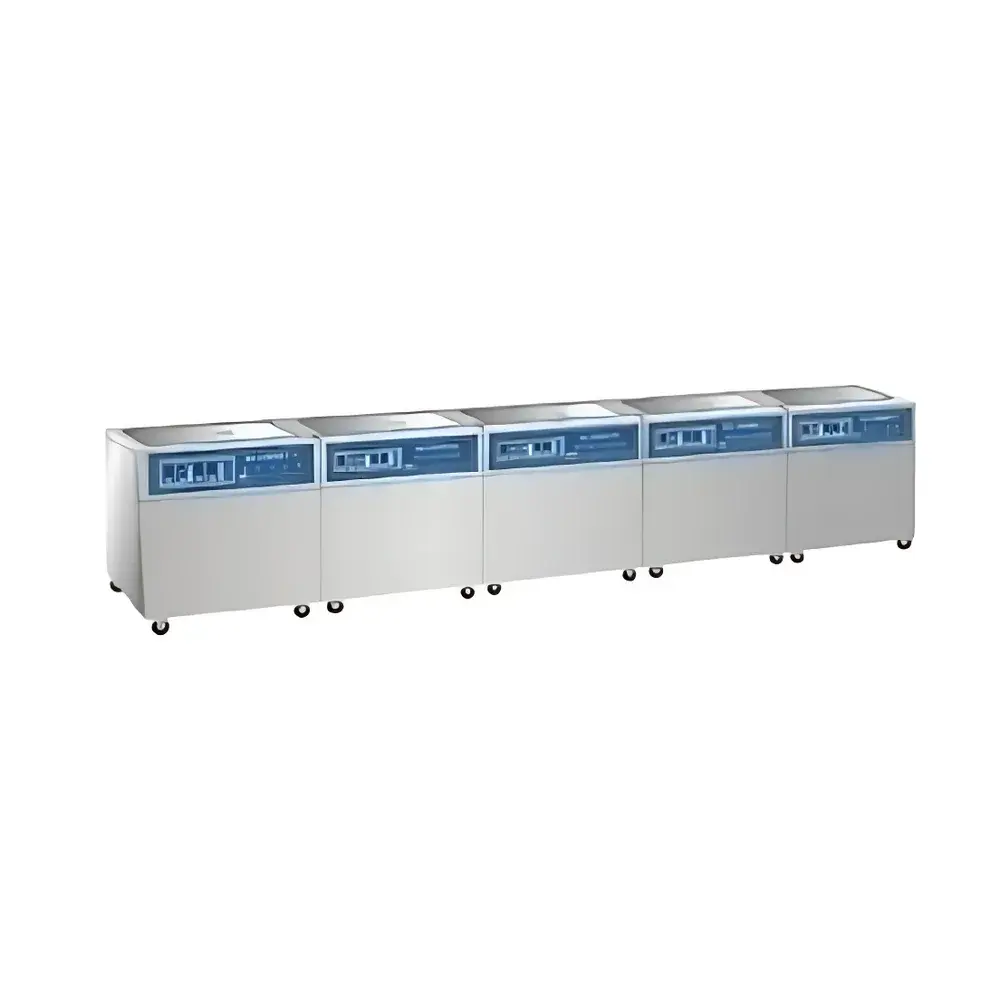
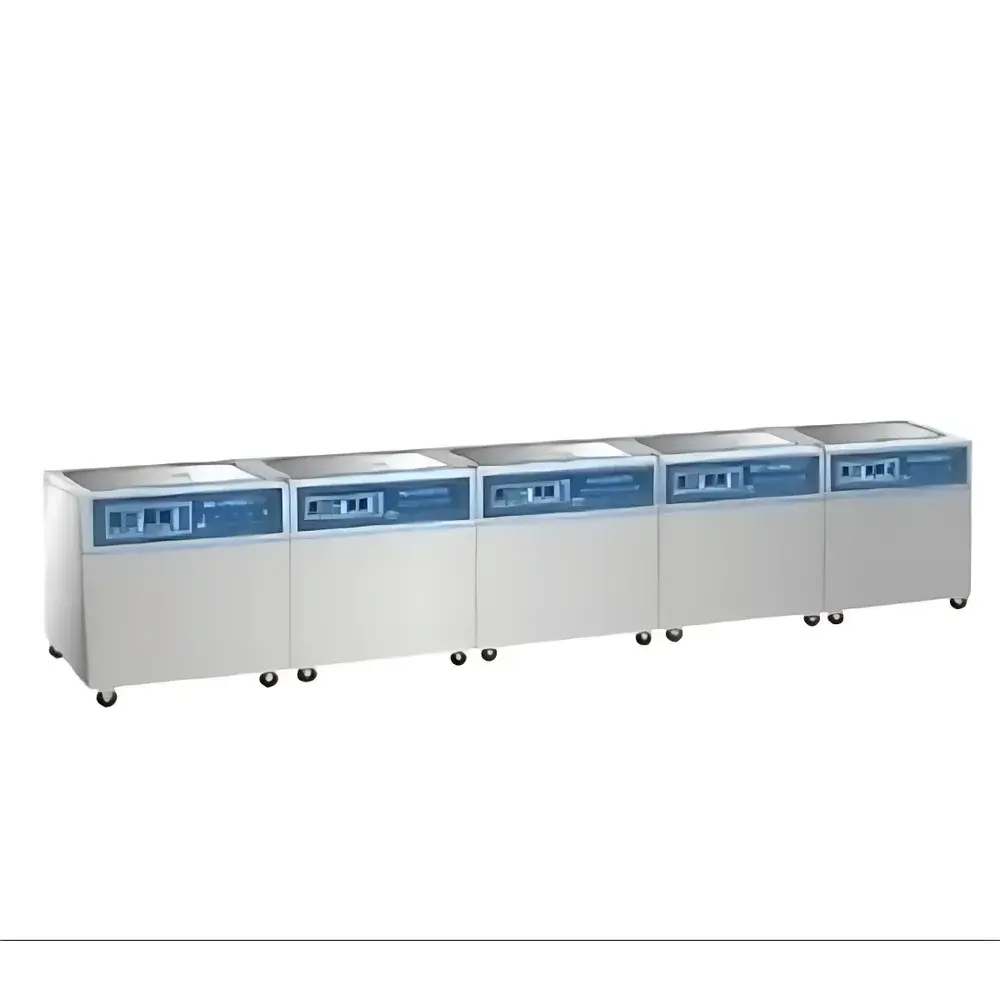
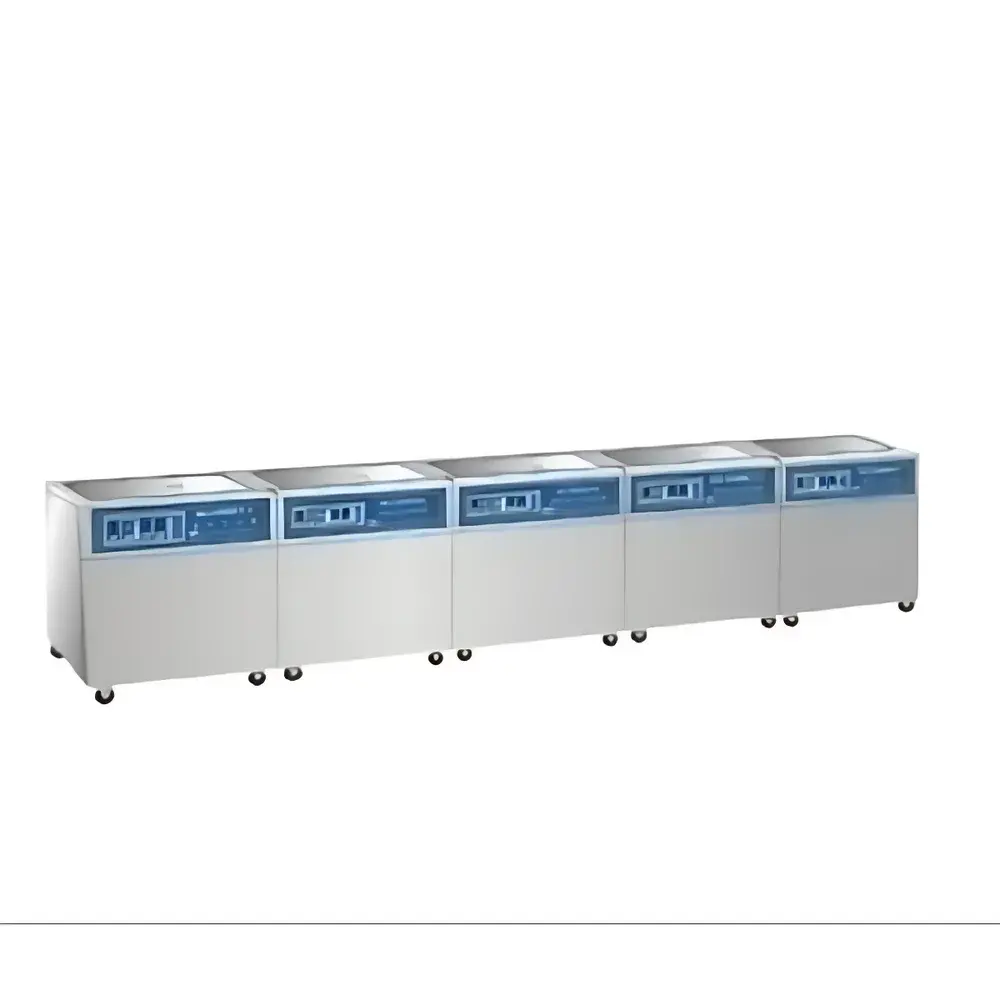
Supmile KQ-1000DE-G Digital Multi-Tank Ultrasonic Cleaner
| Brand | Supmile |
|---|---|
| Origin | Jiangsu, China |
| Model | KQ-1000DE-G |
| Tank Capacity | 72 L |
| Ultrasonic Frequency | 40 kHz |
| Ultrasonic Power Output | 1000 W (adjustable from 40% to 100%) |
| Heating Power | 4800 W |
| Temperature Control Range | 10–98 °C |
| Timer Range | 1–480 min |
| Dimensions (L×W×H) | 800×550×800 mm |
| Inner Tank Dimensions | 600×300×400 mm |
| Construction | 304 Stainless Steel (tank, housing, and basket) |
Overview
The Supmile KQ-1000DE-G is a digitally controlled, multi-station ultrasonic cleaning system engineered for high-throughput, process-critical laboratory and industrial cleaning applications. Unlike single-tank cleaners, this modular platform integrates five functionally independent stations—pre-wash soak, ultrasonic cleaning, ultrasonic rinse, oil immersion boiling, and forced-air drying—into a configurable linear workflow. Each station operates autonomously with dedicated digital controls, enabling users to select, sequence, and spatially arrange modules according to specific cleaning protocols. The system leverages 40 kHz piezoelectric transducers mounted on the tank bottom to generate stable cavitation fields across the full 72 L working volume, ensuring uniform energy distribution and reproducible cleaning efficacy. Designed for integration into GLP-compliant environments, the KQ-1000DE-G supports traceable parameter logging and repeatable cycle execution—key requirements for validation-driven operations in medical device manufacturing, precision optics, and analytical sample preparation labs.
Key Features
- Modular five-station architecture: Pre-wash soak, ultrasonic cleaning, ultrasonic rinse, oil immersion boiling, and hot-air drying—each station independently controllable and repositionable.
- Digital microprocessor control with real-time display of temperature, time, power level, and water level status.
- Ultrasonic output continuously adjustable from 40% to 100% (370–1000 W), allowing optimization for delicate substrates or heavily soiled components.
- Precise temperature regulation from 10 °C to 98 °C (±1 °C accuracy) via 4800 W heating elements, supporting aqueous, solvent-based, and thermal-assisted cleaning chemistries.
- Programmable timer (1–480 minutes) with auto-shutdown and alarm notification upon cycle completion or fault detection.
- Electronically actuated inlet and drain valves with programmable liquid-level sensing (1–300 mm range), eliminating manual fill/drain steps and reducing operator exposure to solvents or hot liquids.
- Full 304 stainless steel construction—including tank, housing, and heavy-duty mesh baskets—for corrosion resistance, cleanability, and compliance with ISO 13485 and FDA-recommended equipment hygiene standards.
Sample Compatibility & Compliance
The KQ-1000DE-G accommodates a broad spectrum of sample geometries and materials, including surgical instruments, optical lenses, printed circuit boards (PCBs), metal stampings, ceramic substrates, and glassware up to 600 × 300 × 400 mm. Its modular design permits customization for application-specific workflows—e.g., adding filtration recirculation to the rinse station for semiconductor wafer cleaning, or integrating nitrogen purging during drying for moisture-sensitive electronics. All electrical and thermal subsystems conform to IEC 61010-1 safety standards for laboratory equipment. The stainless-steel wetted surfaces meet USP material compatibility guidelines for non-porous metallic components used in pharmaceutical cleaning processes. While not certified to UL or CE as a complete system, individual modules are built to RoHS-compliant component specifications and support IQ/OQ documentation packages for GMP facility qualification.
Software & Data Management
The KQ-1000DE-G features an embedded digital controller with non-volatile memory capable of storing up to 20 user-defined cleaning protocols. Each protocol records setpoints (temperature, time, power %), start/stop timestamps, and operational events (e.g., over-temperature alert, low-water cutoff). Optional RS-232 or USB-C interface enables export of cycle logs in CSV format for audit trail generation. When deployed in regulated environments, the system supports 21 CFR Part 11–compliant data integrity practices through external integration with validated LIMS or MES platforms—specifically, electronic signatures, audit trail review, and role-based access control can be enforced at the enterprise software layer. No proprietary cloud service or firmware update mechanism is embedded; all configuration and diagnostics remain local and offline by default.
Applications
- Pre-sterilization cleaning of reusable surgical and dental instruments in hospital central sterile supply departments (CSSD).
- Removal of polishing compounds, flux residues, and organic contaminants from precision machined parts prior to metrology or coating.
- Decontamination of HPLC columns, syringe filters, and autosampler vials in analytical laboratories.
- Surface preparation of MEMS devices and photomasks before thin-film deposition or lithography.
- Bulk cleaning of calibration standards, reference materials, and certified test samples where particulate-free surfaces are required per ISO 14644-1 Class 5 cleanroom specifications.
- Supporting ASTM F2476 (Standard Guide for Ultrasonic Cleaning Process Validation) through documented parameter control and repeatability.
FAQ
Can the KQ-1000DE-G be validated for use in GMP manufacturing environments?
Yes—its digital parameter logging, independent station control, stainless-steel construction, and compatibility with external audit-trail systems enable full IQ/OQ/PQ execution per Annex 15 and EU GMP guidelines.
Is remote monitoring or Ethernet connectivity available?
No native Ethernet or Wi-Fi capability is included; however, optional RS-232-to-Ethernet gateways may be integrated at the system level for SCADA or building management system (BMS) interfacing.
What maintenance intervals are recommended for sustained performance?
Transducer performance verification every 6 months, tank inspection for pitting or weld integrity annually, and calibration of temperature sensors against NIST-traceable references prior to each qualification cycle.
Does the system support solvent-based cleaning solutions?
Yes—provided the solvent’s flash point exceeds the maximum operating temperature (98 °C) and vapor handling is managed externally via fume hood or condensate recovery unit.
Can individual stations be operated without the full five-module configuration?
Absolutely—the system is designed for partial deployment; any combination of two or more stations may be commissioned and controlled independently using the same digital interface.



