
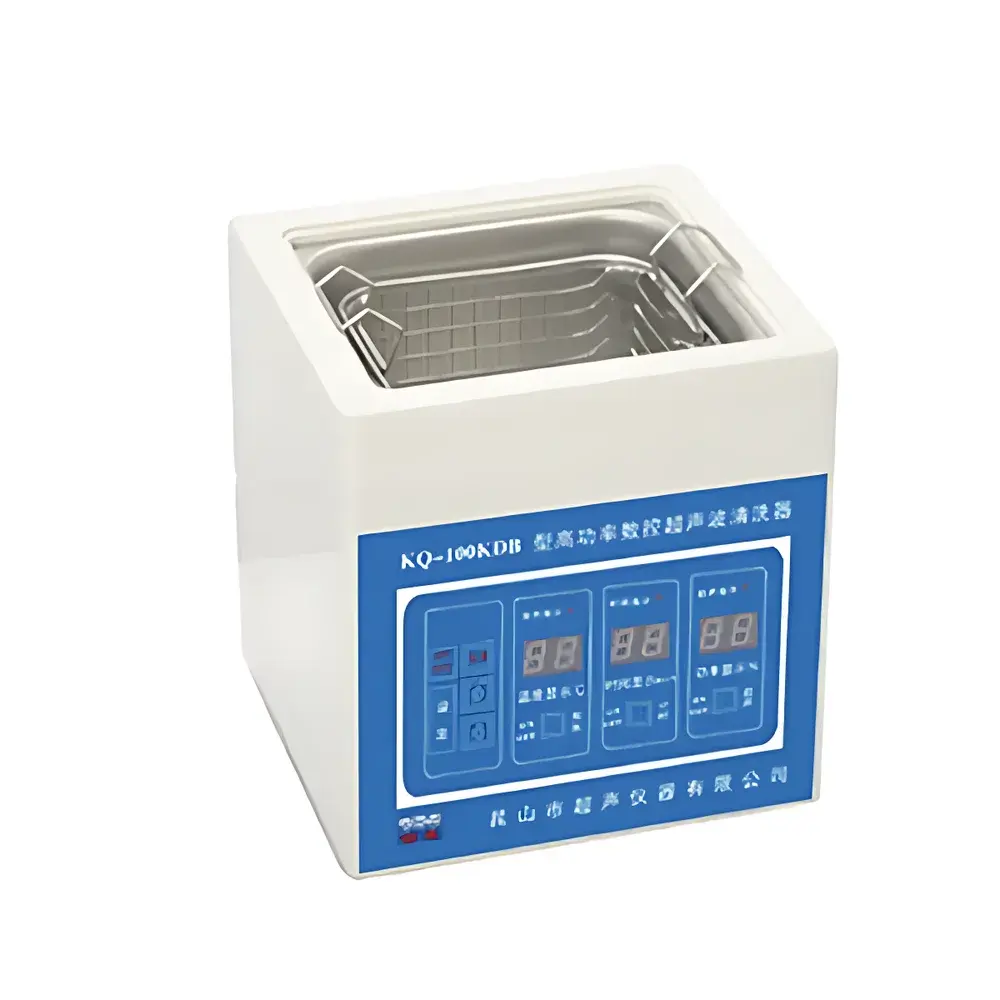
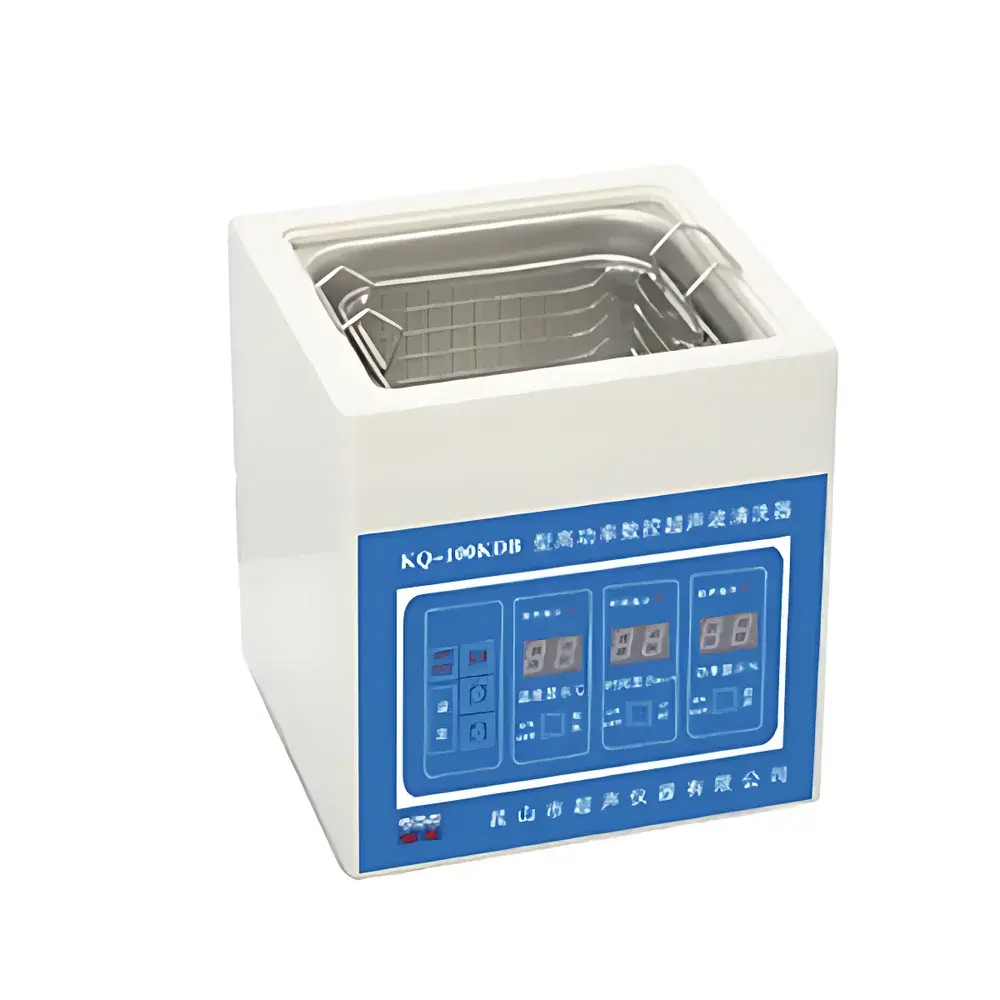
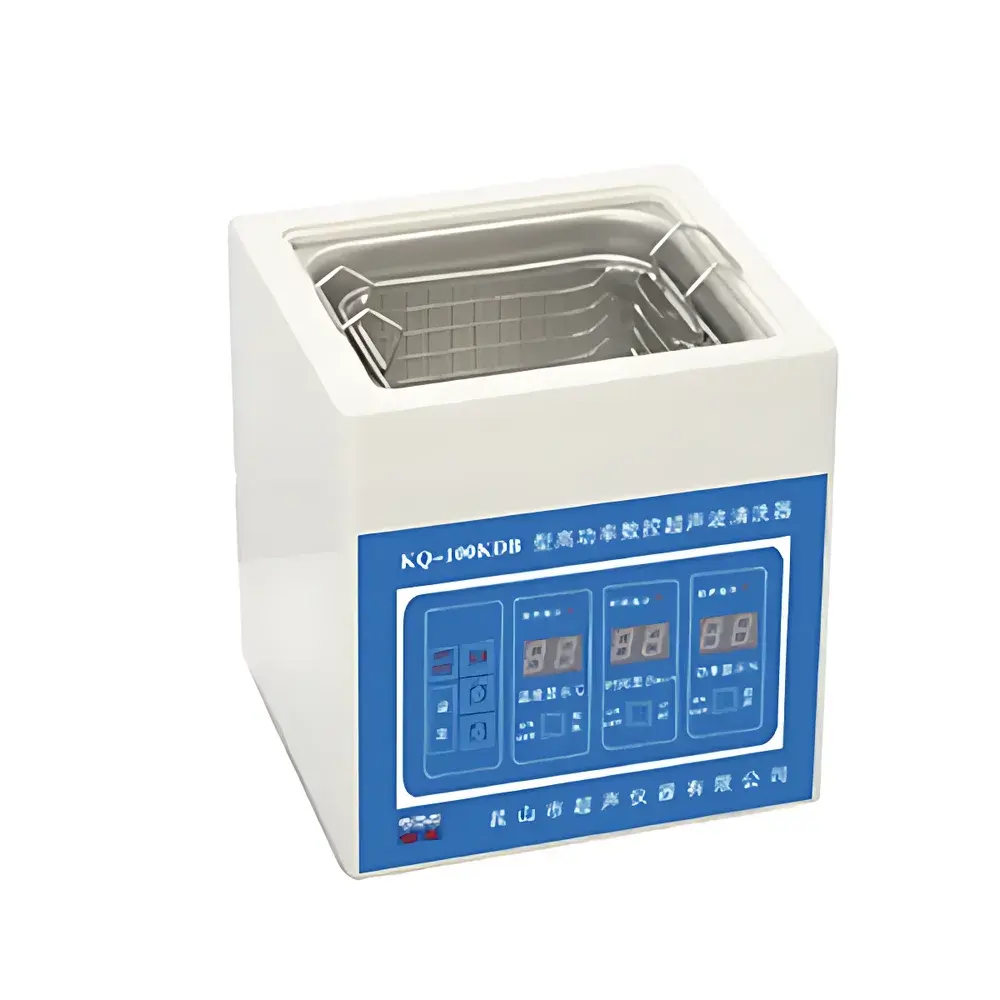
Supmile KQ-100KDB High-Power Ultrasonic Cleaner
| Brand | Supmile |
|---|---|
| Origin | Jiangsu, China |
| Model | KQ-100KDB |
| Tank Capacity | 2 L |
| Ultrasonic Frequency | 40 kHz |
| Ultrasonic Power Output | 100 W (per transducer) |
| Power Adjustment Range | 40–99% |
| Heating Temperature Range | 20–80 °C |
| Timer Range | 1–99 min |
| Heating Power | 200 W |
| Tank Dimensions (L×W×H) | 150 × 140 × 100 mm |
| Overall Dimensions (L×W×H) | 208 × 192 × 210 mm |
| Safety Features | Digital Over-Temperature, Over-Voltage and Over-Current Protection |
| Control Interface | Microprocessor-Based Digital Display with Parameter Memory |
| Construction | 304 Stainless Steel Tank, Engineering Plastic Housing |
| Drain Valve | Yes |
| Lid | None |
Overview
The Supmile KQ-100KDB is a microprocessor-controlled high-power ultrasonic cleaner engineered for precision cleaning of delicate laboratory components, optical elements, precision instruments, and small-volume analytical hardware. It operates on the principle of cavitation—generating high-frequency (40 kHz) acoustic pressure waves in liquid media to produce transient microbubbles that collapse with localized energy release, effectively dislodging particulate contaminants, organic residues, and loosely adhered biofilms from surfaces. With a nominal ultrasonic power output of 100 W per transducer—double the output of standard 50 W units—the KQ-100KDB delivers enhanced cleaning efficiency in demanding applications where conventional low-power cleaners fall short. Its compact 2 L tank volume (150 × 140 × 100 mm internal dimensions) is optimized for benchtop deployment in QC labs, R&D facilities, and university teaching laboratories requiring consistent, repeatable cleaning performance without occupying excessive workspace.
Key Features
- Microprocessor-based digital control system with real-time display of ultrasonic power (%), heating temperature (°C), and elapsed time (min)
- Programmable memory function retains user-defined settings across power cycles for operational consistency
- Dual-stage safety architecture: integrated over-temperature, over-voltage, and over-current protection with visual alarm indicators
- High-efficiency piezoelectric transducers delivering 100 W nominal output per unit—engineered for stable cavitation intensity and long-term reliability
- Adjustable ultrasonic power (40–99%) enabling optimization for sensitive substrates (e.g., coated optics, microfluidic chips) or heavily soiled parts
- Independent heating control (20–80 °C) with PID-regulated thermal stability ±1.5 °C, supporting aqueous and solvent-based cleaning protocols
- Stainless steel 304 tank construction ensures corrosion resistance, chemical compatibility with common lab solvents (e.g., isopropanol, acetone, aqueous alkaline detergents), and compliance with ISO 13485 cleanroom-grade material requirements
- Integrated drain valve facilitates rapid, spill-free solution exchange—critical for multi-step cleaning sequences or hazardous solvent handling
Sample Compatibility & Compliance
The KQ-100KDB accommodates a wide range of sample geometries and materials, including glassware (vials, cuvettes, pipette tips), metal components (syringe needles, surgical tools), ceramic substrates, and polymer-based microdevices. Its 40 kHz frequency balances penetration depth and surface shear force—ideal for sub-millimeter feature cleaning without erosion risk. While not certified to IEC 61000-4 electromagnetic immunity standards out-of-the-box, its circuitry meets basic EMC emission limits for laboratory environments per CISPR 11 Group 1, Class B. The device supports GLP-compliant documentation when paired with external logging systems; however, it does not include FDA 21 CFR Part 11–compliant audit trails or electronic signature capability. Users performing regulated cleaning validation (e.g., per USP or ASTM D2603) should implement external temperature calibration verification and periodic cavitation mapping per ISO 13076.
Software & Data Management
The KQ-100KDB operates via embedded firmware only—no PC connectivity, USB port, or proprietary software suite is provided. All parameter inputs and status monitoring occur through the front-panel LED display and tactile membrane keypad. Settings are retained in non-volatile memory, eliminating reconfiguration after shutdown. For traceability in regulated environments, users must manually record operating parameters (time, temperature, power %) in lab notebooks or LIMS-integrated forms. No data export functionality exists; however, the timer’s cumulative hour counter (up to 999999 h) supports maintenance scheduling and transducer lifetime tracking.
Applications
- Cleaning of HPLC injection valves, GC liners, and mass spectrometry ion sources prior to maintenance
- Removal of flux residues and solder particles from PCBs and semiconductor wafers during prototyping
- Pre-analytical preparation of FTIR ATR crystals and Raman substrates
- Decontamination of reusable pipette tips and microcentrifuge tubes in molecular biology workflows
- Supporting ASTM D2603 ultrasonic degradation testing of polymeric solutions via controlled exposure protocols
- Routine maintenance of optical filters, lens assemblies, and fiber optic connectors in photonics labs
FAQ
Does the KQ-100KDB include a lid or sound-dampening cover?
No—the unit ships without a lid or acoustic enclosure. Users requiring noise reduction (<65 dB(A) at 1 m) must install third-party dampening enclosures compliant with local occupational health regulations.
Is the heater capable of boiling water?
No—the maximum setpoint is 80 °C, and the heating element (200 W) is designed for controlled thermal assistance—not sterilization or boiling.
Can this unit be used with flammable solvents?
Only with appropriate explosion-proof modifications and ventilation controls. The standard KQ-100KDB is not rated for Class I, Division 1 hazardous locations and lacks intrinsically safe circuitry.
What is the expected service life of the transducers?
Under continuous operation at ≤80% power and proper degassing protocols, transducers typically maintain >90% output efficiency for ≥5,000 hours. Annual calibration verification is recommended.
Does the unit support external trigger input or RS-232 communication?
No—it features no external I/O ports or programmable logic interfaces. Automation requires relay-based integration via the main power circuit.



