
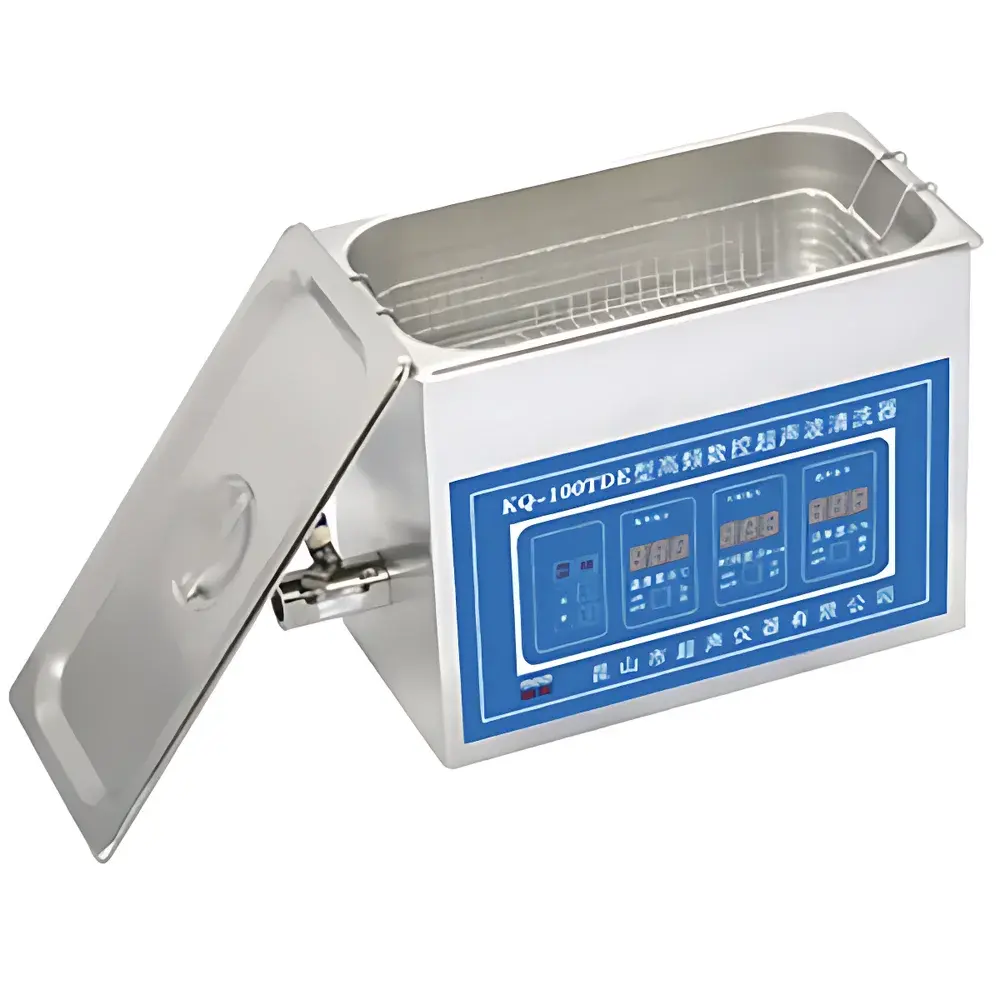
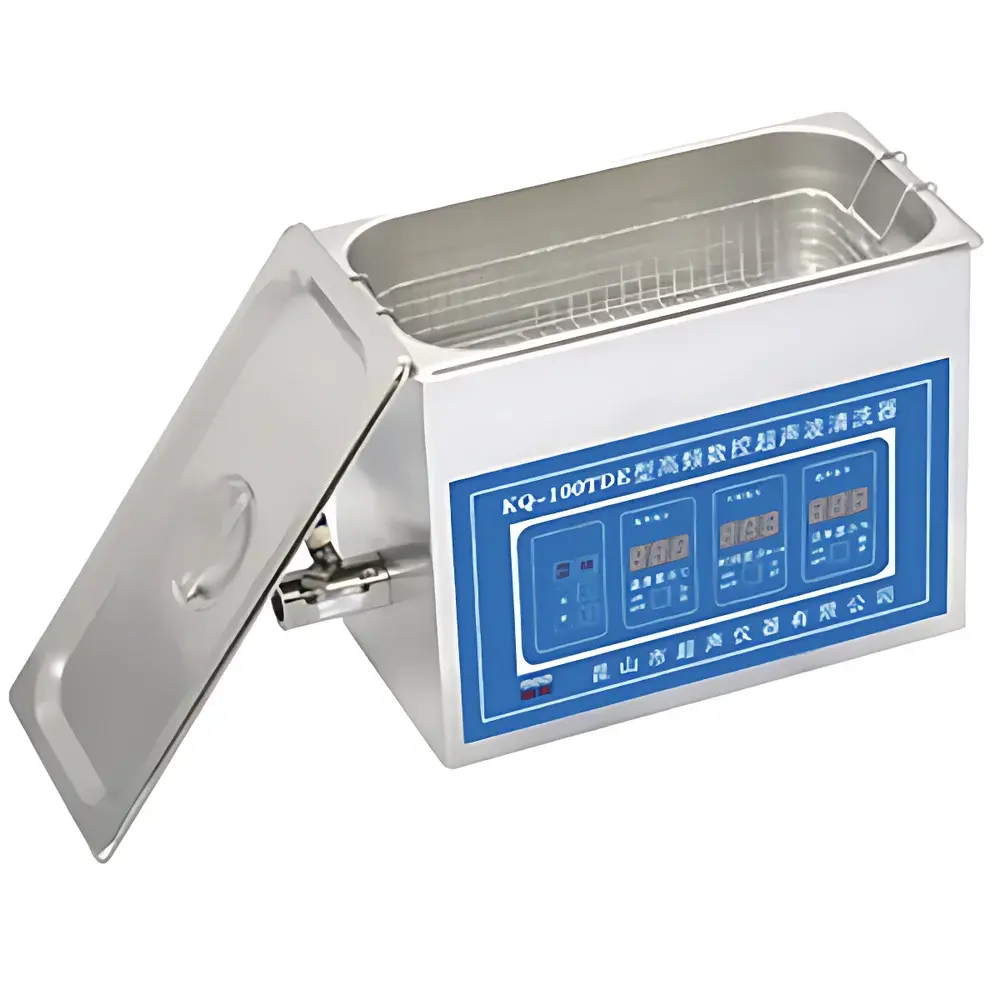
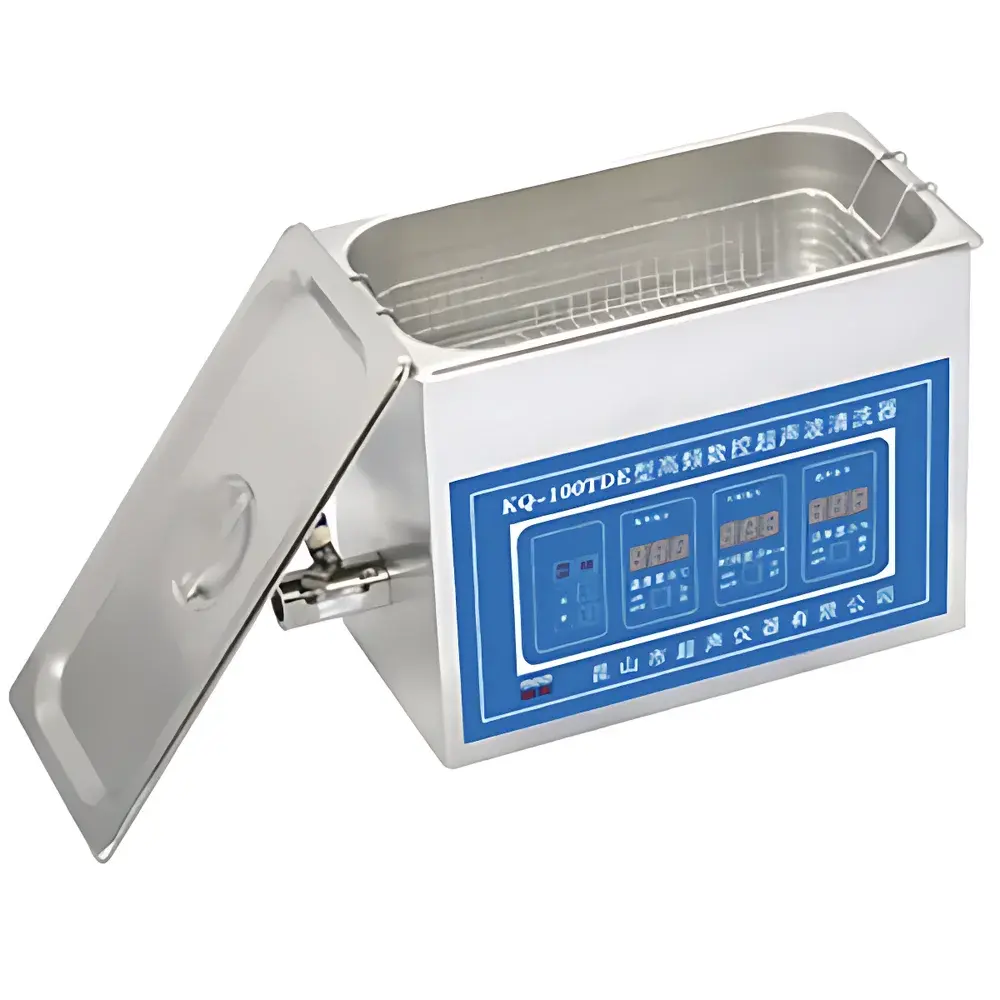
Supmile KQ-100TDE High-Frequency Ultrasonic Cleaner
| Brand | Supmile |
|---|---|
| Origin | China |
| Model | KQ-100TDE |
| Tank Capacity | 4 L |
| Ultrasonic Frequency | 80 kHz |
| Ultrasonic Power | 100 W |
| Power Adjustment Range | 40–100% |
| Heating Temperature Range | 10–80 °C |
| Timer Range | 1–480 min |
| Sound-Dampening Lid | Yes |
| Drain Control | Manual |
| Tank Material | 304 Stainless Steel |
| Protection Features | Over-temperature, over-voltage, and over-current digital monitoring |
Overview
The Supmile KQ-100TDE is a benchtop high-frequency ultrasonic cleaner engineered for precision cleaning of delicate laboratory components, optical elements, semiconductor wafers, microfluidic devices, and analytical instrumentation parts. Operating at an elevated frequency of 80 kHz—significantly higher than conventional 40 kHz units—the KQ-100TDE generates finer, more uniformly distributed cavitation bubbles. This enables gentler yet highly effective removal of sub-micron particulate contaminants, organic residues, and thin-film deposits without surface erosion or mechanical damage to sensitive substrates. Its 4-liter stainless steel tank (300 × 150 × 100 mm internal dimensions) supports consistent acoustic field distribution and thermal stability during extended cleaning cycles. The unit integrates digital microcontroller-based operation with real-time feedback on ultrasonic power output, bath temperature (both setpoint and actual), and elapsed time—ensuring reproducible process conditions essential for QC/QA workflows and GLP-compliant documentation.
Key Features
- High-Frequency Cavitation: 80 kHz transducer array delivers dense, low-energy cavitation ideal for cleaning fragile substrates including quartz cuvettes, HPLC columns, MEMS devices, and sputtered metal films.
- Digital Precision Control: Microprocessor-driven interface enables independent adjustment of ultrasonic power (40–100% in 1% increments), heating temperature (10–80 °C, ±1 °C accuracy), and timer (1–480 minutes, ±1 second resolution).
- Robust Construction: Entire tank and housing fabricated from electropolished 304 stainless steel; corrosion-resistant, non-porous, and compliant with ISO 15195 and ASTM D2603 requirements for laboratory-grade cleaning equipment.
- Integrated Safety Architecture: Triple-layer digital protection system monitors real-time temperature, input voltage, and current draw—automatically suspending operation upon detection of out-of-spec conditions and displaying fault codes.
- Acoustic Optimization: Sound-dampening lid reduces ambient noise to <55 dB(A) at 1 m distance while minimizing evaporative loss and improving energy efficiency by up to 22% compared to open-tank configurations.
- Thermal & Acoustic Stability: Dedicated 400 W heating element with PID control ensures uniform bath temperature distribution (<±0.5 °C spatial variance across tank volume) and prevents thermal shock during cold-start cycles.
Sample Compatibility & Compliance
The KQ-100TDE is validated for use with glassware (volumetric flasks, pipettes, NMR tubes), metal components (stainless steel tweezers, surgical instruments), ceramic substrates (alumina crucibles, piezoelectric sensors), and polymer-based labware (PC, PTFE, and PP fixtures), provided compatibility with aqueous or mild solvent-based cleaning solutions. It meets structural and electrical safety requirements per IEC 61010-1:2010 (Safety Requirements for Electrical Equipment for Measurement, Control, and Laboratory Use). While not certified as medical device sterilizers, its performance aligns with ISO 15883-1 Annex C guidance for ultrasonic cleaning validation in pre-sterilization processing. The unit supports audit-ready operation when paired with external data loggers compliant with FDA 21 CFR Part 11 for electronic record integrity.
Software & Data Management
The KQ-100TDE operates via embedded firmware with no external PC dependency. All operational parameters—including power level, temperature setpoint, timer duration, and cumulative runtime—are stored in non-volatile memory with automatic recall on power-up. Digital display provides simultaneous readout of set vs. actual values for temperature and time, along with dynamic power metering. For laboratories requiring traceable process records, the unit supports optional RS-232 or USB-to-serial interface modules (sold separately), enabling integration with LIMS or custom SCADA systems for timestamped parameter logging, alarm event capture, and automated report generation. Firmware updates are performed via secure bootloader protocol to maintain data integrity and regulatory compliance.
Applications
- Cleaning of HPLC, GC, and IC sample vials, autosampler needles, and injection ports prior to trace-level analysis
- Removal of photoresist residues and etch byproducts from silicon wafers and photomasks in microfabrication labs
- Decontamination of electron microscopy grids, TEM specimen holders, and AFM cantilevers
- Routine maintenance of viscometers, rheometers, and particle size analyzers’ flow cells and optical windows
- Preparation of calibration standards for ICP-MS and AAS by eliminating adsorbed metal ions from quartz and borosilicate glassware
- Validation support for cleaning process qualification (CPQ) under ISO 13485 and ISO 9001 quality management systems
FAQ
Is the KQ-100TDE suitable for cleaning delicate optics such as laser lenses or interferometer mirrors?
Yes—its 80 kHz frequency minimizes macro-cavitation pitting and is routinely used for cleaning fused silica, CaF₂, and BK7 optical components when paired with low-surface-tension, non-ionic detergent formulations.
Can the unit be operated without heating enabled?
Yes—temperature control is fully independent; users may deactivate heating while maintaining ultrasonic agitation for cold cleaning applications.
What type of water should be used in the tank?
Deionized (DI) water or distilled water is strongly recommended to prevent mineral scaling on transducers and tank walls; tap water use requires periodic descaling with citric acid solution.
Does the unit include a degassing function?
No dedicated degas mode is provided; however, initiating ultrasonic operation at reduced power (40–60%) for 5–10 minutes before sample immersion effectively removes dissolved air from the bath medium.
How often should the transducers be inspected or serviced?
Under normal laboratory use (≤6 hrs/day), transducer integrity should be verified annually via impedance spectroscopy or acoustic emission testing—no routine maintenance is required beyond visual inspection and tank cleaning.
Related Products



