
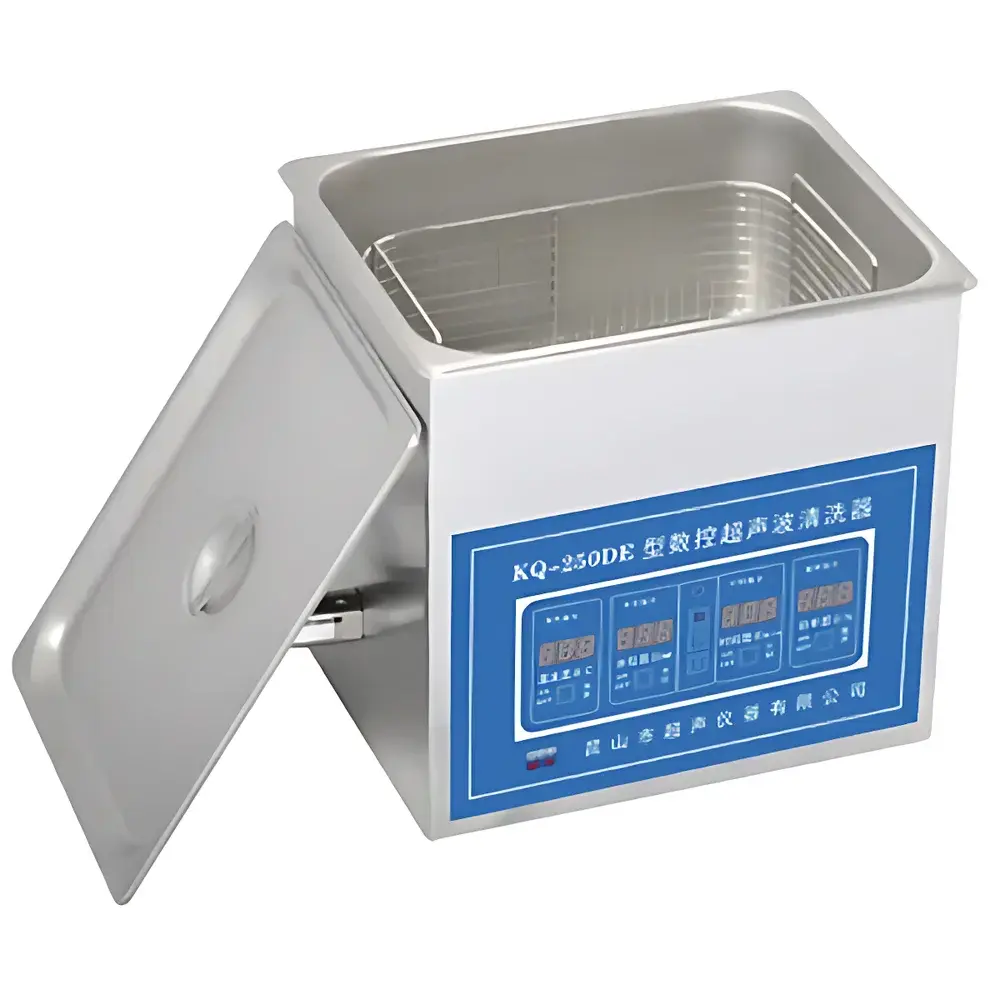
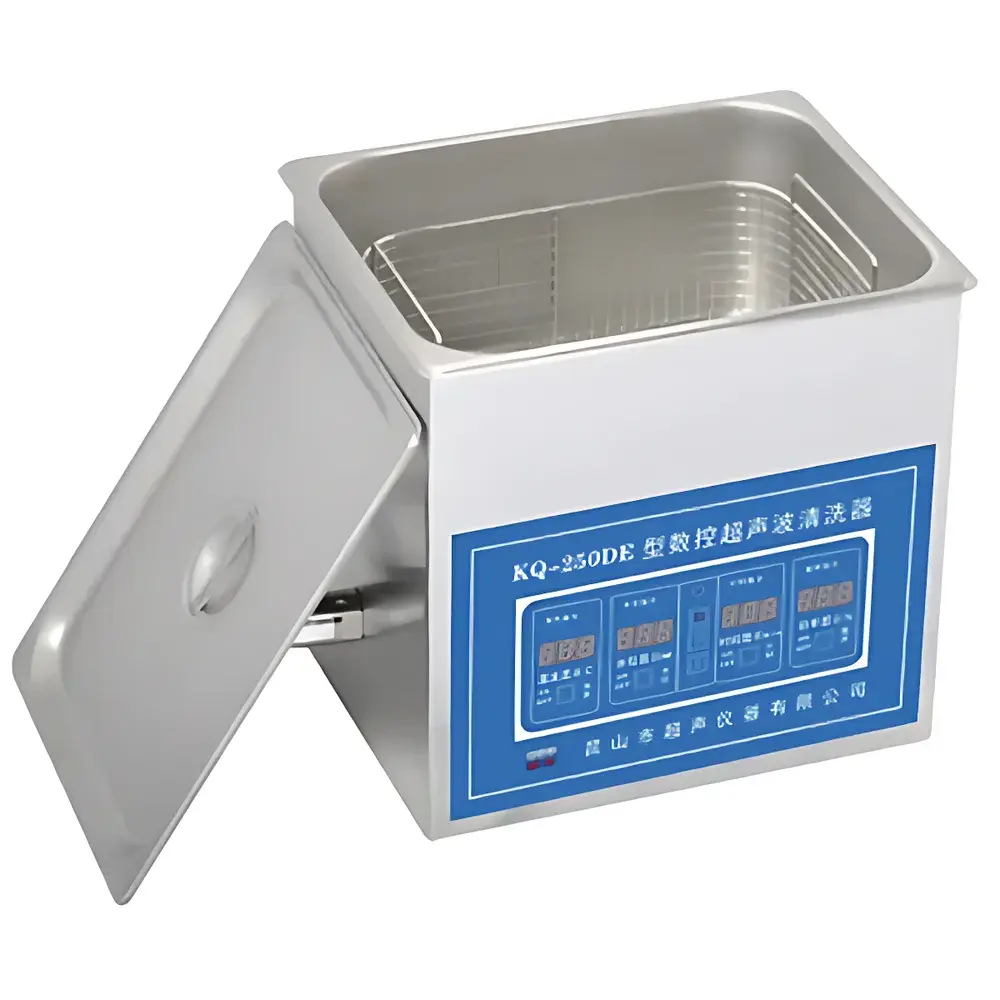
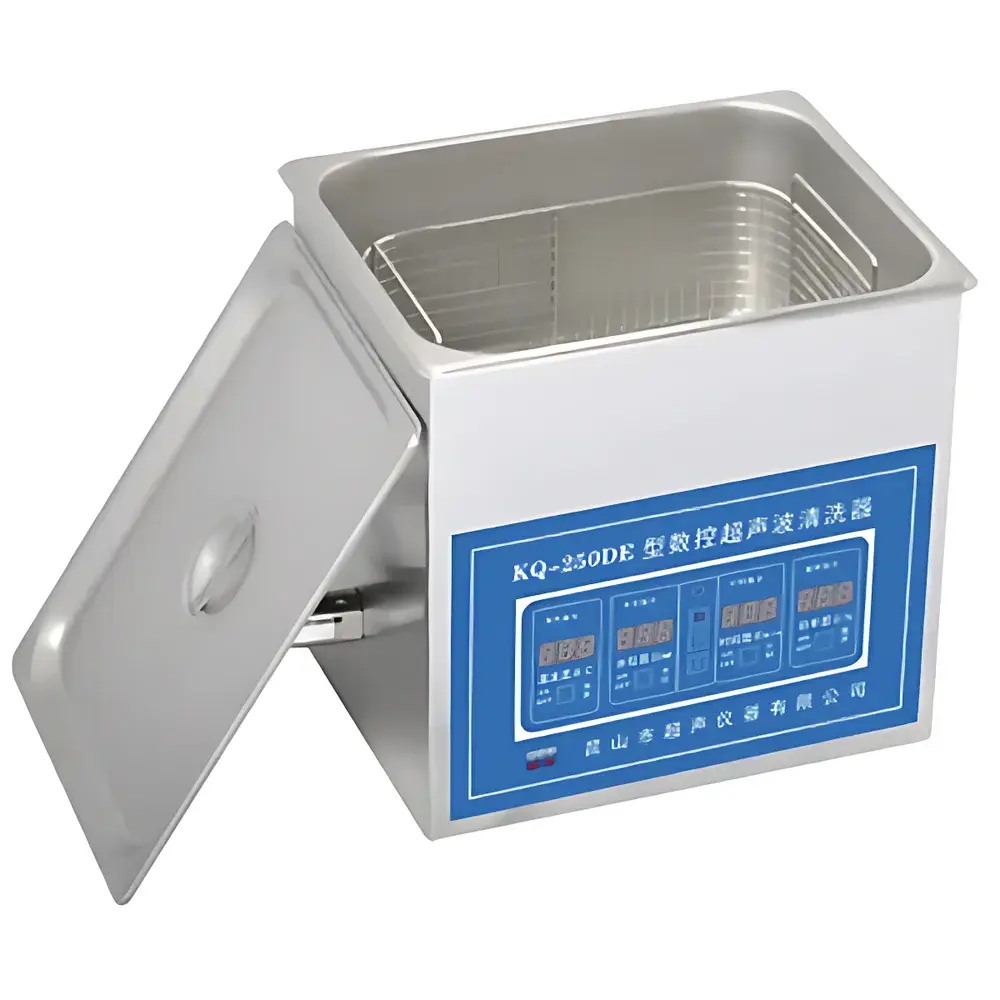
Supmile KQ-250DE Benchtop Ultrasonic Cleaner
| Brand | Supmile |
|---|---|
| Origin | Jiangsu, China |
| Manufacturer Type | Authorized Distributor |
| Instrument Type | General-Purpose Ultrasonic Cleaner |
| Tank Capacity | 10 L |
| Ultrasonic Frequency | 40 kHz |
| Nominal Ultrasonic Power | 250 W |
| Adjustable Ultrasonic Power Range | 40–100% |
| Heating Temperature Range | Ambient to 80 °C |
| Timer Range | 1–480 min |
| Sound-Dampening Lid | Included |
| Manual Fill/Drain | Yes |
| Tank Material | 304 Stainless Steel |
| Dimensions (W×D×H) | 320 × 264 × 345 mm |
| Inner Tank Dimensions (W×D×H) | 300 × 240 × 150 mm |
| Heating Power | 400 W |
| Input Power | 220 V / 50 Hz |
| Safety Protections | Overtemperature, Overcurrent, Overvoltage, Low-Water-Level, and No-Solution Detection |
| Display | Digital LED with Real-Time Monitoring of Time, Power %, Set & Actual Temperature |
Overview
The Supmile KQ-250DE is a benchtop ultrasonic cleaner engineered for precision cleaning, degassing, dispersion, and sample preparation in academic, industrial, and quality control laboratories. It operates on the principle of cavitation—generated by high-frequency (40 kHz) acoustic waves transmitted through liquid media—producing microscopic implosions that dislodge particulate contaminants from surfaces without mechanical abrasion. Its optimized transducer array (five 50 W elements, total 250 W nominal output) delivers uniform energy distribution across the 10 L stainless steel tank (300 × 240 × 150 mm internal dimensions), ensuring reproducible cleaning performance across diverse sample geometries. The unit integrates automatic frequency sweeping technology to maintain resonance stability under varying load and solution conditions, minimizing standing wave formation and enhancing cleaning consistency—critical for applications requiring trace-level cleanliness, such as HPLC vial preparation, optical component cleaning, or semiconductor wafer pre-treatment.
Key Features
- Microprocessor-controlled operation with digital LED display showing real-time ultrasonic power (%), set and actual temperature, and remaining timer duration
- Adjustable ultrasonic power (40–100% in 10% increments) enabling optimization for delicate substrates (e.g., microfluidic chips) or heavily soiled components (e.g., metal fixtures)
- Precise thermostatic heating (ambient to 80 °C, ±1 °C accuracy) with independent PID control—essential for temperature-sensitive cleaning protocols and accelerated solvent-based processes
- Comprehensive safety architecture: automatic shutdown triggered by overtemperature, overcurrent, overvoltage, low water level, or dry-tank conditions
- 304 stainless steel tank and lid construction ensures long-term corrosion resistance against aqueous, mild alkaline, and alcohol-based cleaning solutions
- Included sound-dampening lid reduces ambient noise to ≤55 dB(A) at 1 m distance, supporting compliance with laboratory occupational health standards
- Manual fill-and-drain system with ergonomic spigot facilitates rapid solution exchange and residue-free tank maintenance
Sample Compatibility & Compliance
The KQ-250DE accommodates a broad range of laboratory items—including glassware (vials, cuvettes, pipette tips), metal parts (syringe needles, surgical instruments), ceramics, and polymer components—provided they are chemically compatible with the selected cleaning medium. Its design conforms to general electrical safety requirements per IEC 61010-1 for laboratory equipment. While not certified for sterile processing per ISO 13485 or EN 285, it supports GLP-compliant workflows when integrated into documented cleaning SOPs. Temperature and time parameters are fully recordable via manual log; for regulated environments requiring audit trails (e.g., pharmaceutical QC labs), external data logging or integration with LIMS is recommended.
Software & Data Management
This model operates via embedded firmware without PC connectivity or proprietary software. All operational parameters—including power setting, temperature setpoint, and timer value—are retained in non-volatile memory after power cycling. The digital interface provides immediate visual feedback of active status and fault codes (e.g., “E1” = low water, “E2” = overtemperature). For laboratories implementing 21 CFR Part 11 compliance, parameter verification must be performed manually prior to each run, and process records maintained separately. Optional accessories—such as calibrated PT100 probes or USB data loggers—can be interfaced externally to support traceable temperature/time validation.
Applications
- Cleaning of analytical glassware prior to spectroscopic or chromatographic analysis to eliminate organic carryover and particulate interference
- Preparation of samples for SEM/TEM imaging, where surface contamination must be reduced below sub-micron levels
- Ultrasonic-assisted extraction of plant metabolites or environmental analytes using ethanol or aqueous buffers
- Deagglomeration of nanoparticle suspensions (e.g., TiO₂, SiO₂) for DLS or zeta potential measurement
- Removal of flux residues from printed circuit boards during electronics R&D
- Cell lysis and homogenization in molecular biology workflows, particularly for soft-tissue samples under chilled conditions
FAQ
Is the KQ-250DE suitable for cleaning delicate optics or MEMS devices?
Yes—when operated at 40–60% power with low-surface-tension solvents (e.g., isopropanol) and controlled temperature (≤40 °C), it effectively removes submicron particles without damaging coated or microstructured surfaces.
Can this unit be used with flammable solvents?
No—this model lacks explosion-proof certification and is rated exclusively for aqueous and polar non-flammable solutions. Use only in well-ventilated areas with approved solvents per local EHS guidelines.
What maintenance is required for long-term reliability?
Regular descaling of the tank interior using 5% citric acid solution every 200 operating hours prevents transducer efficiency loss; transducer coupling gel integrity should be verified annually by qualified service personnel.
Does the unit include a degassing function?
Yes—the default sweep mode inherently promotes dissolved gas removal during initial sonication; for critical degassing (e.g., before HPLC mobile phase filtration), operate at 60% power for 5–10 minutes prior to sample immersion.
Is calibration documentation provided with shipment?
A factory test report confirming functional verification of timer accuracy, temperature control, and power output is included; NIST-traceable calibration certificates require separate arrangement with authorized service centers.



