
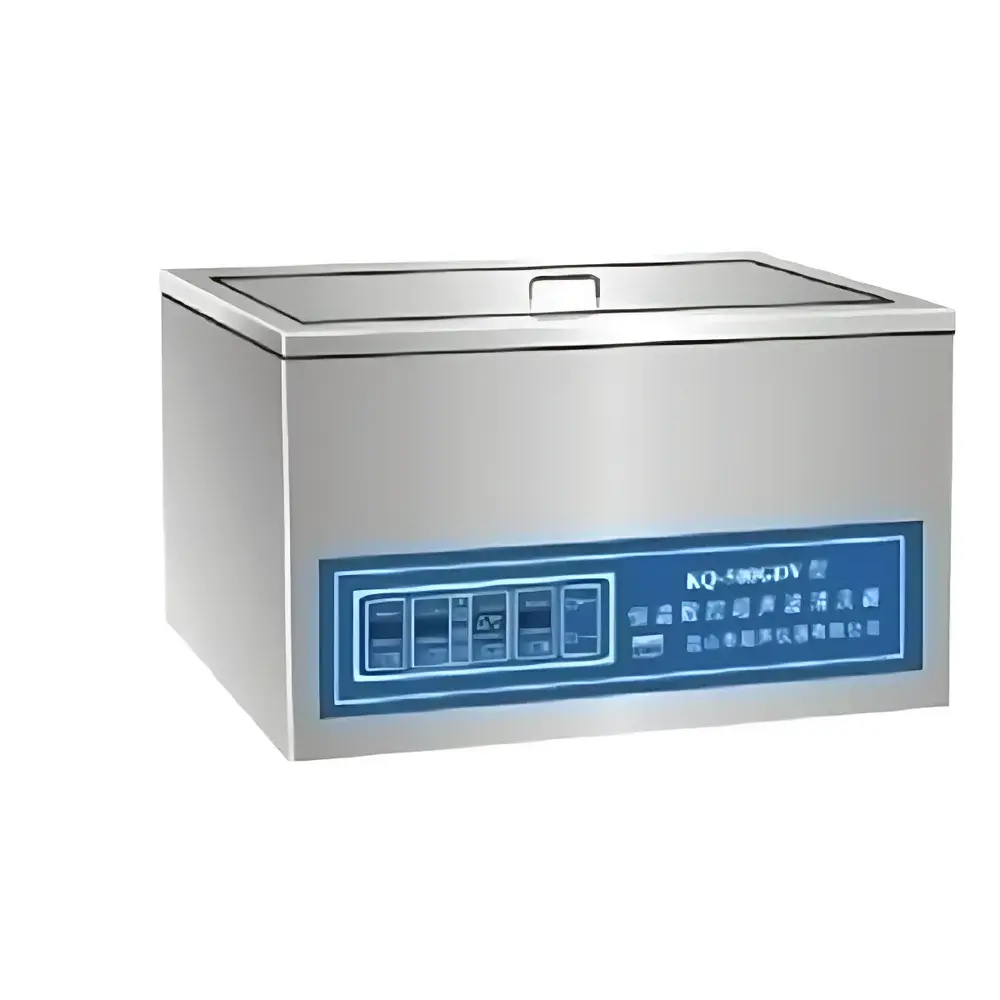
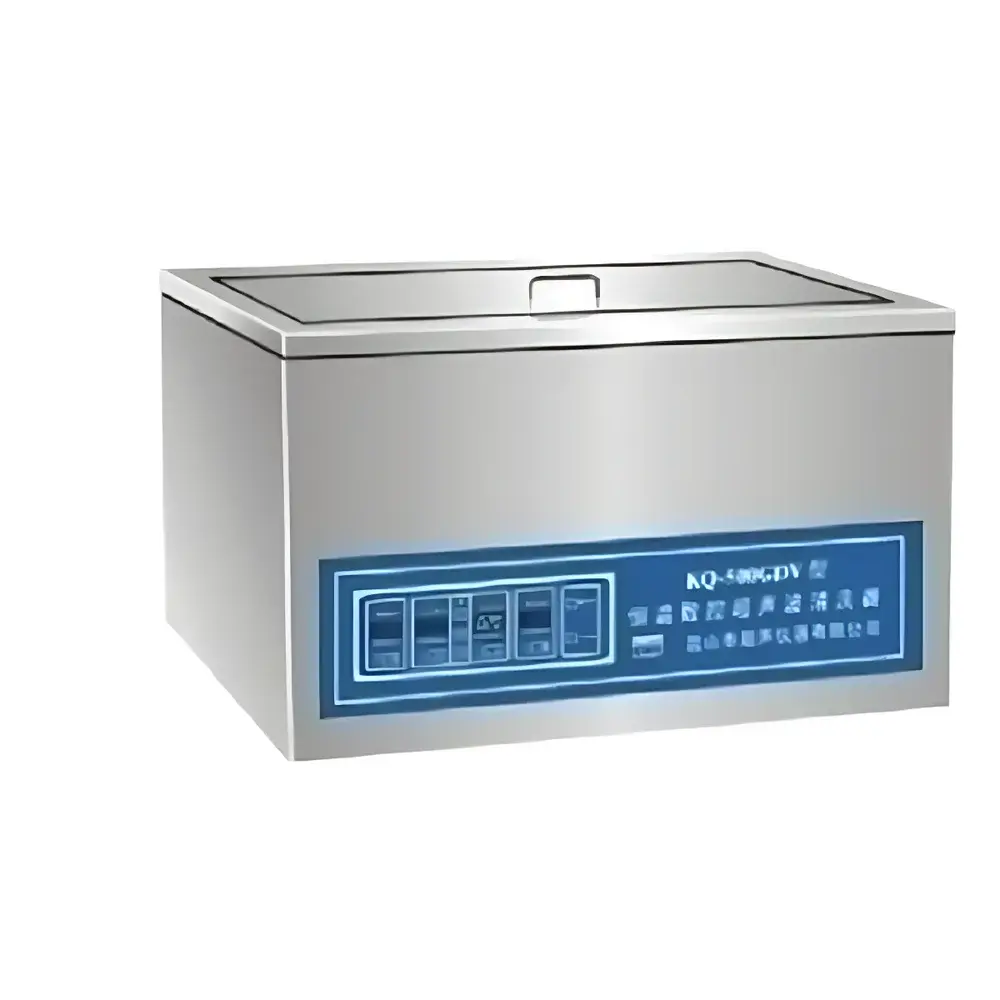
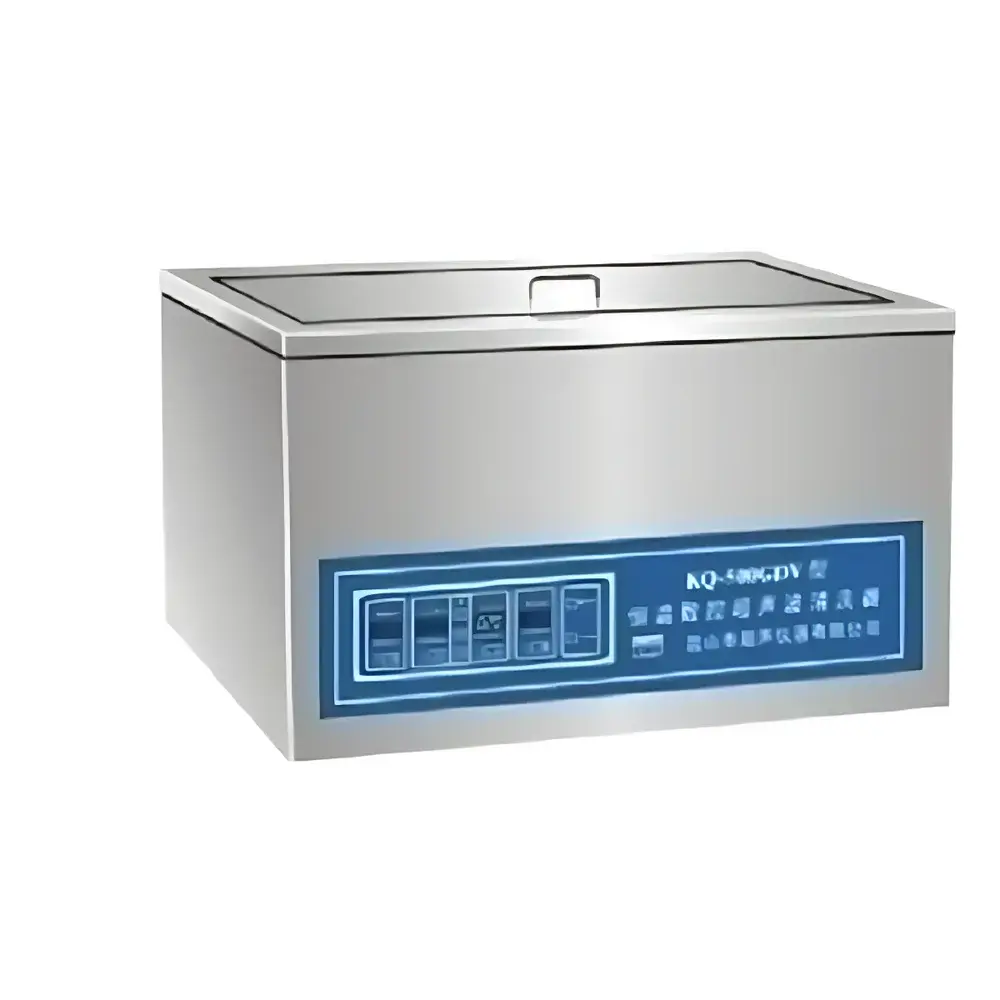
Supmile KQ-300GDV Benchtop Temperature-Controlled Ultrasonic Cleaner
| Brand | Supmile |
|---|---|
| Origin | Jiangsu, China |
| Model | KQ-300GDV |
| Capacity | 13 L |
| Ultrasonic Frequency | 40 kHz |
| Ultrasonic Power | 300 W |
| Power Adjustment Range | 40–100% |
| Temperature Control Range | 0–80 °C |
| Timer Range | 1–480 min |
| Insulated Lid | Yes |
| Electronic Inlet/Outlet Control | Yes |
| Heating Power | 600 W |
| Refrigeration Power | 350 W |
| External Dimensions (L×W×H) | 640 × 490 × 540 mm |
| Tank Internal Dimensions | 300 × 240 × 180 mm |
| Water Level Adjustment Range | 80–130 mm |
| Construction Material | Stainless Steel (tank, basket, lid, and housing) |
Overview
The Supmile KQ-300GDV is a benchtop temperature-controlled ultrasonic cleaner engineered for precision laboratory applications requiring stable thermal conditions during sonication. Unlike standard ultrasonic cleaners that only provide heating, the KQ-300GDV integrates a sealed, fluorine-free compressor-based refrigeration system with independent heating elements—enabling active dual-mode thermal regulation. This closed-loop temperature control architecture maintains solution temperature within ±0.5 °C across the full 0–80 °C range, eliminating thermal drift during extended processing cycles. The device operates on the principle of piezoelectric transduction at a fixed frequency of 40 kHz, generating cavitation in aqueous and mild solvent-based media to remove particulate, organic, and biofilm contaminants from surfaces with high reproducibility. Its design targets workflows where temperature-sensitive sample integrity is critical—such as botanical extraction, polymer dissolution, catalyst activation, and microfluidic device cleaning—where uncontrolled exothermic cavitation could otherwise compromise reaction kinetics or analyte stability.
Key Features
- Benchtop form factor with compact footprint (640 × 490 × 540 mm) optimized for fume hood or lab bench integration
- Stainless steel construction throughout: 304-grade tank, mesh basket, insulated lid, and housing ensure corrosion resistance and long-term structural integrity
- Dual-mode thermal management: simultaneous heating (600 W) and refrigeration (350 W) enable precise isothermal operation without external chillers
- Digital PID temperature controller with real-time display and memory function for repeatable setpoint recall
- Adjustable ultrasonic power output (40–100% of 300 W nominal), allowing optimization for delicate substrates or aggressive contamination removal
- Programmable timer (1–480 minutes) with automatic shutdown and audible end-of-cycle alert
- Electrically actuated inlet and outlet valves support automated fill-and-drain protocols, reducing manual handling and cross-contamination risk
- Acoustically damped lid with thermal insulation minimizes noise emission (<55 dB(A)) and heat loss during operation
- Water level sensor with adjustable range (80–130 mm) ensures optimal transducer coupling and consistent cavitation field uniformity
Sample Compatibility & Compliance
The KQ-300GDV accommodates a broad range of sample formats—including glassware (vials, cuvettes, chromatography columns), metal components (surgical instruments, MEMS devices), ceramic substrates, and polymer-based microplates—provided they are compatible with aqueous or low-surface-tension solvents (e.g., ethanol, isopropanol, diluted alkaline solutions). It complies with IEC 61000-6-3 (EMC emissions) and IEC 61010-1 (safety requirements for electrical equipment for measurement, control, and laboratory use). While not certified for ISO 13485 or FDA 21 CFR Part 11 out-of-the-box, its digital logging capability (time, temperature, power, duration) supports GLP/GMP-aligned documentation when integrated into validated laboratory information management systems (LIMS). Users performing regulated extractions—e.g., herbal active ingredient isolation per Chinese Pharmacopoeia or USP compounding support—must validate thermal stability and cleaning efficacy per internal SOPs.
Software & Data Management
The KQ-300GDV features an embedded microcontroller with non-volatile memory storing up to 10 user-defined protocols, each retaining temperature setpoint, power level, timer value, and water level configuration. All parameters are displayed on a high-contrast LCD interface with tactile membrane buttons; no external PC connection or proprietary software is required for routine operation. For traceability, the unit logs timestamped operational data (start time, final temperature, total runtime) to internal memory—accessible via front-panel navigation. Export functionality is not included, but external data loggers may interface via optional analog voltage outputs (0–5 V DC) corresponding to real-time temperature and power status. Audit trails meet basic GLP record-keeping expectations when combined with procedural documentation and operator sign-off.
Applications
- Standardized botanical extraction: Maintaining constant bath temperature during ultrasonic-assisted leaching of flavonoids, alkaloids, or polysaccharides from plant matrices
- Precision cleaning of optical components and semiconductor wafers prior to coating or metrology
- Dispersion of nanomaterials (e.g., graphene oxide, metal oxides) in aqueous suspensions under thermally stabilized conditions
- Cell lysis and protein solubilization where temperature-sensitive epitopes or enzymatic activity must be preserved
- De-gassing of HPLC mobile phases and calibration standards to eliminate bubble-induced baseline noise
- Preparation of homogeneous emulsions for pharmaceutical formulation development
- Cleaning of reusable lab-on-a-chip devices without thermal stress-induced channel deformation
FAQ
Does the KQ-300GDV support continuous operation at elevated temperatures?
Yes—the integrated refrigeration system enables sustained operation at any temperature between 0 °C and 80 °C, including prolonged runs at 60–70 °C, without thermal runaway or compressor overload.
Can the unit be used with organic solvents?
It is rated for aqueous solutions and water-miscible solvents (e.g., ethanol, acetone, IPA) below their flash points; flammable or chlorinated solvents require additional explosion-proof safeguards not built into this model.
Is the stainless steel tank electropolished?
No—the tank uses standard 304 stainless steel with a brushed finish; electropolishing is available as a custom option upon request.
What maintenance is required for the refrigeration module?
The sealed compressor requires no scheduled refrigerant servicing; annual inspection of condenser coil cleanliness and door gasket integrity is recommended for optimal thermal efficiency.
How is cavitation uniformity verified across the tank volume?
Users may perform aluminum foil test per ASTM D2603 or conduct calorimetric mapping using calibrated thermistors at defined grid points to confirm spatial consistency of energy distribution.



