
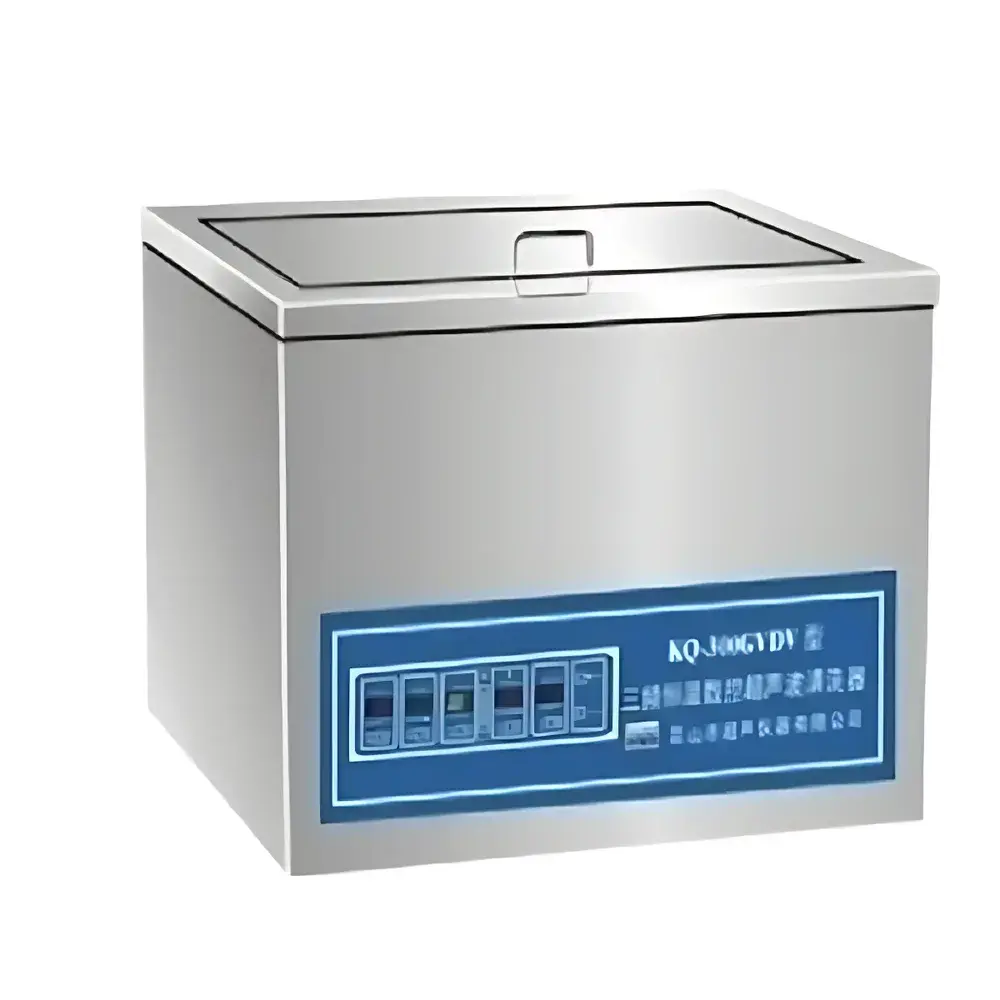
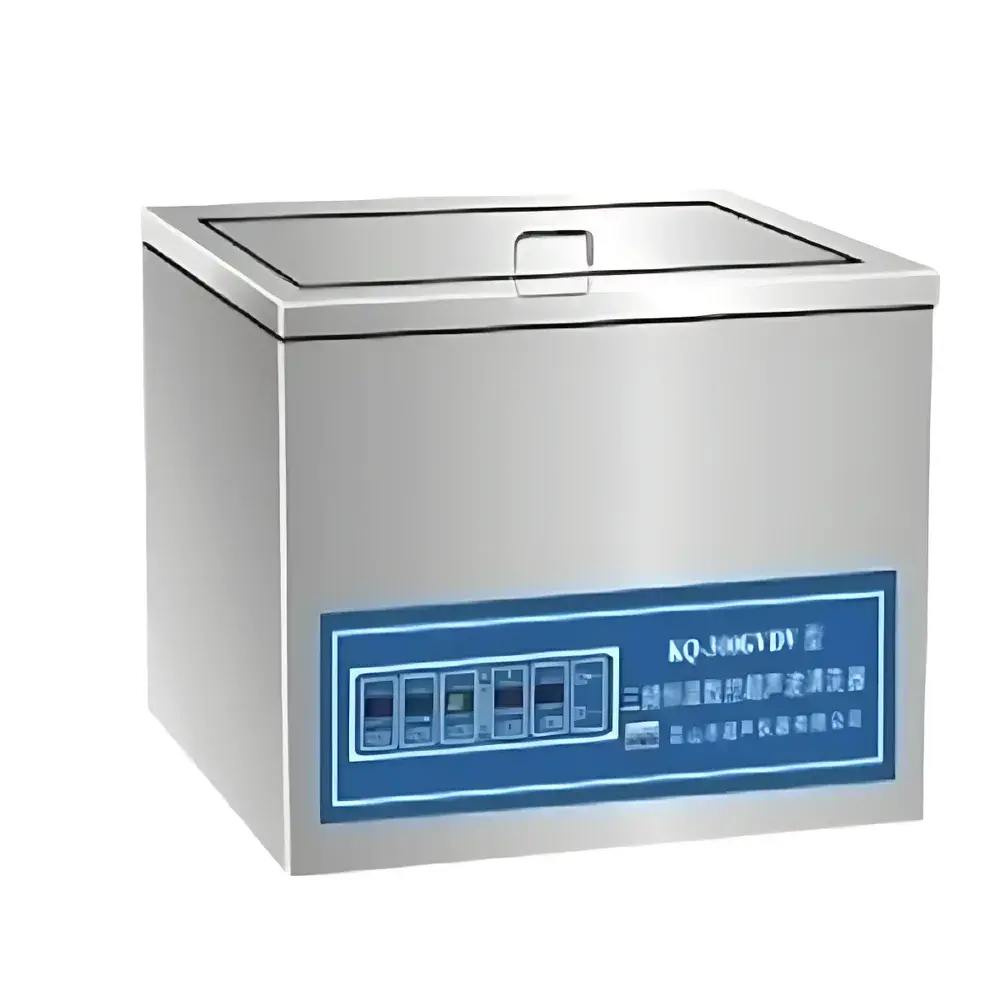
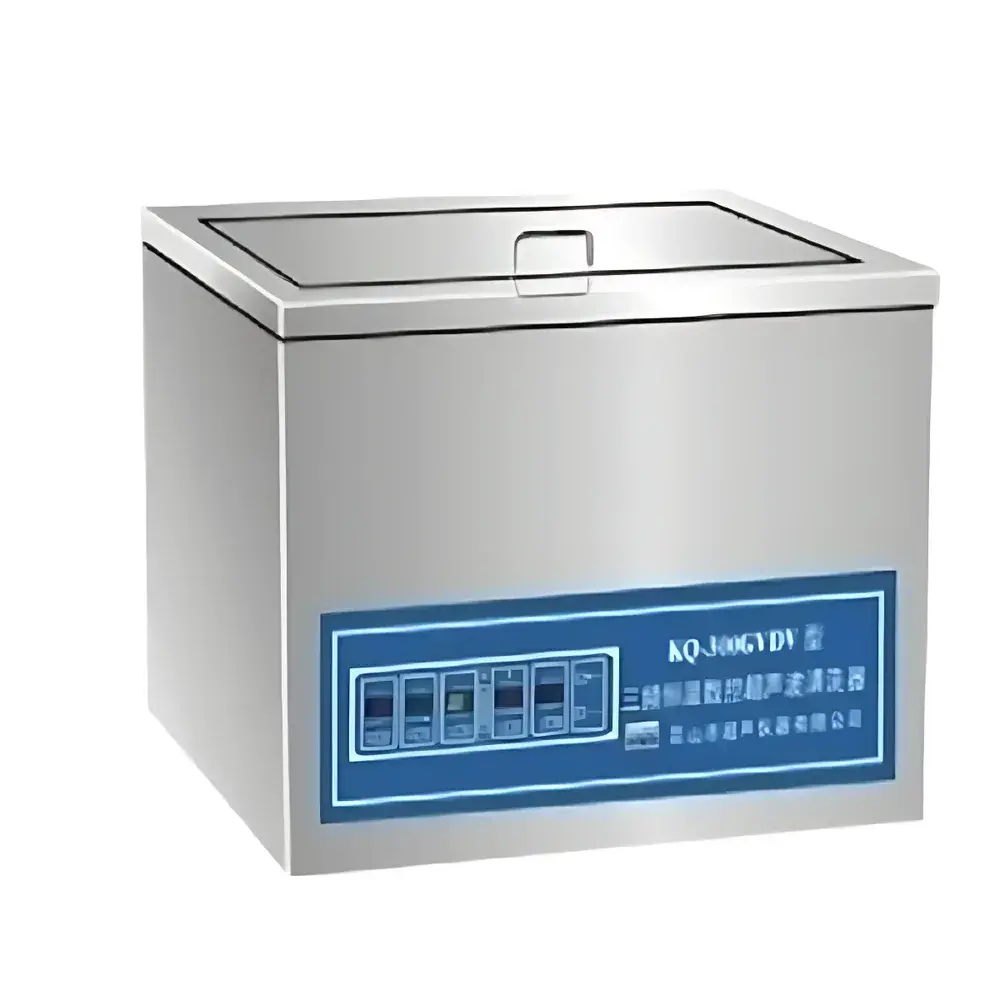
Supmile KQ-500GVDV Dual-Frequency Benchtop Ultrasonic Cleaner with Integrated Thermoregulation
| Brand | Supmile |
|---|---|
| Origin | Jiangsu, China |
| Model | KQ-500GVDV |
| Tank Capacity | 27 L |
| Ultrasonic Frequencies | 80 kHz / 45 kHz |
| Total Ultrasonic Power | 500 W |
| Power Adjustment Range | 40–100% |
| Temperature Control Range | 0–80 °C |
| Timer Range | 1–480 min |
| Insulated Lid | Yes |
| Electronic Inlet/Outlet Valves | Yes |
| Construction | Stainless Steel (304) Tank, Lid, Basket & Housing |
| Heating Power | 1000 W |
| Refrigeration Power | 350 W |
| Dimensions (L×W×H) | 910 × 490 × 540 mm |
| Internal Tank Dimensions | 500 × 300 × 180 mm |
Overview
The Supmile KQ-500GVDV is a dual-frequency benchtop ultrasonic cleaner engineered for precision laboratory applications requiring both stable temperature control and high-fidelity acoustic energy delivery. Unlike conventional ultrasonic cleaners that rely solely on resistive heating, the KQ-500GVDV integrates a sealed, fluorine-free refrigeration compressor with intelligent thermal management logic—enabling active cooling and heating to maintain solution temperature within ±0.5 °C across the full 0–80 °C operating range. This thermoregulated architecture supports time-sensitive protocols where cavitation efficiency, solute solubility, or sample integrity are temperature-dependent—such as botanical extraction, nanoparticle dispersion, polymer dissolution, and enzymatic decontamination of delicate substrates. The system operates at two discrete ultrasonic frequencies (45 kHz and 80 kHz), allowing users to select optimal acoustic wavelength-to-feature-size ratios for different sample geometries and contaminant adhesion mechanisms. Its closed-loop thermal control eliminates thermal drift during extended sonication cycles, making it suitable for GLP-compliant workflows where process repeatability is essential.
Key Features
- Dual-frequency transduction (45 kHz and 80 kHz) with automatic frequency sweeping to prevent standing-wave node formation and ensure uniform energy distribution
- Integrated thermoregulation system combining 1000 W PTC heating and 350 W hermetic compressor-based cooling for precise, dynamic temperature stabilization
- Digitally controlled power output (40–100% in 1% increments) enabling reproducible cavitation intensity calibration across experiments
- Programmable timer (1–480 minutes) with auto-shutdown and audible alert; all parameters stored in non-volatile memory for repeatable method recall
- Electronically actuated inlet and drain valves for hands-free fluid handling—reducing operator exposure and contamination risk
- Full 304 stainless steel construction (tank, basket, lid, and housing) with double-wall insulation for acoustic damping and thermal retention
- Advanced microcontroller-based drive circuitry featuring real-time impedance matching and adaptive sweep modulation for consistent transducer efficiency
Sample Compatibility & Compliance
The KQ-500GVDV accommodates a broad spectrum of sample types—including glassware, metal components, ceramic filters, silicone tubing, optical lenses, and porous biomaterials—without compromising structural integrity or surface finish. Its dual-frequency capability allows optimization for both macro-scale particulate removal (e.g., machining residue from surgical instruments at 45 kHz) and micro/nano-scale emulsification or cell lysis (e.g., lipid vesicle formation at 80 kHz). All wetted surfaces comply with ISO 8573-1 Class 3 air purity standards when used with deionized water or validated cleaning agents. The unit meets IEC 61000-6-3 (EMC emission limits) and IEC 61000-6-2 (immunity requirements), and its firmware architecture supports audit-trail generation for 21 CFR Part 11–aligned environments when integrated with compliant LIMS platforms. Optional validation kits enable IQ/OQ documentation per ASTM D2603 and USP particulate matter testing protocols.
Software & Data Management
Operation is managed via an embedded 4.3-inch TFT LCD interface with capacitive touch controls and multilingual support (English, German, French, Japanese). The onboard controller logs timestamped operational data—including actual temperature, applied power %, elapsed time, and frequency mode—for up to 10,000 cycles. Export is supported via USB 2.0 to CSV format for traceability in QA/QC reporting. While no proprietary PC software is bundled, the device implements Modbus RTU over RS-485 for integration into centralized lab automation systems. Firmware updates are performed via USB stick using signed binaries, ensuring integrity verification prior to installation. All parameter changes trigger automatic logging of user ID (if enabled via external authentication), timestamp, and pre/post values—supporting ALCOA+ data governance principles.
Applications
- Standardized cleaning of HPLC vials, GC autosampler trays, and ICP-MS nebulizers per ASTM E1417
- Temperature-controlled extraction of polyphenols, alkaloids, and terpenoids from plant matrices under optimized cavitation kinetics
- Dispersion of carbon nanotubes and metal-organic frameworks (MOFs) in aqueous or organic media without agglomerate reformation
- Deagglomeration of ceramic slurries prior to sintering or tape-casting processes
- Removal of photoresist residues from semiconductor wafers during R&D prototyping
- Pre-analytical preparation of tissue homogenates for proteomics workflows requiring minimal thermal denaturation
FAQ
Does the KQ-500GVDV support continuous operation at elevated temperatures?
Yes—the thermoregulation system maintains setpoint stability for up to 480 minutes without thermal saturation, provided ambient conditions remain ≤30 °C and relative humidity ≤70%.
Can both frequencies operate simultaneously?
No—frequencies are selected manually or programmatically; simultaneous dual-frequency output is not implemented due to transducer coupling constraints and regulatory limits on acoustic pressure summation.
Is the refrigeration system serviceable in the field?
The sealed compressor is rated for 30,000 hours MTBF and requires no routine maintenance; field replacement is possible using OEM-specified service kits and vacuum/recharge procedures.
What safety certifications does the unit carry?
It bears CE marking per Directive 2014/30/EU (EMC) and 2014/35/EU (LVD), and complies with UL 61010-1:2012 third edition for laboratory electrical equipment.
How is calibration verified for temperature and power output?
NIST-traceable PT100 sensors are factory-calibrated against reference baths; ultrasonic power is validated using calorimetric methods per ASTM E2810, with certificate included.



