
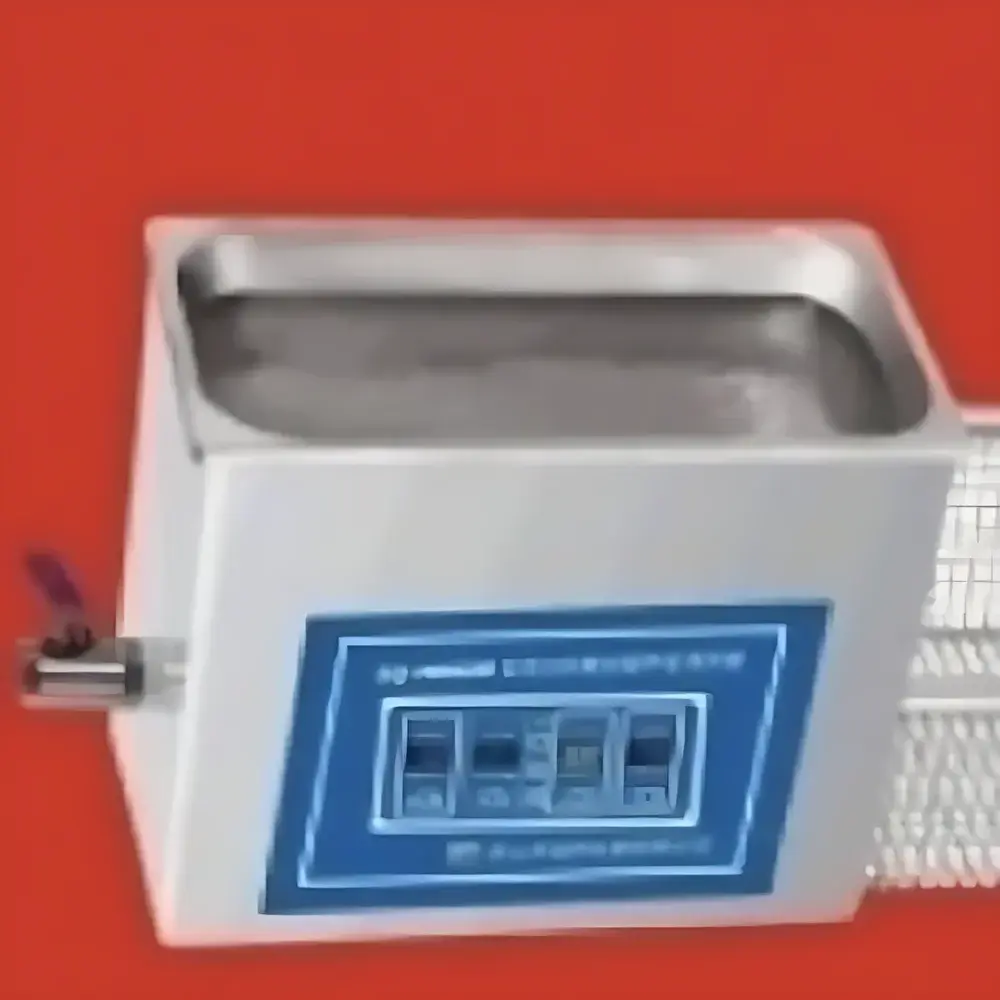
Supmile KQ-700TDB High-Frequency Ultrasonic Cleaner
| Brand | Supmile |
|---|---|
| Origin | China (Manufactured in Beijing) |
| Model | KQ-700TDB |
| Tank Capacity | 22.5 L |
| Ultrasonic Frequency | 80 kHz |
| Ultrasonic Power Output | 700 W |
| Power Adjustable | Yes (40–100% in 10% increments) |
| Heating Temperature Range | 10–80 °C |
| Timer Range | 1–480 min |
| Drain | Manual |
| Tank Material | 304 Stainless Steel |
| Heating Power | 1000 W |
| Protection Features | Low-water cutoff, over-temperature, over-voltage, and over-current protection |
| Control Interface | Digital LED display with microcontroller-based firmware |
| Internal Dimensions (L×W×H) | 500 × 300 × 150 mm |
| External Dimensions (L×W×H) | 530 × 320 × 365 mm |
| Basket Material | 304 Stainless Steel mesh (argon-welded construction) |
Overview
The Supmile KQ-700TDB is a high-frequency benchtop ultrasonic cleaner engineered for precision cleaning of delicate laboratory components, optical elements, semiconductor wafers, medical instruments, and analytical hardware. Operating at a stable 80 kHz frequency, it generates uniform cavitation energy across its 22.5 L stainless steel tank—optimized to balance cleaning efficacy with minimal surface erosion on sensitive substrates. Unlike lower-frequency cleaners (e.g., 25–40 kHz), the 80 kHz output produces smaller, more densely distributed cavitation bubbles, enabling effective removal of sub-micron particulates and organic residues without compromising dimensional integrity or surface finish. The unit complies with fundamental safety and electromagnetic compatibility requirements per IEC 61000-6-3 and IEC 61000-6-2, and its thermal and electrical protection architecture supports continuous operation under GLP-compliant laboratory environments.
Key Features
- Digital microcontroller-based control system with real-time monitoring of ultrasonic power, bath temperature, and elapsed time
- Adjustable ultrasonic power output (40–100% in 10% steps) for process optimization across diverse sample types and soil loads
- Precise digital temperature regulation from 10 °C to 80 °C ±1.5 °C accuracy, supporting both cold sonication and heated cleaning protocols
- Programmable timer with 1–480 minute range; auto-shutdown upon cycle completion or fault detection
- Integrated safety protections: low-water level cutoff, over-temperature shutdown (≥85 °C), over-voltage (>242 VAC), and over-current (≥5 A) interlocks
- 304 stainless steel tank and basket fabricated via argon arc welding—resistant to corrosion from aqueous solvents, mild alkaline detergents, and IPA-based rinses
- Front-panel LED display showing set/actual temperature, remaining time, power level, and cumulative operational hours (for maintenance tracking and audit readiness)
Sample Compatibility & Compliance
The KQ-700TDB accommodates a broad range of sample geometries and materials, including glassware (vials, cuvettes, pipette tips), metal components (syringe needles, surgical tools), ceramic substrates, silicon wafers, and printed circuit boards. Its 500 × 300 × 150 mm internal tank volume allows immersion of large-format items such as chromatography columns, electrode assemblies, or multi-well plates—provided they are compatible with aqueous or low-surface-tension cleaning media. While not certified to ISO 13485 or FDA 21 CFR Part 11 out-of-the-box, the device’s deterministic control logic, non-volatile parameter memory, and event-triggered safety logging support integration into validated cleaning SOPs under GMP/GLP frameworks. It is routinely deployed in accordance with ASTM D2603 (Standard Test Method for Sonic Shear Stability of Lubricants) and ISO 15091 (Ultrasonic cleaning equipment — Performance testing methods) for routine performance verification.
Software & Data Management
The KQ-700TDB operates without external software dependency—its embedded firmware handles all operational sequencing, parameter retention, and fault diagnostics. All user-defined settings (power level, temperature, duration) are stored in non-volatile memory and recalled after power cycling. Cumulative runtime is logged in hours and accessible via the front panel—supporting preventive maintenance scheduling per ISO/IEC 17025 Clause 6.4.2. Though the unit lacks USB/Ethernet connectivity or electronic signature capability, its deterministic behavior, repeatable setpoint response, and built-in audit trail (via LED-displayed error codes and shutdown events) facilitate documentation for internal quality audits. For laboratories requiring full 21 CFR Part 11 compliance, third-party data loggers may be interfaced via analog voltage outputs (available on request for OEM configurations).
Applications
- Pre-analytical cleaning of HPLC/GC autosampler vials, injection ports, and flow cells
- Removal of photoresist residue and metallic contaminants from photomasks and MEMS devices
- Decontamination of reusable endoscopic accessories prior to sterilization
- Surface preparation of TEM grids and AFM probes prior to coating or imaging
- Extraction aid for solid-phase microextraction (SPME) fiber conditioning
- Routine maintenance of viscometer spindles, rheometer geometries, and particle sizers’ fluidic pathways
FAQ
Is the KQ-700TDB suitable for cleaning aluminum or soft metals?
Yes—when operated at ≤60% power and ≤50 °C using neutral-pH aqueous detergents, it minimizes pitting or etching on aluminum, brass, and anodized surfaces.
Does the unit include a degassing function?
No—degassing must be performed manually by running the unit empty for 5–10 minutes before loading samples, or via external vacuum degassers for critical applications.
Can I use organic solvents such as acetone or chloroform in this cleaner?
No—this model is rated exclusively for water-based and water-miscible cleaning solutions. Flammable or halogenated solvents pose fire, explosion, and material compatibility risks.
What is the expected service life of the transducers under normal lab use?
With proper maintenance (avoiding dry operation, periodic descaling, and adherence to duty cycles), the piezoelectric transducers typically exceed 5,000 operating hours before measurable output decay.
Is calibration required, and does Supmile provide traceable calibration certificates?
While no formal calibration is mandated per manufacturer specifications, users may verify frequency stability with a calibrated acoustic sensor (e.g., Brüel & Kjær 8103) and temperature accuracy with a NIST-traceable RTD probe; certificate generation requires third-party metrology services.



