
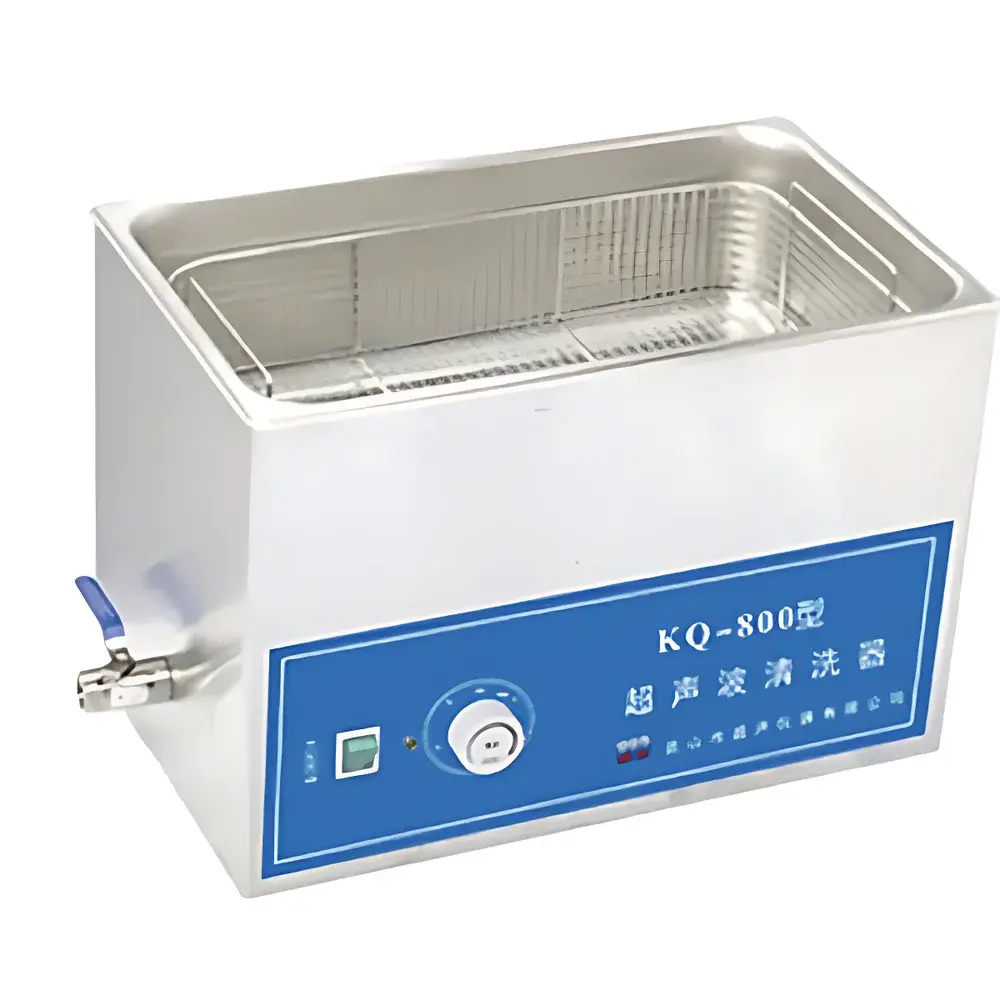
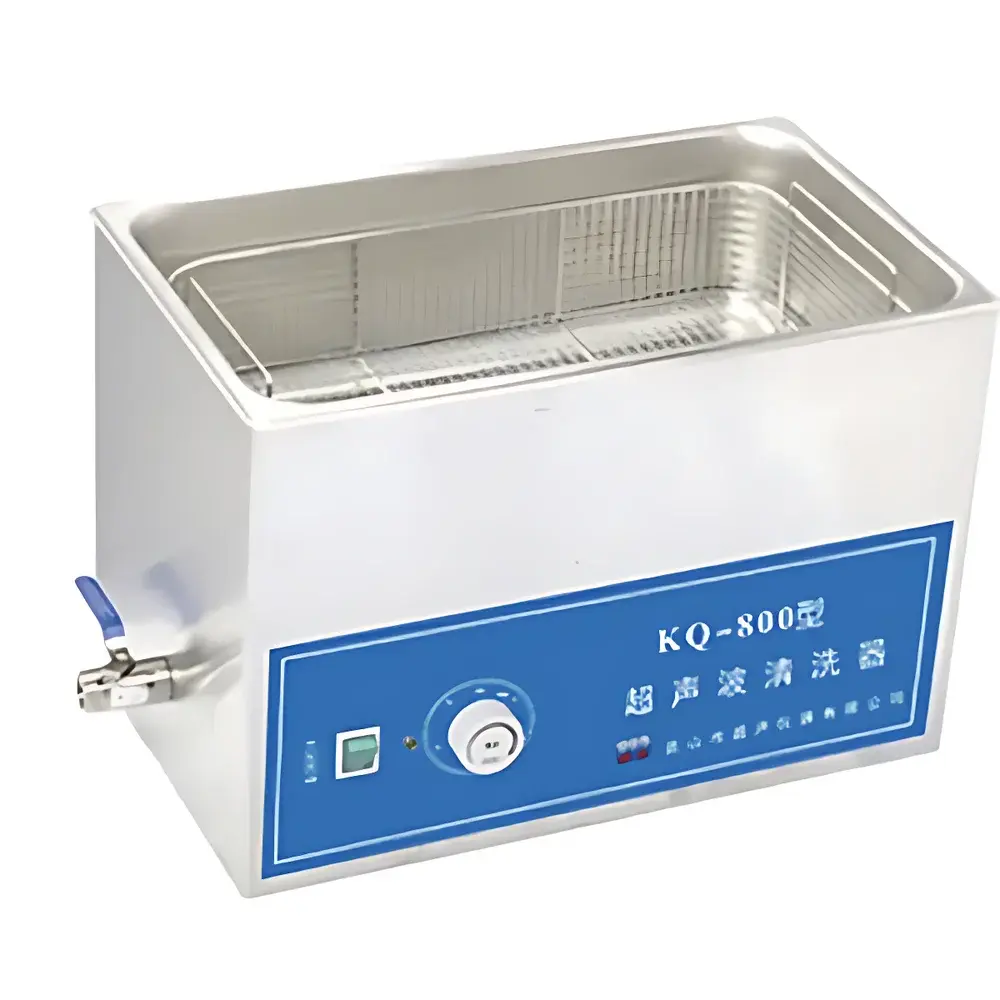
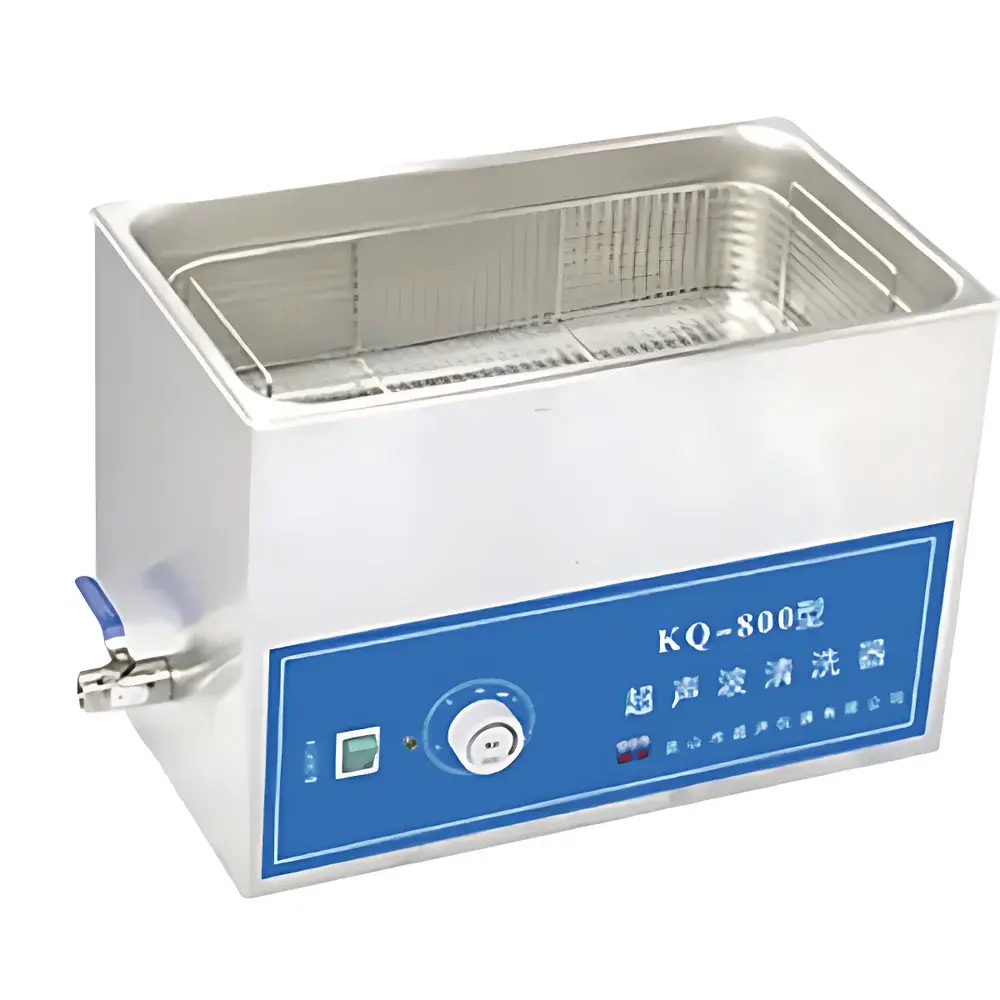
Supmile KQ-800 Benchtop Ultrasonic Cleaner
| Brand | Supmile |
|---|---|
| Origin | Jiangsu, China |
| Model | KQ-800 |
| Tank Capacity | 30 L |
| Ultrasonic Frequency | 40 kHz |
| Total Ultrasonic Power | 800 W |
| Timer Range | 1–20 min (mechanical dial) |
| Drain/Inlet | Manual valve |
| Tank Dimensions (L×W×H) | 500 × 300 × 200 mm |
| External Dimensions (L×W×H) | 530 × 325 × 430 mm |
| Power Supply | 220 V AC, 50 Hz |
| Construction | 304 Stainless Steel Tank & Housing |
| Transducer Configuration | Standard 50 W per transducer, 40 kHz resonant frequency |
| Control Type | Analog mechanical timer and power switch |
Overview
The Supmile KQ-800 is a benchtop ultrasonic cleaner engineered for consistent, non-destructive removal of particulate contaminants, oils, flux residues, and biological films from laboratory glassware, precision instruments, optical components, and small industrial parts. It operates on the principle of acoustic cavitation: high-frequency (40 kHz) ultrasonic energy is transmitted through an aqueous or mild solvent-based cleaning medium via piezoelectric transducers bonded to the stainless steel tank bottom. This generates controlled microbubble formation and implosion, producing localized shear forces and microstreaming that dislodge adherent soils without mechanical abrasion. Designed for routine use in QC laboratories, R&D facilities, and maintenance workshops, the KQ-800 delivers reproducible cleaning performance across standardized protocols—making it suitable for pre-analytical sample preparation, instrument maintenance prior to calibration, and post-processing cleaning of machined or soldered components.
Key Features
- Robust 304 stainless steel tank and housing—resistant to corrosion from common cleaning solutions including alkaline detergents, ethanol/water mixtures, and low-concentration acidic rinses.
- Fixed-frequency 40 kHz ultrasonic generation with total output power of 800 W, distributed across multiple 50 W transducers for uniform energy distribution across the 30 L working volume.
- Mechanical timer with calibrated 1–20 minute range—provides repeatable cycle control without software dependency or firmware updates.
- Manual inlet and drain valves enable flexible integration into lab workflows where automated plumbing is unavailable; compatible with standard ½” NPT fittings.
- Integrated stainless steel mesh basket (included) supports load separation and prevents direct contact between delicate items and tank bottom, minimizing risk of surface scratching.
- Efficient electro-acoustic conversion architecture minimizes reactive power draw and thermal drift during extended operation—verified under continuous 20-minute duty cycles at ambient temperatures up to 30 °C.
Sample Compatibility & Compliance
The KQ-800 accommodates a broad range of substrates, including borosilicate glassware (vials, pipettes, cuvettes), stainless steel tools, aluminum fixtures, ceramic substrates, and polymer components rated for ultrasonic exposure (e.g., PTFE, polypropylene). It is not recommended for use with soft metals (e.g., thin copper foils), fragile coatings (e.g., anti-reflective layers), or heat-sensitive polymers (e.g., polystyrene, PETG) unless validated per ISO 13485 or internal SOPs. While the unit itself carries no CE or UL certification, its electrical design complies with IEC 61010-1:2010 safety requirements for laboratory equipment when operated within specified voltage (220 V ±10%) and environmental (non-condensing, 5–40 °C) limits. Users implementing the KQ-800 in regulated environments (e.g., pharmaceutical QC labs) are advised to perform periodic verification of cavitation intensity (per ASTM E1727-19) and timer accuracy (±5% tolerance) as part of their equipment qualification (IQ/OQ/PQ) process.
Software & Data Management
The KQ-800 is a standalone analog instrument with no embedded microcontroller, firmware, or digital interface. Consequently, it requires no software installation, network connectivity, or cybersecurity validation. All operational parameters—including time setting and power activation—are manually controlled via front-panel rotary switches. This architecture eliminates risks associated with firmware corruption, timestamp drift, or audit-trail gaps. For laboratories operating under FDA 21 CFR Part 11 or EU Annex 11 requirements, the absence of electronic records means manual logbook entries (e.g., operator ID, batch number, start/end time, solution type) constitute the sole source of traceability—aligning with GLP-compliant documentation practices for non-critical cleaning steps.
Applications
- Pre-analysis cleaning of HPLC vials, GC autosampler needles, and ICP-MS sample introduction components.
- Removal of polishing compounds and oxide layers from metallographic specimens prior to SEM imaging.
- Routine decontamination of reusable pipette tips, forceps, and surgical instruments in academic and clinical research settings.
- Cleaning of printed circuit boards (PCBs) after soldering to eliminate rosin flux residues prior to conformal coating.
- Supporting ASTM D2621 (ultrasonic cleaning validation for automotive parts) and ISO 11553-1 (safety requirements for ultrasonic cleaning systems) test preparations.
FAQ
Is the KQ-800 suitable for cleaning delicate optics or coated lenses?
No—unfiltered 40 kHz cavitation may damage anti-reflective, hydrophobic, or thin-film coatings. Use only after protocol validation with representative samples and lower-power alternatives (e.g., 80–130 kHz units) for such applications.
Can I use organic solvents like acetone or chloroform in this unit?
Not recommended. The KQ-800 is designed for aqueous or water-miscible solutions only. Flammable or halogenated solvents pose fire, explosion, and material compatibility hazards—and void warranty coverage.
What maintenance is required to sustain optimal cavitation performance?
Transducer adhesion integrity and tank fluid level must be verified weekly. De-gassing of fresh solution for 5–10 minutes before loading is essential. Annual inspection of transducer bonding and electrical insulation resistance (>2 MΩ) is advised per ISO/IEC 17025 maintenance guidelines.



