
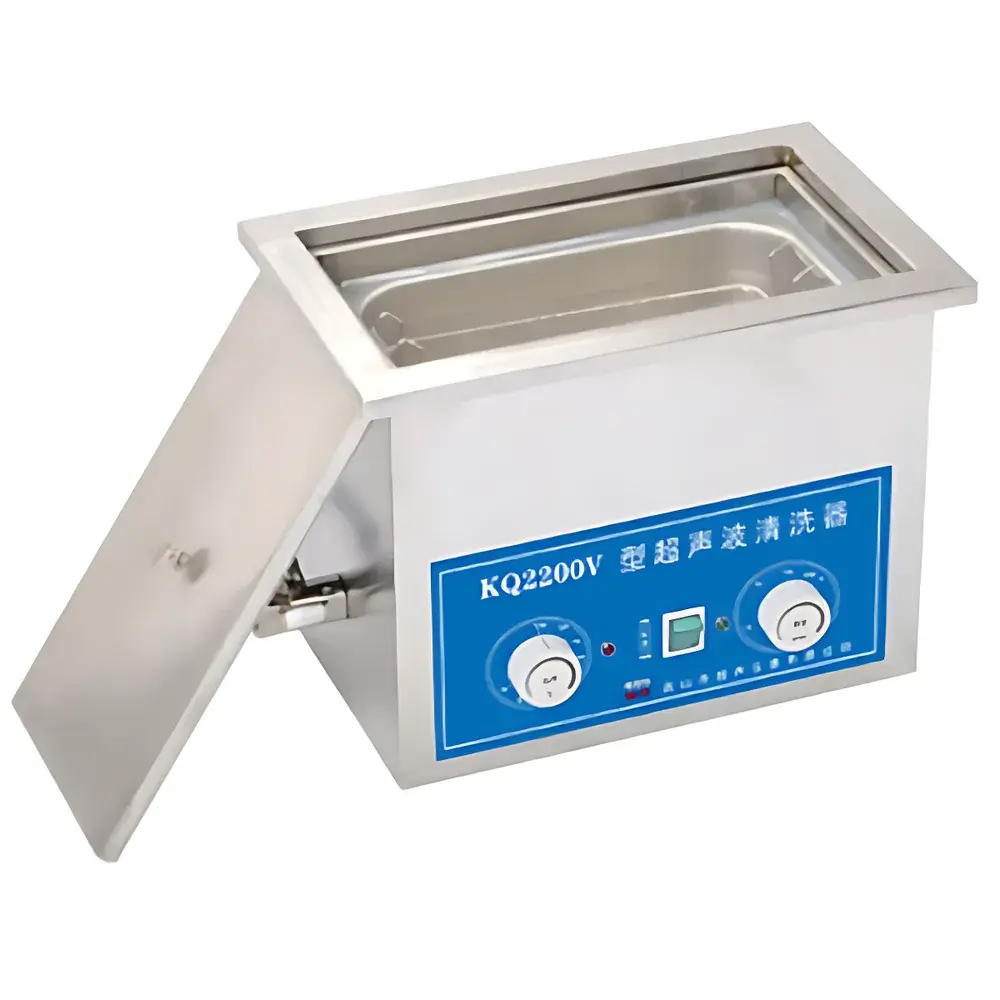
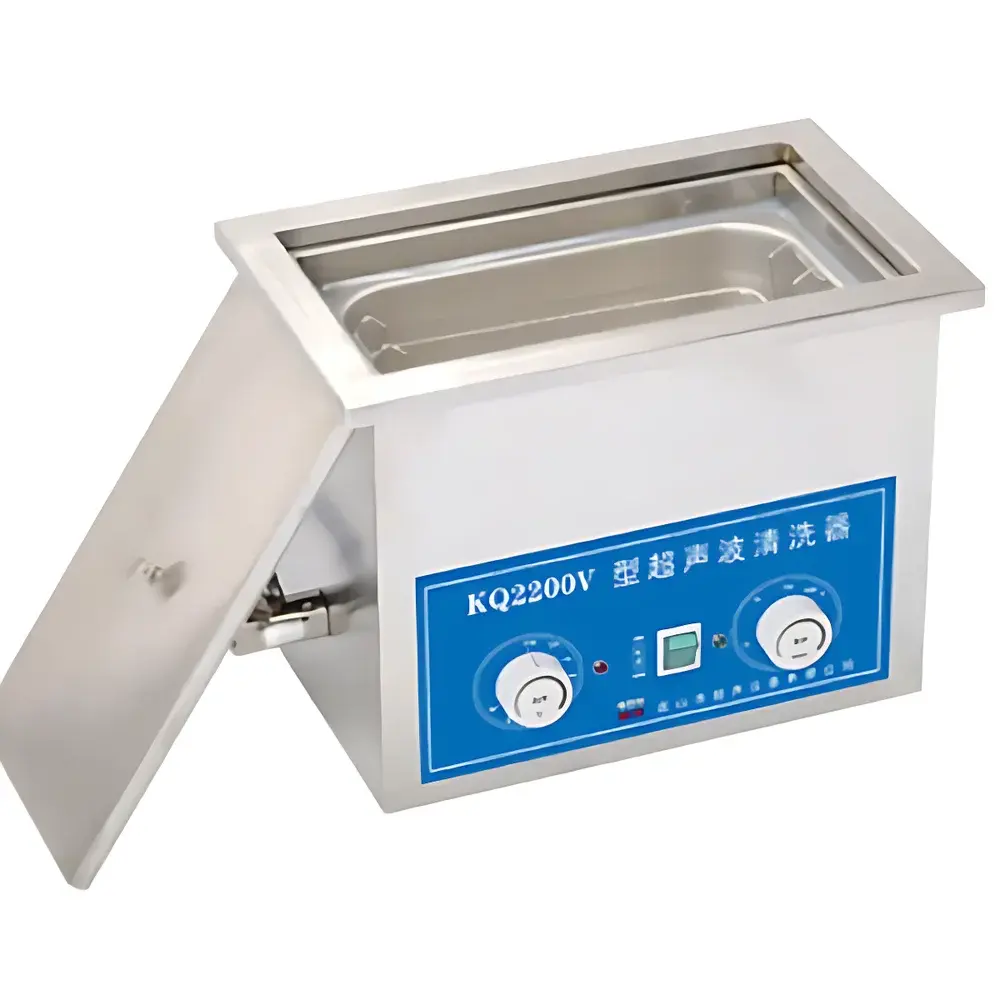
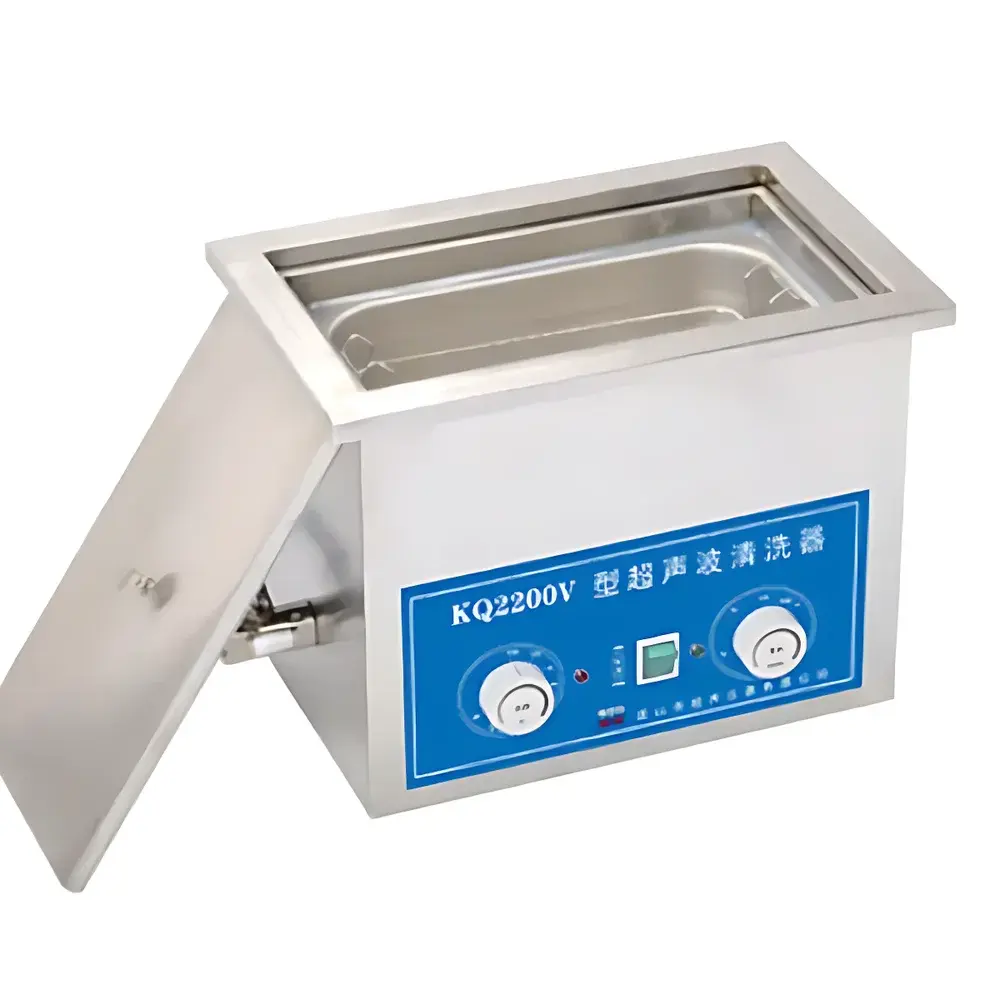
Supmile KQ2200V Benchtop Ultrasonic Cleaner
| Brand | Supmile |
|---|---|
| Origin | Jiangsu, China |
| Model | KQ2200V |
| Capacity | 4 L |
| Ultrasonic Frequency | 40 kHz |
| Ultrasonic Power | 100 W |
| Temperature Range | Ambient to 80 °C |
| Timer Range | 1–20 min |
| Lid | Sound-Dampening Cover Included |
| Drain/Inlet | Manual Valve |
| Heating Power | 400 W |
| Inner Tank Dimensions | 230 × 140 × 130 mm |
| Overall Dimensions | 345 × 250 × 315 mm |
| Construction Material | 304 Stainless Steel |
| Control Type | Mechanical Knob Interface |
| Transducer Configuration | Dual 50 W / 40 kHz Units |
Overview
The Supmile KQ2200V is a benchtop ultrasonic cleaner engineered for precision cleaning and sample preparation in academic, industrial, and quality control laboratories. It operates on the principle of cavitation—generated by high-frequency (40 kHz) acoustic energy transmitted through liquid media—producing microscopic implosions that dislodge particulate contaminants, organic residues, and biofilms from surfaces of immersed objects. Its dual-transducer design (2 × 50 W), coupled with automatic frequency sweeping circuitry, ensures stable energy delivery across varying load conditions and liquid levels, minimizing standing wave formation and enhancing cleaning uniformity. The unit is optimized for routine decontamination of glassware, metal parts, surgical instruments, microfluidic components, and analytical sample holders—particularly where manual scrubbing risks surface damage or incomplete residue removal.
Key Features
- Robust 304 stainless steel tank with V-shaped sealed enclosure, providing superior thermal insulation and acoustic damping to reduce ambient noise by up to 15 dB(A) during operation.
- Mechanical timer and temperature controls offer intuitive, repeatable settings without software dependency—ideal for GLP-compliant environments requiring audit-trail-free, deterministic operation.
- Integrated heating system (400 W) enables temperature-controlled cleaning between ambient and 80 °C, supporting applications such as solvent-assisted degreasing, enzymatic residue removal, and low-temperature sterilization pre-treatment.
- Sound-dampening lid with ergonomic latch ensures operator safety and consistent cavity coupling while minimizing airborne noise propagation in shared lab spaces.
- Manual inlet and drain valves allow flexible integration into lab water supply systems or use with purified/deionized water reservoirs; no permanent plumbing required.
- Standard accessories include a removable stainless steel mesh basket (120 µm aperture) and non-slip rubber feet for vibration isolation on benchtop surfaces.
Sample Compatibility & Compliance
The KQ2200V accommodates a wide range of sample geometries and materials—including borosilicate glass, aluminum alloys, titanium implants, ceramic substrates, and polymer-based microplates—without compromising structural integrity. Its 4 L working volume supports simultaneous cleaning of multiple vials, cuvettes, or small-scale reactor components. While not certified to IEC 61000-6-3 (EMC) or ISO 13485 for medical device reprocessing, the unit meets general electrical safety requirements per GB 4793.1 (equivalent to IEC 61010-1) for laboratory equipment. Users performing regulated cleaning validation (e.g., in pharmaceutical QC labs) may reference ASTM D2603 (Standard Test Method for Sonic Shear Stability of Lubricants) or USP (Ultrasonic Cleaning of Laboratory Glassware) when establishing SOPs.
Software & Data Management
This model operates exclusively via analog controls—no embedded firmware, USB interface, or data logging capability is provided. Such architecture eliminates cybersecurity concerns, reduces maintenance overhead, and ensures long-term operational continuity without dependency on proprietary drivers or OS compatibility. For labs requiring traceability, external digital timers or calibrated thermometers can be used to document process parameters in accordance with internal QA protocols or ISO/IEC 17025 documentation requirements.
Applications
- Routine cleaning and rinsing of HPLC vials, GC autosampler trays, and pipette tips prior to analytical use.
- Preparation of TEM/SEM specimens by removing carbon contamination and polishing debris from grids and stubs.
- Extraction support for botanical or environmental samples using sonication-assisted solvent leaching (e.g., EPA Method 3550C).
- Cell lysis and homogenization of soft tissues at sub-cytolytic intensities when combined with appropriate buffer chemistry.
- Removal of flux residues from PCB assemblies and microelectronic packaging prior to solderability testing (J-STD-001 compliant workflows).
- Deaeration of degassed solvents and aqueous buffers prior to chromatography or spectroscopy analysis.
FAQ
Is the KQ2200V suitable for cleaning delicate optical lenses or coated surfaces?
Yes—when operated at lower time settings (1–3 min) and without heating, it effectively removes dust and light oils without abrasion. However, avoid prolonged exposure of anti-reflective or hydrophobic coatings to ultrasonic fields without prior compatibility verification.
Can this unit be used with flammable solvents such as acetone or ethanol?
No. The KQ2200V lacks explosion-proof certification and its heating element poses ignition risk. Only aqueous or non-volatile, non-flammable cleaning solutions are permitted.
Does the unit support continuous operation beyond 20 minutes?
The mechanical timer caps at 20 min; for extended cycles, users must manually reset the timer after each interval. Duty cycle should not exceed 80% to prevent transducer overheating.
What maintenance is required for long-term reliability?
Routine inspection of the tank seal integrity, periodic descaling with dilute citric acid (if using hard water), and visual verification of transducer adhesion to the tank bottom every 6 months are recommended.
Is calibration documentation available for temperature or timer accuracy?
Factory calibration certificates are not included; however, the unit accepts third-party NIST-traceable thermometer and stopwatch verification per ISO/IEC 17025 Annex A.3 guidelines.



