
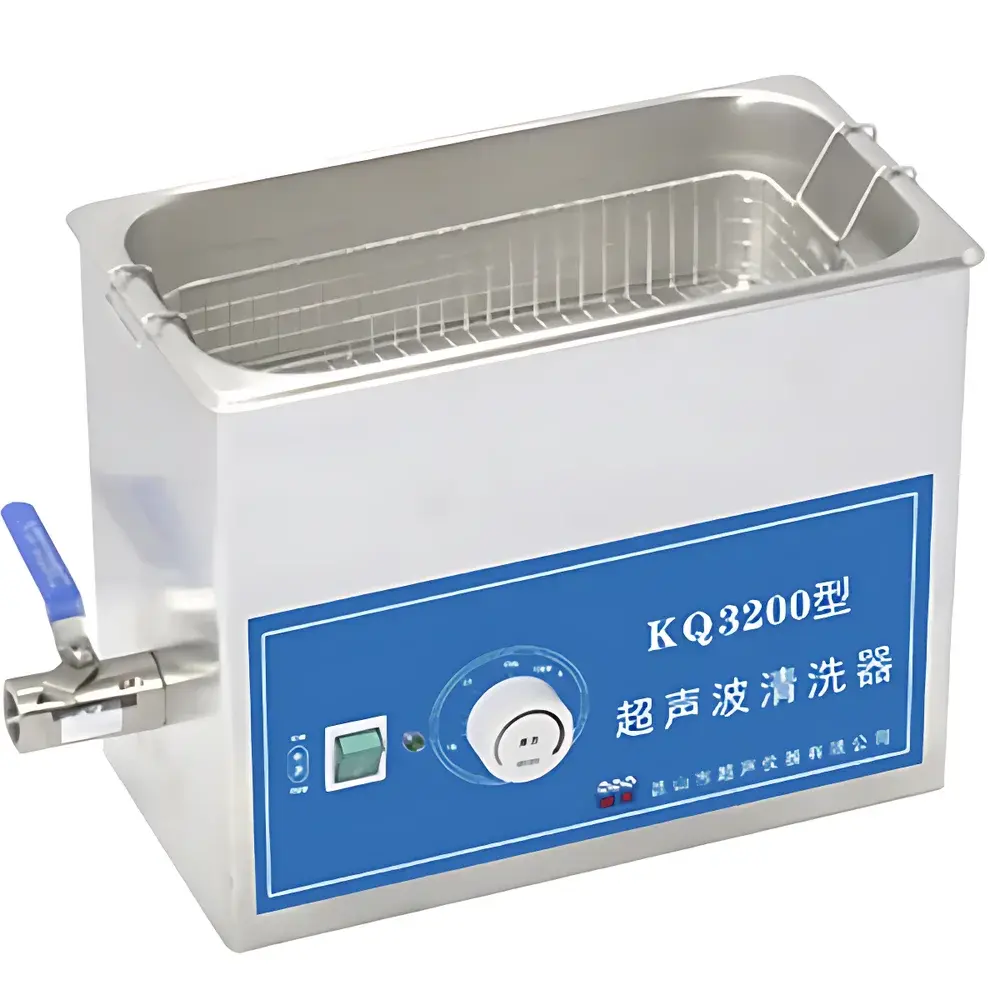
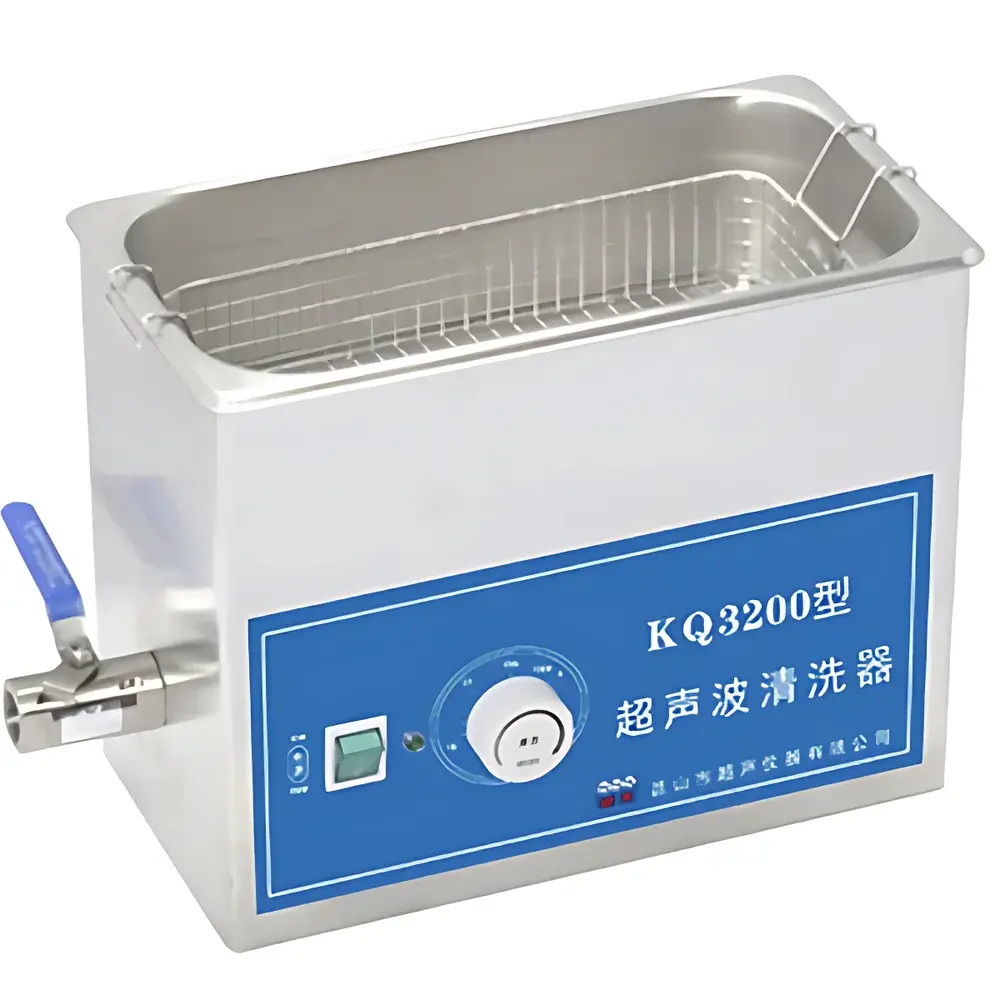
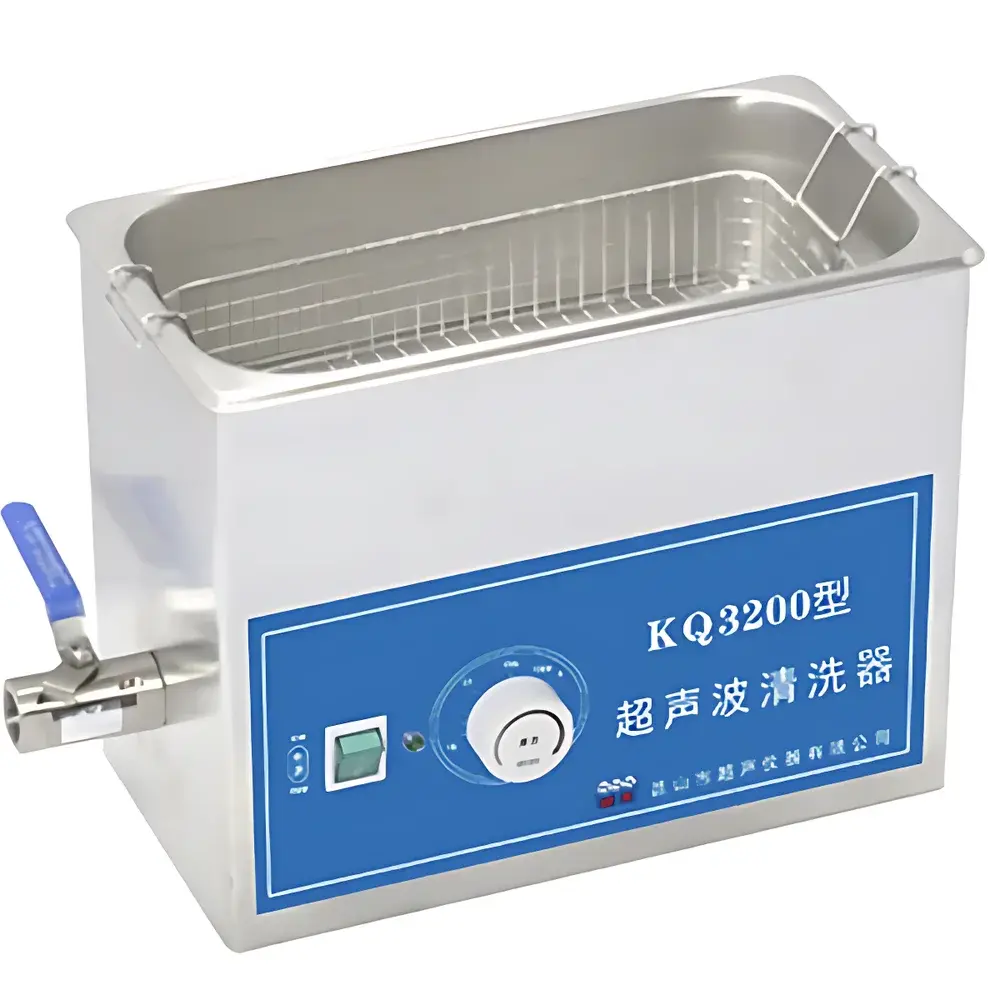
Supmile KQ3200 Benchtop Ultrasonic Cleaner
| Brand | Supmile |
|---|---|
| Origin | Jiangsu, China |
| Manufacturer Type | Authorized Distributor |
| Product Category | Domestic |
| Model | KQ3200 |
| Instrument Type | General-Purpose |
| Capacity | 6 L |
| Ultrasonic Frequency | 40 kHz |
| Ultrasonic Power Output | 150 W |
| Timer Range | 1–20 min (adjustable) |
| Sound-Dampening Lid | Not included |
| Drain/Inlet | Manual valve control |
| Tank Dimensions (L×W×H) | 300 × 150 × 150 mm |
| External Dimensions (L×W×H) | 320 × 174 × 320 mm |
| Power Supply | 220 V / 50 Hz |
| Tank Material | 304 Stainless Steel |
| Control Interface | Mechanical knob-based timer and power switch |
| Transducer Configuration | Standard dual 50 W transducers (total 100 W nominal |
Overview
The Supmile KQ3200 is a benchtop general-purpose ultrasonic cleaner engineered for consistent, reproducible cleaning performance in academic, industrial, and quality control laboratories. It operates on the principle of cavitation—generating high-frequency pressure waves (40 kHz) in liquid media that induce microbubble formation and implosive collapse, delivering localized mechanical energy to dislodge particulate contaminants, organic residues, and biofilms from submerged surfaces. Unlike fixed-frequency systems prone to standing-wave node formation and uneven energy distribution, the KQ3200 incorporates automatic frequency sweeping technology across a narrow bandwidth centered at 40 kHz. This sweep minimizes acoustic shadowing, ensures uniform energy delivery throughout the 6 L stainless-steel tank, and improves cleaning efficacy across heterogeneous sample geometries—including pipette tips, glassware, metal fixtures, and precision optics.
Key Features
- High-efficiency piezoelectric transducer array: Two 50 W transducers mounted on the tank bottom, impedance-matched and driven by a swept-frequency generator to achieve effective 150 W acoustic output with reduced reactive power loss.
- 304 stainless-steel tank and housing: Corrosion-resistant construction compliant with ISO 8573-1 for cleanroom-compatible operation; seamless welds prevent residue entrapment and simplify decontamination.
- Mechanical timer interface: Robust rotary knob with tactile feedback enables precise setting of cleaning cycles from 1 to 20 minutes—ideal for GLP-compliant documentation where digital logs are not required but repeatability is essential.
- Optimized cavitation field homogeneity: Sweep modulation mitigates hot/cold spots, supporting consistent removal of sub-10 µm particles per ASTM D2603 and ISO 13485-relevant validation protocols.
- Manual fill-and-drain configuration: Integrated ball valves allow controlled liquid introduction and waste evacuation without external plumbing—suitable for intermittent use in shared lab environments with limited utility access.
Sample Compatibility & Compliance
The KQ3200 accommodates a wide range of laboratory substrates including borosilicate glassware (vials, cuvettes, beakers), stainless-steel tools (tweezers, forceps), ceramic components, and polymer-based consumables (e.g., polypropylene centrifuge tubes). It is compatible with aqueous detergents, ethanol/water mixtures, and low-concentration alkaline solutions—provided pH remains within 4–10 to preserve transducer integrity. While not certified to UL 61010-1 or IEC 61000-6-3 out-of-the-box, its 304 SS construction, grounded chassis, and thermal cutoff protection align with foundational electrical safety expectations for Class II laboratory equipment. Users performing cleaning validation under GMP or ISO 13485 must conduct in-house mapping of cavitation intensity (via aluminum foil erosion test per ASTM E1491) and document cycle parameters per SOP requirements.
Software & Data Management
The KQ3200 operates as a standalone analog instrument with no embedded firmware, network interface, or data export capability. Its mechanical timer provides deterministic, non-volatile cycle execution—eliminating software failure modes and ensuring audit-trail simplicity for regulated workflows where electronic records are unnecessary or undesired. For labs requiring traceability, manual log entry (operator, date, duration, solution type, load description) satisfies basic GLP documentation standards. No software installation, license management, or cybersecurity patching is involved—reducing total cost of ownership and administrative overhead.
Applications
- Routine glassware decontamination prior to spectrophotometric or chromatographic analysis
- Preparation of TEM/SEM specimens by removing polishing residues from metallographic samples
- Removal of solder flux and particulate debris from PCB assemblies during R&D prototyping
- Disaggregation of aggregated nanoparticles in colloidal suspension preparation
- Supporting solvent-based extraction workflows (e.g., plant metabolite isolation) through enhanced mass transfer
- Cell lysate clarification and enzyme recovery from immobilized biocatalyst supports
FAQ
Is the KQ3200 suitable for cleaning delicate optical components such as lenses or prisms?
Yes—when operated with low-surface-tension, non-ionic detergent solutions and cycle times ≤5 min at ambient temperature, it effectively removes fingerprint oils and dust without inducing microscratches on coated or uncoated optics.
Can the unit be used with flammable solvents like acetone or hexane?
No. The KQ3200 lacks explosion-proof certification and thermal monitoring for volatile organics. Only aqueous or water-miscible solutions with flash points >60 °C are recommended.
Does the absence of a lid affect cleaning performance or safety?
The open-tank design increases evaporative losses during extended cycles (>10 min) and may elevate ambient noise levels (~55 dB at 1 m); however, it simplifies loading/unloading and eliminates condensation-related contamination risks common with sealed-lid units.
What maintenance is required to sustain long-term transducer efficiency?
Monthly inspection of tank integrity, quarterly descaling with 5% citric acid solution (if using hard water), and annual verification of transducer adhesion integrity via visual and impedance check using a multimeter are advised.
Is calibration or third-party verification available for this model?
Supmile does not provide factory calibration certificates. Users conducting critical cleaning validation should perform in-house cavitation mapping and timer accuracy verification using NIST-traceable stopwatches and standardized aluminum foil test procedures.



