
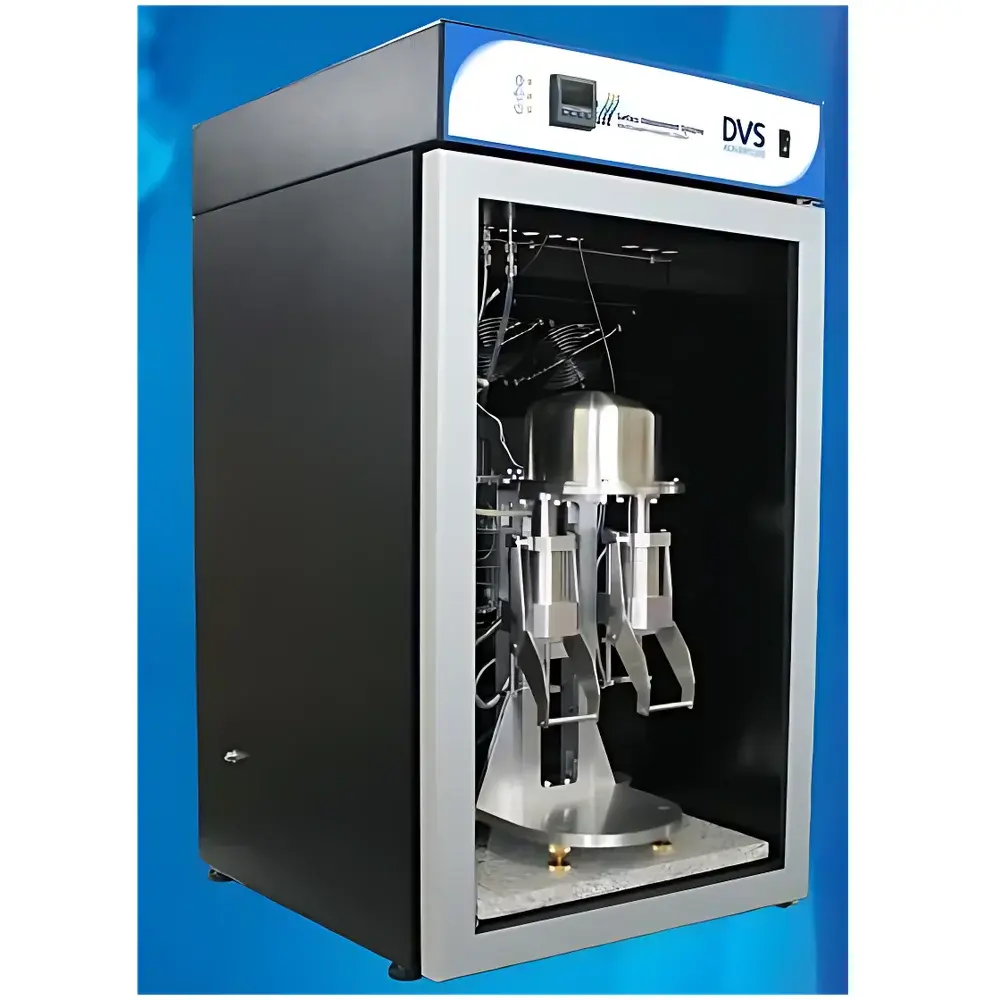
Surface Measurement Systems DVS Adventure Dynamic Vapor Sorption Analyzer
| Brand | SMS |
|---|---|
| Origin | United Kingdom |
| Model | DVS Adventure |
| Temperature Range | 5–85 °C |
| Relative Humidity Range | 0–98% RH |
| Sample Mass Capacity | 1–5000 mg |
| In-situ Heating/Drying Capability | up to 300 °C |
| Humidity Generation Method | Dual-gas mixing (dry carrier gas + saturated vapor) with digital mass flow control |
| Compatibility | Raman spectroscopy (via optical fiber), color video microscopy, NIR spectroscopy |
| Modularity | Upgradable to organic vapor sorption |
| Construction | Anti-static stainless steel |
| Compliance | Designed for GLP/GMP-aligned workflows |
Overview
The Surface Measurement Systems DVS Adventure is a high-precision dynamic vapor sorption (DVS) analyzer operating on the gravimetric principle. It quantifies real-time mass changes in solid or powdered samples exposed to controlled water vapor partial pressures across a broad thermodynamic range. Unlike static or barometric methods, DVS Adventure employs continuous, dual-gas mixing—combining precisely regulated dry nitrogen (or air) with saturated water vapor—to generate stable, traceable relative humidity (RH) setpoints from 0% to 98% RH at temperatures between 5 °C and 85 °C. Its integrated thermal architecture ensures full thermal equilibrium between the sample chamber, vapor generator, and environmental enclosure—eliminating condensation artifacts and enabling reproducible isotherm acquisition even at low temperatures or high RH extremes. As the culmination of over 30 years of DVS innovation since SMS’s 1992 introduction of the first commercial dynamic water vapor sorption instrument, the DVS Adventure delivers metrologically robust data essential for understanding moisture-induced structural transitions, hydration kinetics, deliquescence behavior, and long-term stability in pharmaceuticals, battery materials, polymers, catalysts, and functional coatings.
Key Features
- Gravimetric measurement using ultra-microbalance with sub-μg resolution and active drift compensation
- Full thermal integration: sample stage, vapor delivery path, and humidity generator housed within a single temperature-controlled chamber (5–85 °C)
- In-situ thermal conditioning: programmable heating and drying cycles up to 300 °C directly within the sample pan—enabling activation, dehydration, or thermal pre-treatment without sample transfer
- Dual-gas humidity generation with digital mass flow controllers (MFCs) for precise, repeatable RH ramping and stepwise equilibration
- Open-access sample chamber design for rapid loading/unloading and compatibility with heterogeneous or irregularly shaped specimens
- Anti-static stainless-steel construction minimizing electrostatic interference and ensuring long-term mechanical stability
- Modular hardware platform: factory-upgradable to full organic vapor sorption (OVS) capability via optional vapor modules and calibration kits
Sample Compatibility & Compliance
The DVS Adventure accommodates sample masses from 1 mg to 5000 mg—including powders, granules, films, fibers, tablets, and porous monoliths—without requiring pelletization or binder addition. Its open geometry supports direct placement of samples on standard platinum or ceramic pans, enabling surface-layer analysis as well as bulk-phase characterization. The system meets foundational requirements for regulated environments: its firmware and DVS Win software incorporate role-based user permissions, electronic signatures, and time-stamped audit trails compliant with FDA 21 CFR Part 11. Experimental metadata—including temperature, RH, flow rates, balance readings, and timestamps—is embedded in every raw data file, facilitating traceability during GLP or GMP audits. While not certified to ISO/IEC 17025 out-of-the-box, the instrument is routinely deployed in ISO 11607, USP <1151>, and ICH Q5C-compliant laboratories for excipient moisture mapping and formulation stability assessment.
Software & Data Management
DVS Win software provides end-to-end experimental control—from method definition (RH ramps, dwell times, temperature profiles) to real-time visualization and post-acquisition modeling. Built-in models include BET, GAB, Peleg, and Fickian diffusion fitting; custom scripts support advanced kinetic analysis (e.g., moving boundary, dual-mode sorption). All raw mass vs. time datasets are stored in vendor-neutral .csv format alongside XML metadata. Data export supports direct import into MATLAB, Python (via pandas), and industry-standard statistical packages. Software updates are delivered through secure HTTPS channels, with version history and change logs maintained for validation documentation.
Applications
- Pharmaceutical development: quantifying moisture-induced amorphous content changes, hydrate formation/dissociation, and tablet capping risk prediction
- Battery electrode research: correlating water uptake in cathode precursors (e.g., NMC, LFP) with interfacial side reactions and SEI instability
- Polymer science: measuring water plasticization effects on Tg, modulus loss, and dimensional stability in barrier films and hydrogels
- Food science: modeling shelf-life based on moisture sorption hysteresis and monolayer moisture content (m0) estimation
- Materials engineering: evaluating desiccant performance, MOF water capture capacity, and cementitious phase hydration kinetics
FAQ
What carrier gases are supported?
Dry nitrogen is recommended for highest RH precision and oxidation-sensitive samples; dry air is optionally supported with appropriate filtration.
Can the system operate unattended overnight?
Yes—fully programmable multi-step protocols with automatic RH/temperature sequencing and data logging enable extended autonomous operation.
Is calibration traceable to national standards?
Mass calibration uses NIST-traceable weights; RH calibration is performed using saturated salt solutions per ISO 18847 and verified against chilled-mirror hygrometry.
How is temperature uniformity validated across the sample chamber?
SMS provides a thermal mapping report (per ASTM E2251) documenting spatial gradients ≤ ±0.3 °C at steady state across the active sample zone.
Does the system support automated sample exchange?
No—the DVS Adventure is a single-sample platform optimized for method rigor and thermal fidelity; high-throughput screening requires separate DVS Resolve or DVS Vacuum configurations.



