
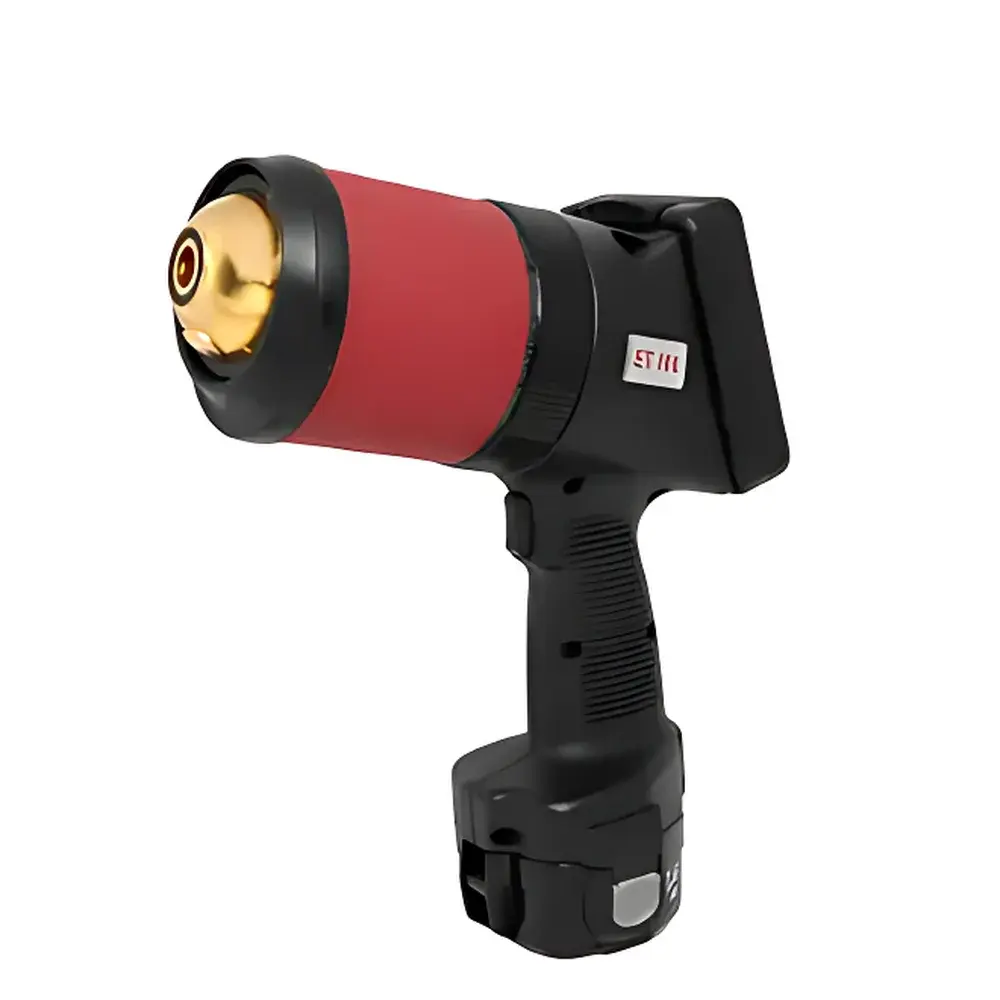
SurfaceOptics ET100 Portable Infrared Emissivity and Reflectance Meter
| Brand | SurfaceOptics |
|---|---|
| Origin | USA |
| Model | ET 100 |
| Measurement Principle | Integrating Sphere-Based Directional-Hemispherical Reflectance (DHR) |
| Spectral Range | Six Discrete Bands (1.5–2, 2–3.5, 3–4, 4–5, 5–10.5, 10.5–21 µm) |
| Incident Angles | 20° and 60° from Normal |
| Measurement Time | ≤10 s per acquisition (after 90 s warm-up) |
| DHR Accuracy | NIST-Traceable Calibration |
| Compliance | ASTM E408-22 |
| Power | Rechargeable NiMH Battery Pack (2 units) |
| Operating Temperature | 0–40 °C (non-condensing) |
| Storage Temperature | −25–70 °C |
| Weight | 2.1 kg (with batteries) |
| Sample Geometry Support | Flat, convex (≥6″ radius), concave (≥12″ radius) |
| Data Storage | Internal SD card (FAT32 formatted, user-replaceable) |
| Display | Touch-enabled LCD interface |
| Probe Design | Modular, field-replaceable measurement head |
| IR Source | Cr-Al-Co alloy filament emitter |
Overview
The SurfaceOptics ET100 is a field-deployable, battery-powered infrared emissivity and directional-hemispherical reflectance (DHR) meter engineered for quantitative optical characterization of material surfaces across the mid- to long-wave infrared (MWIR–LWIR) spectrum. It operates on the fundamental principle of integrating sphere-based reflectometry: an internal chromium-aluminum-cobalt (Cr-Al-Co) filament emits broadband IR radiation onto the sample surface at precisely controlled incident angles (20° or 60° from normal), while a calibrated detector within the integrated sphere captures the total reflected flux across six discrete spectral bands spanning 1.5–21 µm. By applying Kirchhoff’s law of thermal radiation under local thermodynamic equilibrium assumptions, the instrument computes band-integrated and total hemispherical emissivity (εh) from measured DHR values. Designed for compliance with ASTM E408-22 (“Standard Test Methods for Total Normal Emittance of Surfaces Using Reference Temperatures”), the ET100 delivers traceable, repeatable results without requiring external cryogenic cooling or laboratory-grade environmental control—making it suitable for both benchtop validation and in-situ field assessment of thermal management surfaces.
Key Features
- Portable, self-contained architecture with integrated integrating sphere, IR source, precision optics, and embedded microprocessor—no external PC or power supply required
- NIST-traceable calibration delivered with each unit via gold-coated mirror reference standard; optional annual recalibration services available
- Two selectable incident angles (20° and 60°) enabling differentiation between specular-dominant and diffuse-dominant surface behavior
- Six non-overlapping spectral bands optimized for thermal radiation analysis: 1.5–2 µm, 2–3.5 µm, 3–4 µm, 4–5 µm, 5–10.5 µm, and 10.5–21 µm
- Modular probe design allows rapid replacement of the measurement head in case of contamination or mechanical wear—minimizing downtime
- Touchscreen LCD interface with intuitive workflow navigation; all system diagnostics, measurement logs, and configuration settings accessible onsite
- Onboard data logging to removable SD card (FAT32 format); timestamped, angle-tagged, and band-resolved reflectance records stored in CSV-compatible format
- Operational autonomy: up to 4 hours of continuous use per full charge using dual rechargeable NiMH battery packs
Sample Compatibility & Compliance
The ET100 accommodates a wide range of real-world surface geometries without sample preparation: flat substrates, convex surfaces with curvature radius ≥6 inches, and concave surfaces with radius ≥12 inches. Its non-contact, low-flux measurement protocol avoids thermal perturbation of temperature-sensitive coatings or thin films. All measurements adhere to ASTM E408-22 requirements for total normal emittance determination via reflectance substitution. While primarily intended for ambient-temperature materials, the instrument supports emissivity estimation of surfaces maintained at stable temperatures below 100 °C when used with appropriate thermal shielding. Data integrity meets GLP-aligned documentation standards: each measurement file includes instrument serial number, calibration certificate ID, operator ID (user-input), ambient temperature/humidity (optional external sensor input), and full audit trail metadata.
Software & Data Management
Raw DHR values are recorded in ASCII-encoded CSV files with column headers specifying band index, incident angle, date/time stamp, and raw digital counts normalized to reference standard response. No proprietary binary formats or vendor-locked software dependencies are employed. Users may import datasets directly into MATLAB, Python (NumPy/Pandas), Excel, or third-party spectral analysis platforms. Optional SurfaceOptics DataBridge™ desktop application (Windows/macOS) provides batch processing, emissivity mapping across multi-angle datasets, uncertainty propagation modeling based on NIST calibration uncertainties, and automated report generation compliant with ISO/IEC 17025 documentation templates. All firmware updates are delivered via SD card—no internet connection required in secure or remote environments.
Applications
- Aerospace thermal control: validation of low-emissivity coatings on satellite radiators, thermal blankets, and re-entry vehicle heat shields
- Building envelope diagnostics: quantification of solar absorptance and thermal emittance for cool roof membranes, insulated glazing units, and radiant barrier systems
- Photovoltaic and solar thermal R&D: optimization of selective absorber coatings for concentrated solar power (CSP) receivers and photothermal conversion efficiency modeling
- Defense and IR signature management: baseline emissivity profiling of camouflage paints, stealth composites, and multispectral countermeasure surfaces
- Quality assurance in optical thin-film manufacturing: rapid lot-to-lot verification of IR-reflective dielectric stacks and metal-dielectric interference filters
- Academic and national lab research: experimental validation of radiative transfer models, bidirectional reflectance distribution function (BRDF) parameterization, and Kirchhoff’s law applicability limits
FAQ
Does the ET100 measure true hemispherical emissivity directly?
No—it measures directional-hemispherical reflectance (DHR) at 20° or 60° incidence and computes total hemispherical emissivity under the assumption of surface isotropy and diffuse thermal emission, per ASTM E408 methodology.
Can the ET100 be used on curved or textured surfaces?
Yes—its optical design supports convex surfaces with radius ≥6 inches and concave surfaces with radius ≥12 inches; surface roughness up to Ra ≈ 5 µm does not significantly affect measurement fidelity.
Is spectral calibration performed in-house or by NIST?
SurfaceOptics performs end-to-end system calibration using NIST-traceable reference standards; each unit ships with a certificate listing measurement uncertainty budgets per band and angle.
What is the warm-up requirement before first measurement?
A 90-second stabilization period is required for thermal equilibrium of the Cr-Al-Co source and detector electronics; subsequent measurements require no additional warm-up.
How is measurement repeatability verified during field use?
The included gold mirror standard enables daily verification; deviation >±0.005 in DHR across any band triggers recalibration recommendation per ASTM E408 Annex A3.



