SurfaceTech Laser MBE Thin Film Deposition System
| Brand | SurfaceTech |
|---|---|
| Origin | Germany |
| Model | Laser MBE |
| Vacuum Class | Ultra-High Vacuum (UHV) |
| Base Pressure | ≤5×10⁻¹⁰ mbar (typical) |
| Substrate Heater | Resistive, 100–1000 °C (±0.5 °C stability) |
| Target Capacity | Up to 5 × 1-inch targets on rotating carousel |
| Laser Integration | Nd:YAG or excimer laser compatible (193–266 nm, pulse energy up to 500 mJ, repetition rate 1–10 Hz) |
| Load-Lock Capacity | 5 substrates + 2 target carousels |
| In-situ Diagnostics Ports | RHEED, OES, FTIR, QMS (CF-63/CF-100 flanges) |
| Automation Level | Fully programmable deposition sequence with real-time parameter logging and audit trail |
| Compliance | Designed for GLP/GMP-aligned lab environments |
Overview
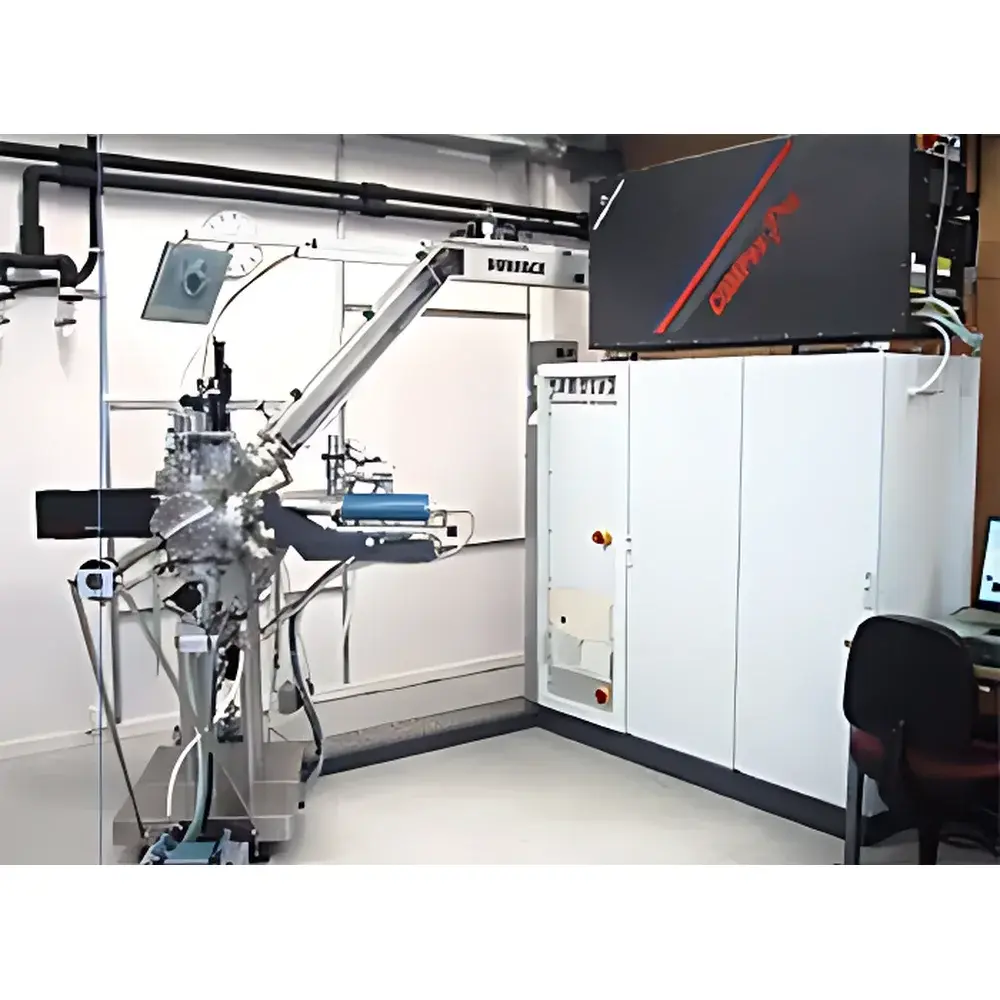
The SurfaceTech Laser MBE is an ultra-high vacuum (UHV) thin film deposition system engineered specifically for pulsed laser deposition (PLD) and laser-assisted molecular beam epitaxy (Laser MBE) applications in academic and industrial research laboratories. Unlike conventional PLD systems, this platform integrates core MBE-grade vacuum integrity, thermal management, and process modularity—enabling atomic-layer precision growth of complex oxides, nitrides, chalcogenides, and multiferroic heterostructures. Its operational principle relies on high-energy pulsed laser ablation of solid targets under UHV conditions (≤5×10⁻¹⁰ mbar), generating stoichiometric plumes that condense epitaxially on heated single-crystal substrates. The cold-wall chamber design minimizes outgassing during deposition, while the load-lock architecture ensures uninterrupted vacuum integrity during sample and target exchange—critical for oxygen-sensitive materials such as YBCO, LSCO, or SrTiO₃-based interfaces.
Key Features
- Modular UHV architecture with standardized CF flanges (CF-63 and CF-100), enabling seamless integration of RHEED, OES, FTIR, quadrupole mass spectrometry (QMS), plasma sources, or effusion cells.
- Advanced substrate heating system: resistive heater with ±0.5 °C temperature stability from 100 °C to 1000 °C; optional laser-target heating for localized thermal control of multi-material targets.
- Carousel-based target handling: accommodates up to five 1-inch targets; entire carousel—not individual targets—is transferred under UHV to eliminate cross-contamination.
- SURFACE Laser Energy Density Control (LEDC) option: real-time pulse-by-pulse energy calibration ensures constant fluence across extended runs, delivering >99.8% shot-to-shot reproducibility in film stoichiometry and thickness.
- Full optical enclosure: Class 1 laser safety compliance with interlocked access doors and beam path containment—no external alignment required post-installation.
- Integrated load-lock chamber: holds up to five wafers (up to 4″ diameter) and two target carousels, supporting rapid batch processing without breaking main chamber vacuum.
Sample Compatibility & Compliance
The Laser MBE supports a broad range of substrate materials—including Si, sapphire, MgO, STO, LSAT, and flexible metallic foils—and accommodates both conductive and insulating targets (e.g., La₀.₇Sr₀.₃MnO₃, BiFeO₃, MoS₂, GaN). All wetted surfaces are electropolished stainless steel or oxygen-free copper, passivated per ASTM A967 for low particulate generation. The system conforms to ISO 27401:2017 for UHV equipment qualification and includes documentation packages suitable for GLP audits. Optional 21 CFR Part 11-compliant software modules provide role-based user authentication, electronic signatures, and immutable audit trails for regulated R&D environments.
Software & Data Management
Control is managed via SURFACE’s proprietary LabControl Suite—a Windows-based, deterministic real-time OS with deterministic I/O timing (<10 ms jitter). The interface enables full scripting of multi-step deposition protocols (e.g., alternating target ablation, shutter sequencing, temperature ramps, gas dosing), with synchronized data acquisition from thermocouples, pressure gauges, laser monitors, and diagnostics tools. All process parameters are time-stamped and exported in HDF5 format for traceability. Built-in self-test routines validate vacuum integrity, heater response, shutter actuation, and laser trigger synchronization prior to each run—reducing operator-dependent error.
Applications
This system is routinely deployed in studies requiring atomic-scale interface engineering: oxide heterostructures for emergent transport phenomena (e.g., 2DEG at LAO/STO), ferroelectric tunnel junctions, topological insulator thin films (Bi₂Se₃, Sb₂Te₃), and metastable phase synthesis (e.g., high-pressure polymorphs stabilized via kinetic control). It serves as a foundational tool for groups pursuing quantum materials discovery, neuromorphic device prototyping, and scalable thin-film sensor development—particularly where stoichiometric fidelity, interfacial sharpness, and oxygen partial pressure control (via optional leak-valve O₂ dosing) are non-negotiable.
FAQ
What vacuum level can the Laser MBE achieve, and how is it maintained?
The base pressure is ≤5×10⁻¹⁰ mbar, achieved using a combination of turbomolecular pumping (≥800 L/s N₂), ion getter pumps, and titanium sublimation. Cold-wall design and all-metal seals minimize virtual leaks and outgassing during deposition.
Can the system be upgraded to a cluster configuration?
Yes—central transfer module insertion between the PLD chamber and load-lock enables straightforward expansion into a multi-chamber cluster (e.g., adding sputtering, ALD, or in-situ etch modules) without requalification of existing components.
Is remote support available for troubleshooting and calibration?
SurfaceTech provides secure, encrypted remote access for firmware updates, diagnostic logging, and real-time parameter validation—fully compliant with ISO/IEC 27001 information security standards.
Does the system support reactive gas introduction during deposition?
Yes—integrated precision leak valves allow controlled introduction of O₂, N₂, or Ar with mass flow controllers (MFCs) calibrated to ±1% full scale, enabling reactive PLD of oxides and nitrides.
What documentation is provided for regulatory compliance?
Each system ships with Factory Acceptance Test (FAT) reports, UHV performance certificates, electrical safety certification (CE/UKCA), and optional IQ/OQ documentation aligned with ISO 13485 and FDA guidance for laboratory instrumentation.