Surfcam CREST DX Surface Roughness and Profile Measuring System
| Brand | ACCRETECH (Tokyo Seimitsu) |
|---|---|
| Origin | Japan |
| Type | CNC-Controlled Non-Contact + Contact Hybrid Profilometer |
| Axes | 5-Axis Synchronized Motion |
| Drive Speed | Up to 100 mm/s |
| Z-Range | 10 mm |
| X-Range | 200 mm |
| Vertical Resolution | 0.31 nm |
| Measurement Principle | High-Stability Homodyne Laser Interferometry (for CREST DX) + Dual-Sensor Tactile Stylus (for NEX 100 DX/SD) |
| Compliance | ISO 25178-605, ISO 4287, ISO 4288, ISO 11562, ISO 21920-1 |
| Operation Mode | Fully Automated |
| Sensor Options | Integrated Dual-Mode (Stylus + Auto-Focus Optical) |
| Software Platform | SURFPAK DX v8.x with Audit Trail & CFR 21 Part 11 Ready Configuration |
| Data Export | CSV, XML, STEP AP212, PDF Report (GLP/GMP Compliant Templates) |
Overview
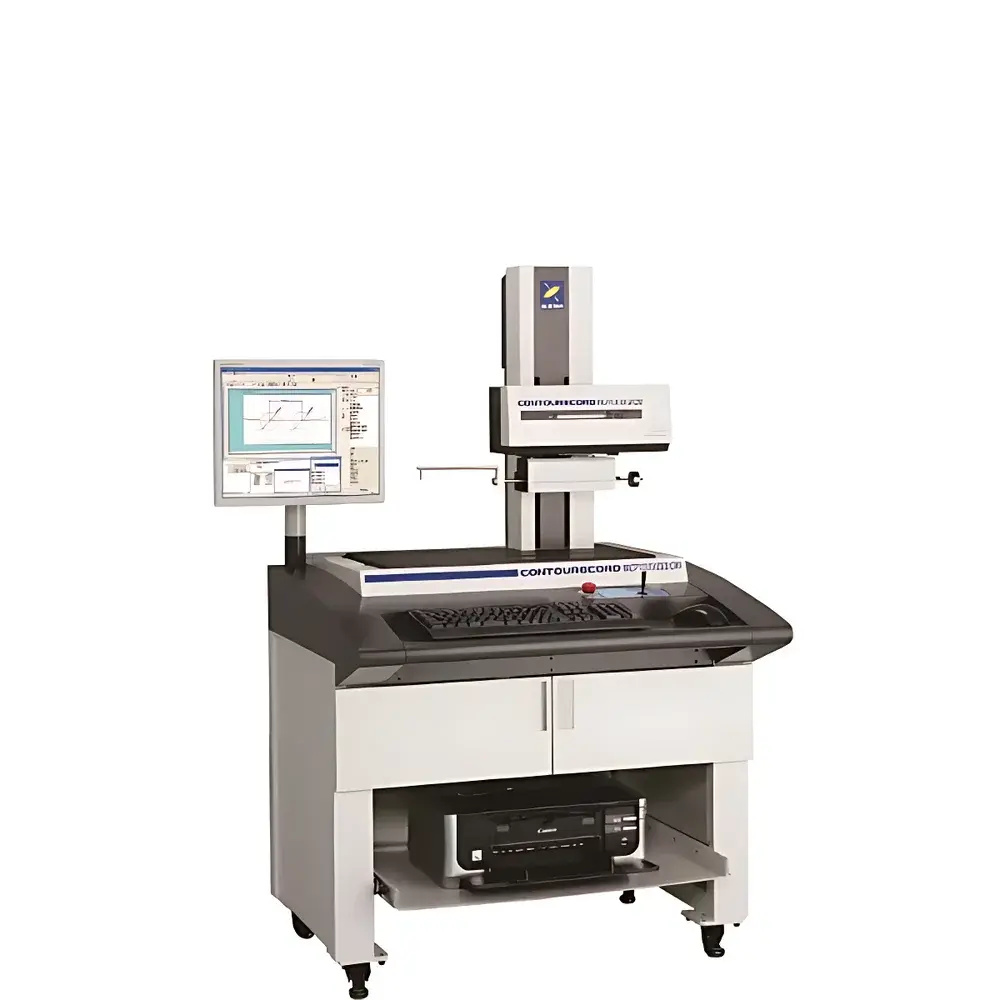
The Surfcam CREST DX is a high-precision, fully automated surface metrology system engineered for simultaneous evaluation of surface roughness and contour geometry on precision-engineered components. Unlike conventional single-mode profilometers, the CREST DX integrates a high-stability homodyne laser interferometric sensor with a thermally compensated linear motor stage architecture—enabling sub-nanometer vertical resolution (0.31 nm) and traceable dimensional accuracy across its full 13 mm vertical measurement range. Its 5-axis synchronized motion control allows dynamic tip-angle compensation during scanning, ensuring faithful reproduction of steep flanks, micro-grooves, and freeform surfaces without stylus lift-off or data interpolation artifacts. Designed for integration into production metrology cells and R&D laboratories alike, the system operates under strict adherence to ISO 25178-605 (areal surface texture), ISO 4287 (profile roughness parameters), and ISO 11562 (filtering methodology), delivering metrologically sound results suitable for first-article inspection, process capability studies (Cpk/Ppk), and regulatory submission packages.
Key Features
- Hybrid dual-sensor architecture: Combines tactile stylus profiling (per ISO 3274) with auto-focus optical height sensing—enabling reliable measurement of low-reflectivity, multi-material, or optically challenging surfaces (e.g., black anodized aluminum, matte ceramics, PVD-coated tools).
- Linear motor-driven X- and Z-axes with granite base and air-bearing guideways ensure mechanical stability, minimal thermal drift (<0.3 µm/°C), and repeatability better than ±0.5 nm over 24-hour operation.
- Real-time 5-axis path planning compensates for probe tilt, curvature, and local surface normal deviation—critical for accurate assessment of curved gears, turbine blades, and orthopedic implants.
- Full compliance with ISO 25178-605: Supports areal parameter calculation (Sa, Sq, Sz, Sk, Spk, Svk) alongside profile-based parameters (Ra, Rz, Rq, Rsk, Rku) within a unified software environment.
- CFR 21 Part 11–ready firmware and SURFPAK DX v8.x software provide electronic signatures, role-based access control, audit trail logging, and immutable raw-data archiving—meeting FDA, ISO 13485, and IATF 16949 documentation requirements.
Sample Compatibility & Compliance
The CREST DX accommodates workpieces up to 200 mm in lateral travel (X-axis) and 10 mm in vertical range (Z-axis), supporting both flat calibration standards and complex 3D parts—including bearing races, injection-molded plastic housings, semiconductor wafer edge profiles, and medical device surfaces. Its non-contact auto-focus mode eliminates stylus wear and enables measurement of soft polymers, thin films, and fragile MEMS structures where contact force must remain below 0.5 mN. All hardware and firmware comply with CE marking directives (2014/30/EU EMC, 2014/35/EU LVD), RoHS 2011/65/EU, and JIS B 7501-2015 verification protocols. Calibration certificates are issued per ISO/IEC 17025-accredited procedures, with traceability to NMIJ (Japan) and PTB (Germany) primary standards.
Software & Data Management
SURFPAK DX v8.x serves as the central analytical engine—providing ISO-compliant filtering (Gaussian, Spline, Robust Gaussian), segmentation tools for feature-specific analysis (e.g., groove depth on sealing surfaces), and statistical process monitoring dashboards. Raw interferometric data is stored in vendor-neutral HDF5 format with embedded metadata (timestamp, operator ID, environmental conditions, calibration status). The system supports scheduled automated reporting via SMTP and network file share export, with optional integration into MES/QMS platforms via RESTful API. All user actions—including parameter edits, filter selections, and report generation—are logged with cryptographic hash integrity verification and time-stamped audit trails compliant with GLP and GMP Annex 11.
Applications
- Aerospace: Evaluation of turbine vane leading-edge roughness, EDM recast layer characterization, and additive-manufactured part surface fidelity validation.
- Automotive: Quantification of cylinder bore honing patterns (plateau finish), gear flank micro-geometry, and NVH-critical seal surface topography.
- Medical Devices: Verification of orthopedic implant surface texture per ASTM F2791, stent strut edge radius, and dental CAD/CAM crown margin integrity.
- Semiconductors: Wafer edge profile mapping, CMP uniformity assessment, and photomask defect height quantification.
- Research & Standards Labs: Development and inter-laboratory comparison of new areal texture parameters under ISO/TC 213 working groups.
FAQ
Does the CREST DX require periodic recalibration by an accredited lab?
Yes. ACCRETECH recommends annual calibration using certified step-height and roughness standards traceable to NMIJ. On-site verification with reference artifacts is supported quarterly per ISO 17025 internal audit requirements.
Can the system measure surfaces with reflectivity below 5% or above 95%?
Yes. The auto-focus optical sensor uses multi-wavelength LED illumination and adaptive threshold detection—eliminating dependence on surface albedo. Validation data shows <±2 nm height deviation across matte black epoxy (3% reflectivity) and polished stainless steel (98%).
Is SURFPAK DX compatible with Windows 11 and SQL Server 2022?
Yes. Version 8.3.2 and later support Windows 11 Pro (64-bit) and Microsoft SQL Server 2019/2022 for centralized database deployment, including encrypted column-level storage for sensitive measurement records.
What is the maximum allowable vibration level at the installation site?
Vibration must not exceed 2.5 µm peak-to-peak at frequencies between 1–100 Hz. A passive granite isolation table (minimum mass: 1,200 kg) is required; active damping systems are recommended for environments adjacent to CNC machining centers.
How does the system handle thermal expansion during extended measurement cycles?
The granite base incorporates embedded temperature sensors feeding real-time compensation algorithms into the laser interferometer’s phase decoder—reducing thermal error contribution to <0.1 nm/°C across the full Z-range.