
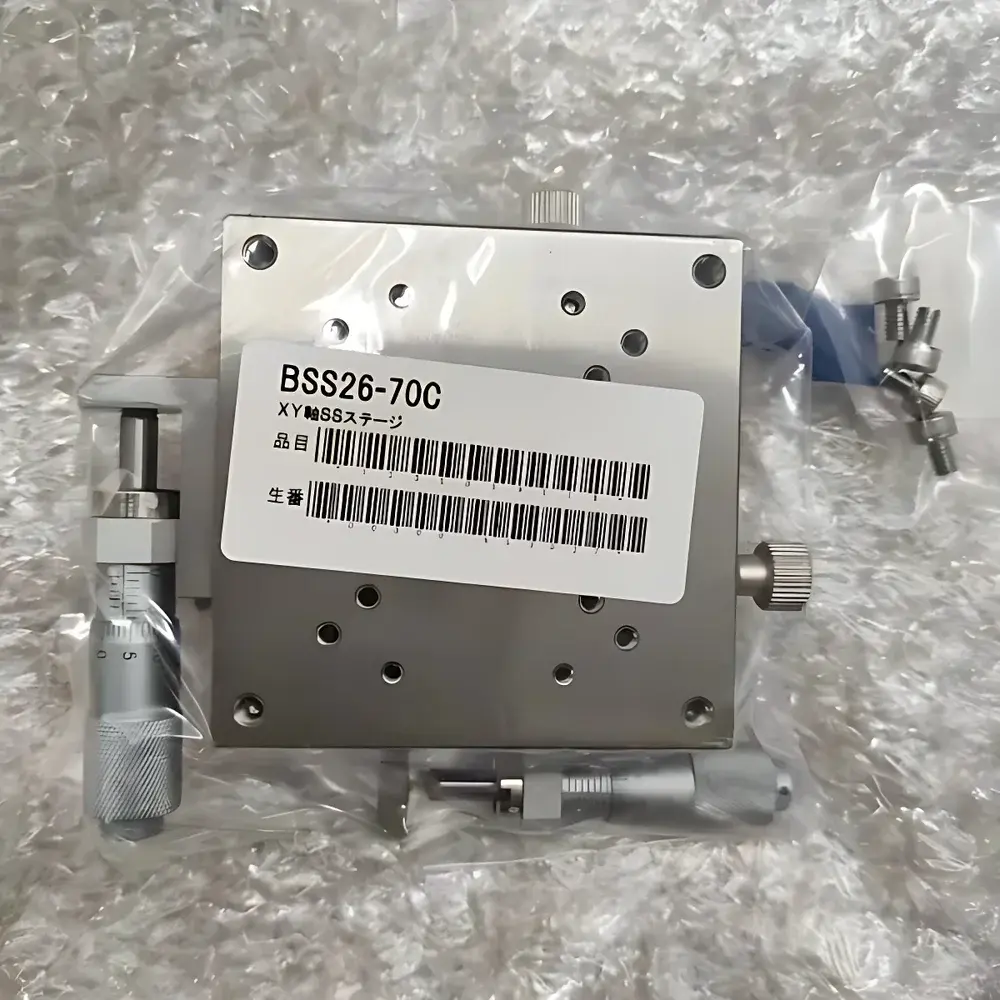
Suruga Seiki BSS16-70CZ Precision X-Axis Manual Translation Stage
| Brand | Suruga Seiki |
|---|---|
| Origin | Japan |
| Model | BSS16-70CZ |
| Platform Surface | 70 × 70 mm |
| Travel Range | ±6.5 mm (13 mm total) |
| Load Capacity | 219.5 N (22.4 kgf) |
| Feed Mechanism | Standard Micrometer Head (Pitch = 0.5 mm) |
| Minimum Micrometer Resolution | 10 µm/div |
| Positioning Accuracy | Straightness ≤1 µm, Pitch ≤25″, Yaw ≤15″, Roll Parallelism ≤12 µm |
| Permissible Moment Loads | Pitch/Yaw/Roll = 12.9 / 13.8 / 12.9 N·m |
| Torque Rigidity | Pitch/Yaw/Roll = 0.09 / 0.1 / 0.09 ″/N·cm |
| Permissible Parallelism Tolerance | ≤30 µm |
| Perpendicularity Tolerance | ≤10 µm |
| Mass | 1.16 kg |
| Guide Type | Linear Ball Bearing Rail |
| Construction Material | Stainless Steel with Electroless Nickel Plating |
Overview
The Suruga Seiki BSS16-70CZ is a high-precision manual X-axis translation stage engineered for demanding alignment and positioning tasks in printed electronics manufacturing and semiconductor component handling. Designed using Couette-type mechanical architecture and precision-machined stainless steel components, it delivers sub-micron straightness and angular stability under static and quasi-static loading conditions. Its core functionality relies on a calibrated micrometer-driven feed system coupled with preloaded linear ball bearing rails—ensuring repeatable, hysteresis-free motion without motorized complexity. This stage is not intended for dynamic scanning or automated motion control; rather, it serves as a foundational metrology-grade positioning module within cleanroom-compatible optical benches, mask aligners, inkjet printhead calibration rigs, and thin-film deposition tooling setups where deterministic manual adjustment is preferred over servo-based actuation.
Key Features
- Precision-engineered 70 × 70 mm platform with ±6.5 mm travel (13 mm total stroke), optimized for compact integration into multi-axis stacks used in fine-pitch printed electronics patterning.
- Linear ball bearing rail guidance ensures low-friction, high-reproducibility motion with straightness ≤1 µm across full travel—critical for maintaining registration accuracy during photolithographic or aerosol jet printing processes.
- Micrometer head (standard P = 0.5 mm pitch) offers 10 µm per division resolution, enabling tactile, real-time positional feedback without reliance on external encoders or digital readouts.
- Stainless steel body with electroless nickel plating provides corrosion resistance, non-magnetic properties, and compatibility with ISO Class 5–7 cleanroom environments typical of semiconductor packaging and flexible electronics fabrication lines.
- Structural rigidity validated via moment load testing: permissible pitch/yaw/roll moments up to 12.9–13.8 N·m, supporting auxiliary fixtures such as micro-probes, optical fibers, or vacuum chucks without compromising planar alignment.
- Complies with EU Directive 2011/65/EU (RoHS-10), confirming absence of lead, cadmium, mercury, hexavalent chromium, PBB, PBDE, and four phthalates—essential for export to regulated markets including the EU, South Korea, and North America.
Sample Compatibility & Compliance
The BSS16-70CZ accommodates substrates and tooling fixtures ranging from 10 × 10 mm wafers to 70 × 70 mm glass or polymer carriers. Its 219.5 N (22.4 kgf) static load capacity supports standard vacuum chucks, passive alignment jigs, and optical collimators commonly deployed in R&D and pilot-line printed electronics workflows. The stage meets mechanical interface requirements defined in SEMI F20-02 (Equipment Safety Guidelines) and aligns with dimensional tolerancing practices outlined in ISO 2768-mK. While not certified to ISO 14644-1 for airborne particle classification, its material finish and lack of lubricant migration make it suitable for use downstream of ISO Class 5 laminar flow hoods when paired with compatible mounting hardware.
Software & Data Management
As a manually operated mechanical stage, the BSS16-70CZ does not incorporate embedded firmware, onboard sensors, or digital communication interfaces (e.g., USB, RS-485, or EtherCAT). It operates independently of software control systems—eliminating validation overhead associated with FDA 21 CFR Part 11 compliance for electronic records. However, when integrated into larger platforms equipped with machine vision or laser interferometry, its deterministic displacement behavior allows traceable correlation between micrometer dial readings and coordinate measurements captured by external metrology tools. Documentation includes dimensional drawings, RoHS declaration of conformity, and mechanical test reports for moment rigidity and straightness—available upon request for GMP/GLP audit readiness.
Applications
- Alignment of conductive ink nozzles in aerosol jet printers for high-resolution circuit patterning on flexible substrates.
- Fine-tuning of shadow masks during thermal evaporation of electrode layers in OLED and perovskite solar cell prototyping.
- Positional calibration of near-field scanning optical microscopy (NSOM) probes in printed photonics R&D labs.
- Manual XY stacking in hybrid bonding demonstrators where thermal expansion mismatch necessitates non-motorized, low-heat-generation adjustment.
- Integration into custom-built roll-to-plate gravure or flexographic print heads requiring micron-level lateral registration repeatability.
FAQ
Is the BSS16-70CZ compatible with vacuum environments?
Yes—the stainless steel construction and dry-running linear bearings allow operation under moderate vacuum (≤10⁻² mbar) without outgassing concerns; however, standard grease lubrication requires verification against specific chamber protocols.
Can this stage be stacked with other Suruga Seiki stages (e.g., BSSZ6-70C) to form an XY configuration?
Yes—both BSS16-70CZ and BSSZ6-70C share identical mounting hole patterns (M4 × 6 mm) and base plate geometry, enabling rigid, co-planar XY assembly using included M4-6 bolts.
What is the recommended recalibration interval for the micrometer head?
No scheduled recalibration is required under normal usage; however, periodic verification against a certified gauge block (e.g., ISO 3650 Class K) is advised every 12 months in GLP-regulated settings.
Does the stage include anti-backlash compensation?
No—the micrometer mechanism is non-compensated; users must employ consistent unidirectional approach technique to minimize hysteresis effects during critical positioning steps.
Are replacement micrometer heads available separately?
Yes—Suruga Seiki supplies OEM-compatible micrometer assemblies (part number: MK-05-STD) with identical 0.5 mm pitch and 10 µm graduation, available through authorized distributors.






