
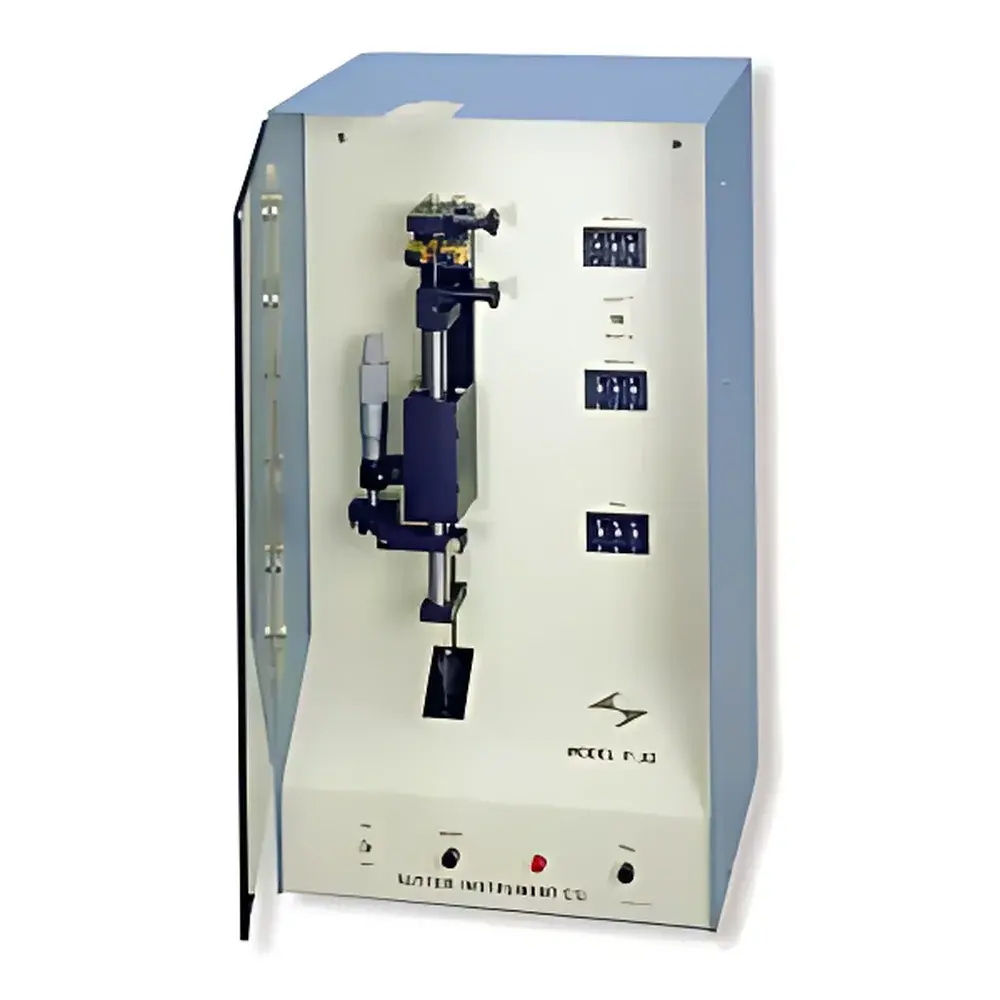
Sutter P-30 Vertical Micropipette Puller
| Brand | Sutter |
|---|---|
| Origin | USA |
| Model | P-30 |
| Heating Element Options | Platinum-Iridium or Nichrome Coil |
| Control Interface | Three Digital Knobs (Heat, Pull, Velocity) |
| Precision Mechanism | Micrometer-Based Pull Length Reproducibility |
| Electrode Tip Diameter | Down to <0.3 µm |
| Power Supply | Constant-Current Source for Heater and Pull Solenoid |
| Dual-Step Heating Mode | Yes |
| RFI Filtering | Integrated |
| Mounting Base | Rubber-Pad Clamping System |
| Construction Materials | Corrosion-Resistant Alloys and Ceramics |
| Voltage/Frequency Options | Dual (115 V / 230 V |
| Application Domain | Intracellular Electrophysiology, Patch-Clamp Recording, Microinjection, Single-Cell Manipulation |
Overview
The Sutter P-30 Vertical Micropipette Puller is a precision-engineered instrument designed for the reproducible fabrication of glass micropipettes used in demanding electrophysiological and microinjection applications. Operating on the principle of controlled resistive heating and symmetric mechanical tension, the P-30 applies calibrated thermal energy—via either platinum-iridium or nichrome coil elements—to the central region of a borosilicate or quartz capillary while simultaneously exerting vertical pulling force through solenoid-driven translation stages. This dual-parameter process enables deterministic taper formation, critical for achieving sub-micron tip geometries (<0.3 µm) with high axial symmetry and minimal wall thickness variation. As a vertically oriented system, the P-30 eliminates gravitational sag effects common in horizontal pullers, ensuring consistent capillary alignment and thermal gradient uniformity across successive pulls. Its architecture reflects decades of refinement in patch-clamp and intracellular recording workflows, making it a de facto standard in core electrophysiology facilities worldwide.
Key Features
- Vertical pull geometry ensures gravity-independent capillary alignment and repeatable thermal profile distribution.
- Micrometer-adjustable pull length control enables precise replication of taper profiles across batches—essential for inter-experiment comparability in voltage-clamp or current-clamp studies.
- Three independent digital control knobs provide granular, non-volatile setting of heat intensity, pull force magnitude, and pull velocity—each calibrated to engineering-grade resolution and stable over extended operational cycles.
- Constant-current power supply delivers regulated energy to both heater filament and pull solenoid, minimizing thermal drift and mechanical hysteresis during multi-stage protocols.
- Dual-step heating mode supports sequential thermal ramping—optimized for fabricating double-tapered patch pipettes or asymmetric electrodes for simultaneous recording and injection.
- Corrosion-resistant construction—including ceramic insulators, stainless-steel actuation components, and chemically inert mounting hardware—ensures long-term reliability in humidified electrophysiology rigs or cleanroom environments.
- Integrated RFI filtering suppresses electromagnetic interference from nearby amplifiers, digitizers, or stimulators, preserving signal integrity during real-time electrode characterization.
- Rubber-pad clamping system minimizes localized stress and microfracture risk at the capillary ends, significantly increasing usable yield per batch.
Sample Compatibility & Compliance
The P-30 accommodates standard outer diameters of 1.0 mm and 1.5 mm borosilicate (e.g., Sutter BF150-86-10, GC150F-10) and quartz capillaries (e.g., Sutter QF100-72-10), with wall thicknesses ranging from 0.5 to 1.0 mm. It is compatible with both filament-heated and laser-assisted pre-pull configurations when integrated into hybrid fabrication workflows. While not certified to ISO 13485 or FDA 21 CFR Part 11 as a standalone medical device, the P-30 meets general laboratory equipment safety standards (UL 61010-1, IEC 61010-1) and supports GLP/GMP-aligned documentation practices via manual logbook integration and protocol traceability through knob position records. Its design aligns with ASTM E2919-22 guidelines for micropipette performance verification in electrophysiology.
Software & Data Management
The P-30 operates as a fully manual, analog-digital hybrid instrument with no embedded firmware or network interface. All parameter settings are retained mechanically and visually via calibrated dials and micrometer scales—eliminating software dependencies, version control issues, or cybersecurity vulnerabilities. This architecture ensures deterministic behavior under electromagnetic noise conditions typical in shielded Faraday cages. Users maintain full audit trails through handwritten or spreadsheet-based logs correlating knob positions, capillary lot numbers, ambient humidity/temperature, and post-pull electron microscopy validation. For laboratories requiring electronic recordkeeping, the P-30 integrates seamlessly with LIMS platforms via external barcode scanners or manual entry of pull parameters linked to sample IDs.
Applications
- Single-cell patch-clamp electrophysiology (whole-cell, cell-attached, inside-out, outside-out configurations)
- Intracellular sharp-electrode recording in neurons, cardiomyocytes, and oocytes
- Cytoplasmic or nuclear microinjection of DNA, RNA, dyes, or CRISPR-Cas9 complexes
- Fabrication of low-resistance recording pipettes for high-fidelity synaptic current measurement
- Production of high-aspect-ratio pipettes for scanning ion conductance microscopy (SICM)
- Custom taper development for optogenetic stimulation-electrode hybrids
FAQ
What types of glass capillaries are compatible with the P-30?
Standard borosilicate (e.g., Sutter BF150-86-10) and fused quartz (e.g., Sutter QF100-72-10) capillaries with outer diameters of 1.0 mm or 1.5 mm are supported. Wall thickness must be ≥0.5 mm for reliable heating and tensile response.
Can the P-30 produce double-barreled or theta-style pipettes?
No—the P-30 is optimized for single-channel symmetric pulls. Double-barrel fabrication requires specialized horizontal pullers with independent filament zones.
Is calibration required before use?
The P-30 does not require periodic recalibration; however, users should verify heat output using a thermocouple probe and confirm pull-force linearity via load-cell testing annually or after mechanical servicing.
How does the dual-voltage/frequency option affect performance?
Voltage selection (115 V vs. 230 V) adjusts heater power delivery range; frequency selection (50 Hz vs. 60 Hz) ensures stable solenoid timing synchronization in global lab environments—neither alters fundamental taper physics.
What maintenance is recommended for long-term reliability?
Monthly cleaning of heater coil contacts with isopropyl alcohol, annual inspection of solenoid armature travel clearance, and biannual replacement of rubber clamping pads are advised per Sutter’s Field Service Bulletin #P30-MNT-2023.
Related Products






