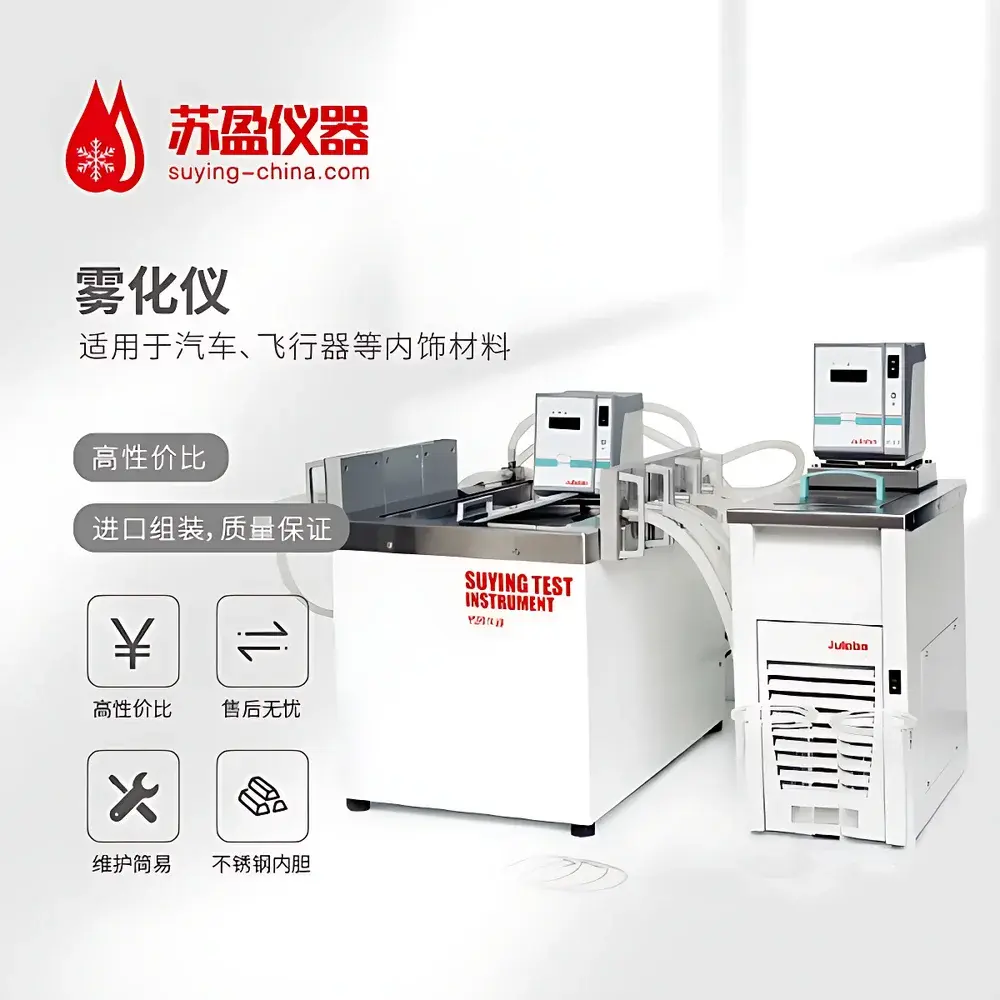
Suying WH-100 Automotive Interior Fogging Tester
| Brand | Suying |
|---|---|
| Origin | Shanghai, China |
| Manufacturer Type | Direct Manufacturer (not distributor) |
| Country of Manufacture | China |
| Model | WH-100 |
| Temperature Range – Heating Chamber | 45–160 °C |
| Temperature Range – Cooling Chamber | −28–100 °C |
| Compliance | ISO 6452, DIN 75201, SAE J1756, GB/T 27630 |
Overview
The Suying WH-100 Automotive Interior Fogging Tester is an engineered precision instrument designed for quantitative assessment of volatile condensable emissions from interior materials used in automotive, aerospace, and rail cabin applications. It operates on the principle of thermal desorption followed by cold-surface condensation—commonly referred to as the “fogging” test method—to measure the mass of volatile organic compounds (VOCs) that volatilize under controlled elevated temperature and subsequently deposit as a thin film on a cooled surface. This gravimetric or photometric measurement directly correlates with potential haze formation on windshields, instrument panels, and optical sensors—critical failure modes addressed in OEM material release specifications. The WH-100 complies with internationally recognized fogging standards including ISO 6452 (2022), DIN 75201 (2019), SAE J1756 (2016), and China’s GB/T 27630–2011, ensuring data traceability and cross-laboratory comparability.
Key Features
- Independent dual-zone thermal control: precisely regulated heating chamber (45–160 °C, ±0.5 °C stability) and cooling chamber (−28–100 °C, ±0.3 °C stability) enable strict adherence to standard-defined test profiles.
- Modular sample holder design compatible with both glass slide (Gravimetric Method) and aluminum foil (Reflectometer Method) substrates per ISO 6452 Annex A & B.
- Stainless steel construction with electropolished interior surfaces minimizes VOC background contamination and supports routine cleaning validation under GLP conditions.
- Integrated digital PID controllers with real-time temperature logging and programmable ramp/soak cycles ensure repeatability across shifts and operators.
- Optional integrated reflectometer module (WH-100-R) provides direct haze quantification (0–100% reflectance loss) without manual weighing, reducing operator variability.
- CE-marked electrical architecture compliant with IEC 61000-6-3 (EMC) and IEC 61000-6-2 (immunity), suitable for installation in ISO/IEC 17025-accredited testing laboratories.
Sample Compatibility & Compliance
The WH-100 accommodates standard-sized specimens (e.g., 25 × 25 mm, 50 × 50 mm, or circular 50 mm diameter) cut from polypropylene, PVC, PU foam, leather, textile composites, adhesives, and sealants—materials routinely specified in Tier-1 supplier technical datasheets. Each test run processes up to three samples simultaneously under identical thermal conditions. All operational parameters—including exposure duration (typically 16 h at 100 °C per DIN 75201), condensation surface temperature (23 °C for gravimetric, 4 °C for reflectometric), and chamber purge gas flow rate (if equipped with optional N₂ purge)—are fully configurable to match customer-specific internal protocols or evolving OEM requirements (e.g., Ford WSS-M99P1111-A, GMW15634, VW TL 52255). Full compliance documentation—including factory calibration certificates traceable to NIM (National Institute of Metrology, China) and uncertainty budgets—is supplied with each unit.
Software & Data Management
The WH-100 operates via embedded firmware with local touchscreen interface (no PC dependency for basic operation). For advanced data governance, optional Suying FogTest Suite v3.2 software enables full audit trail functionality per FDA 21 CFR Part 11: electronic signatures, user role-based access control (admin/operator/auditor), automatic timestamped event logs (start/stop/temperature deviation/alarm), and encrypted PDF report generation with embedded metadata (sample ID, operator, ambient RH/T, calibration status). Raw temperature/time datasets export in CSV format for integration into LIMS platforms (e.g., LabWare, Thermo Fisher SampleManager) or statistical process control (SPC) tools.
Applications
- Pre-release screening of trim materials against OEM fogging limits (e.g., ≤ 2.0 mg condensate for gravimetric; ≤ 15% haze for reflectometric).
- Root-cause analysis of high-fogging batches during production troubleshooting—correlating results with GC-MS VOC profiling data.
- Qualification of low-emission alternatives (bio-based polymers, waterborne coatings) in R&D environments.
- Supporting compliance with China’s GB/T 27630–2011 “Guidelines for Control of Volatile Organic Compounds in Passenger Vehicles” and EU REACH SVHC screening workflows.
- Third-party certification testing for TÜV Rheinland, SGS, or Intertek accredited laboratories performing automotive component homologation.
FAQ
What standards does the WH-100 support out-of-the-box?
ISO 6452:2022, DIN 75201:2019, SAE J1756:2016, and GB/T 27630–2011 are preconfigured in firmware; custom profiles can be added via software.
Is the cooling chamber capable of sub-zero operation without external chillers?
Yes—the integrated cascade refrigeration system achieves −28 °C autonomously, eliminating dependency on liquid nitrogen or external glycol units.
Can the WH-100 be validated for ISO/IEC 17025 accreditation?
Yes—full IQ/OQ documentation package, metrological traceability records, and uncertainty analysis templates are included for laboratory accreditation audits.
Does the system support automated data transfer to enterprise quality systems?
Via optional FogTest Suite with RESTful API and HL7-compliant export modules, enabling seamless integration with SAP QM, Oracle Quality, or custom MES platforms.
What maintenance intervals are recommended for long-term measurement stability?
Quarterly verification of temperature uniformity (per ASTM E220) and annual recalibration of thermocouple inputs and reflectometer baseline are advised; service contracts include remote diagnostics and on-site technician support.