
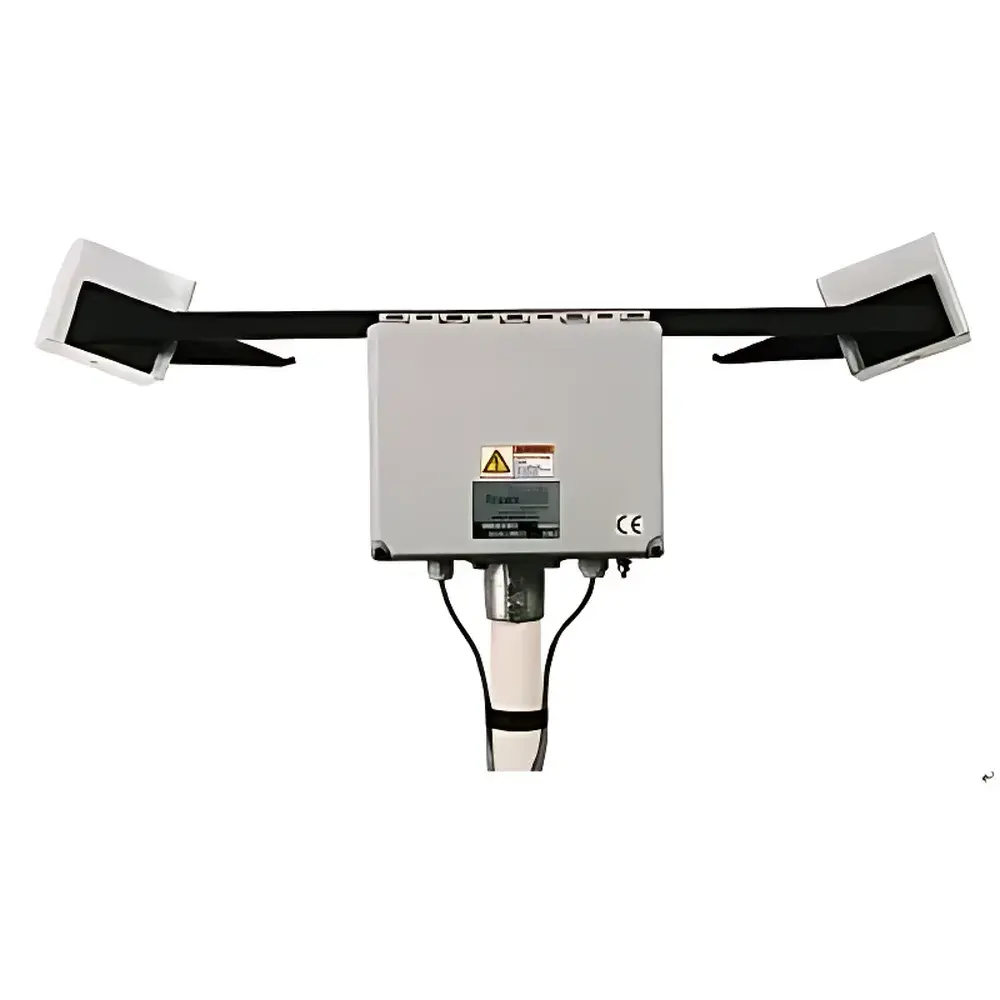
SVSI Sentry Forward-Scatter Atmospheric Visibility Sensor
| Origin | USA |
|---|---|
| Manufacturer Type | Distributor |
| Origin Category | Imported |
| Model | Sentry |
| Price | Upon Request |
Overview
The SVSI Sentry Forward-Scatter Atmospheric Visibility Sensor is an industrial-grade optical instrument engineered for continuous, real-time measurement of atmospheric extinction coefficient and meteorological optical range (MOR) in outdoor environmental monitoring applications. It operates on the well-established 42° forward-scatter principle—where an 880 nm infrared LED transmitter emits a collimated beam intersecting the receiver’s field of view at a precise 42° angle. The scattering volume formed at this intersection serves as the effective sampling region. Particulate matter (e.g., fog droplets, haze aerosols, dust, sea salt) within this volume attenuates the transmitted beam via Mie scattering and absorption; the receiver quantifies the scattered intensity reduction, enabling calculation of the extinction coefficient (σ, in M⁻¹) via calibrated photometric response. MOR (in meters or kilometers) is then derived using the Koschmieder equation: MOR = 3.912 / σ. This physics-based methodology complies with WMO Guide to Meteorological Instruments and Methods of Observation (CIMO Guide, Chapter 12) and supports alignment with ICAO Annex 3 and FAA Advisory Circular 150/5220-17B for aviation weather reporting.
Key Features
- Optimized 42° forward-scatter geometry validated by the U.S. Federal Aviation Administration (FAA) and National Weather Service (NWS) for high fidelity under low-visibility conditions
- Downward-tilted optical window design minimizes precipitation accumulation, dust deposition, and dew formation—significantly reducing maintenance frequency and drift due to window contamination
- Integrated anti-condensation heating hood (standard); optional intelligent thermostatically controlled heating available for sustained operation in sub-zero, high-humidity, or icing-prone environments
- Ruggedized aluminum housing rated IP66 (NEMA-4X), certified for continuous exposure to rain, snow, salt spray, and UV radiation
- Comprehensive electrical protection: transient voltage suppression (TVS) diodes and ferrite-core filtering on all power and signal lines to ensure immunity against ESD, lightning-induced surges, and electromagnetic interference (EMI) per IEC 61000-4 series standards
- Compact form factor (889 × 292 × 305 mm; 8 kg) with standardized 40 mm pole-mount flange and NPT cable gland for rapid deployment on towers, masts, or roadside gantries
Sample Compatibility & Compliance
The Sentry sensor is designed for unattended, long-term monitoring of ambient air containing hydrometeors (fog, drizzle, snow), anthropogenic aerosols (PM₂.₅, PM₁₀), volcanic ash, smoke, and marine aerosols. Its optical path remains insensitive to non-scattering gases (e.g., CO₂, O₃) and unaffected by background solar radiation due to narrow-band 880 nm detection and synchronous modulation. The instrument meets requirements for operational use in Class I meteorological observing systems per WMO Resolution 40 (Cg-16) and supports compliance with FAA Order 8500.1 (Aviation Weather Services) and EN 60529 (IP66). Data logging configurations may be configured to satisfy GLP/GMP audit trail requirements when integrated with compliant SCADA or data acquisition platforms.
Software & Data Management
The Sentry outputs analog (0–10 VDC standard; 0–5 VDC optional) and digital signals (ASCII protocol over RS-232, RS-422, or RS-485, selectable via DIP switch). All serial interfaces support Modbus RTU upon firmware configuration. Time-stamped visibility values (MOR), internal temperature, heater status, and diagnostic flags are transmitted at user-defined intervals (default: 1 Hz). When connected to a compliant data logger or cloud telemetry gateway, raw output supports traceable calibration records, automated fault alerts (e.g., heater failure, signal saturation), and historical trend analysis. Firmware updates and configuration changes are performed via terminal emulator or proprietary configuration utility—no physical access required post-installation.
Applications
- Airport surface visibility monitoring for Category I/II/III approach decision height validation
- Highway intelligent transportation systems (ITS) for dynamic variable message sign (VMS) activation and speed advisory logic
- Maritime navigation safety: port approach corridors, ferry terminals, offshore oil & gas platforms, lighthouses, and coastal fog warning networks
- National meteorological networks (e.g., ASOS, AWOS, MESONET) requiring WMO-compliant MOR reporting
- Automated foghorn control systems with programmable visibility thresholds
- Environmental research stations studying boundary layer aerosol dynamics and regional haze transport
FAQ
What is the measurement principle used by the Sentry sensor?
It employs calibrated 42° forward-scatter photometry at 880 nm to determine extinction coefficient, from which meteorological optical range (MOR) is calculated using the Koschmieder relationship.
Is field calibration required—and how often?
Yes; a full optical calibration is recommended every six months using the integrated field calibration kit. The procedure requires no disassembly and can be completed in ≤30 minutes onsite.
Can the Sentry operate reliably in freezing fog or rime ice conditions?
Yes—standard anti-condensation heating maintains optical window temperature above ambient dew point; optional intelligent heating extends functionality to sustained icing environments down to −40 °C.
What certifications does the Sentry hold for outdoor deployment?
IP66 (IEC 60529) and NEMA-4X enclosures; electrical design conforms to IEC 61000-4-2 (ESD), -4-4 (EFT), and -4-5 (surge) immunity standards.
Does the sensor support integration into existing SCADA or IoT infrastructure?
Yes—via RS-485 Modbus RTU or ASCII serial protocols, with configurable baud rates (up to 115.2 kbps) and framing options compatible with industry-standard PLCs and edge gateways.
Related Products







