
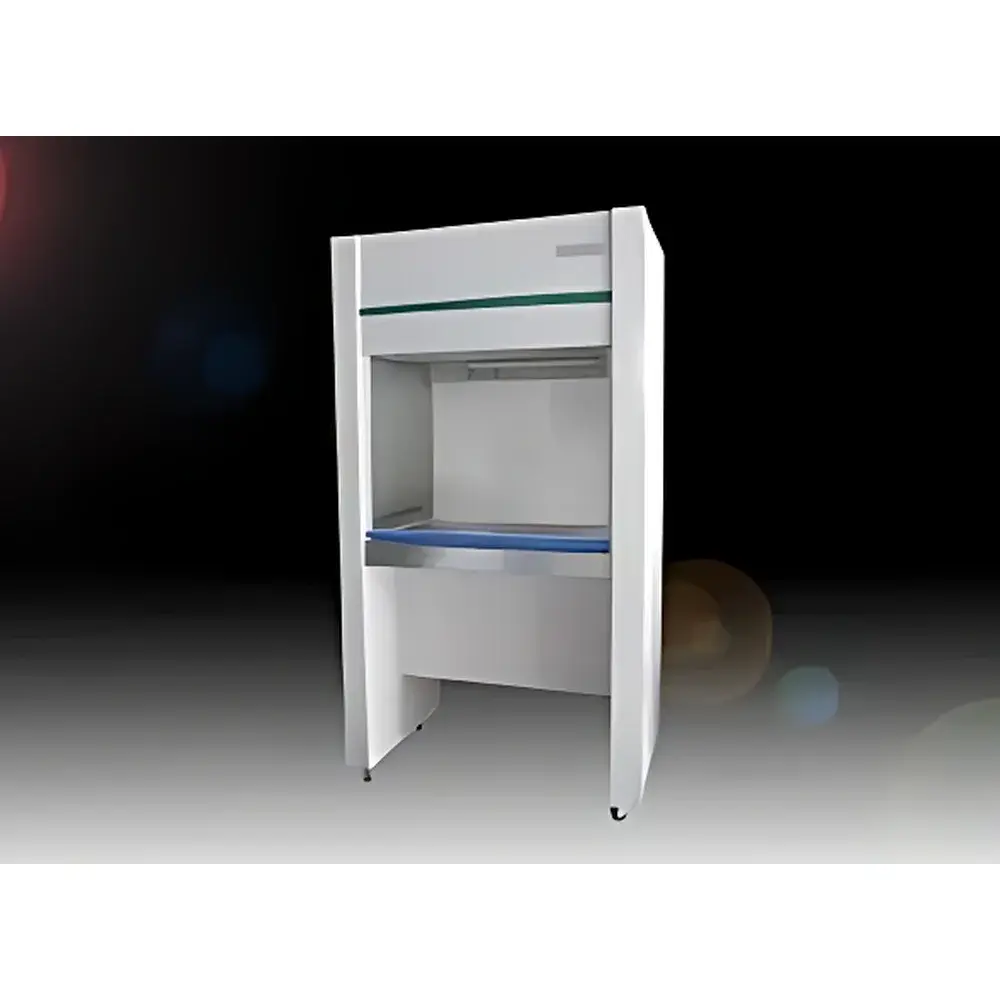
SW-CJ-1F Vertical Laminar Flow Clean Bench
| Origin | Shanghai, China |
|---|---|
| Manufacturer Type | Authorized Distributor |
| Origin Category | Domestic (PRC) |
| Model | SW-CJ-1F |
| Quotation | USD 1,350 (FOB Shanghai) |
| Instrument Category | Vertical Laminar Flow Clean Bench |
| Cleanliness Class | ISO Class 5 (equivalent to Fed. Std. 209E Class 100) @ ≥0.5 µm |
| Noise Level | ≤58 dB(A) |
| User Capacity | Single-operator, dual-access configuration |
| Airflow Pattern | Vertical downward laminar flow |
| Average Air Velocity | 0.3–0.6 m/s (adjustable) |
| Illumination | ≥300 lx |
| Vibration Half-Peak | ≤3 µm |
| Power Supply | AC 220 V / 50 Hz |
| Power Consumption | 0.4 kW |
| Work Area Dimensions (W×D×H) | 870 × 680 × 520 mm |
| Stainless Steel Work Surface | AISI 304 |
| Electrical Outlets | One 2 kW grounded socket (IEC 60320 C13), located within work chamber |
| Microbial Contamination | ≤0.5 CFU/plate·hour (90 mm Petri dish, settle plate method) |
Overview
The SW-CJ-1F Vertical Laminar Flow Clean Bench is an ISO Class 5-certified local containment device engineered for personnel- and product-protective operations in non-sterile but particle-controlled environments. It operates on the principle of vertical unidirectional laminar airflow: air is drawn through a pre-filter, conditioned via a high-efficiency particulate air (HEPA) filter (≥99.995% @ 0.3 µm), and delivered vertically downward across the work surface at a controlled, uniform velocity (0.3–0.6 m/s). This airflow architecture establishes a sterile barrier zone over the work area—effectively sweeping airborne particles, aerosols, and microorganisms away from the operator and sample zone. Unlike biological safety cabinets, the SW-CJ-1F does not recirculate air nor provide protection against hazardous biological agents; it is strictly intended for applications requiring particulate-free conditions—such as aseptic handling of non-pathogenic cultures, precision assembly of optical components, semiconductor prototyping, and formulation of non-hazardous pharmaceutical intermediates.
Key Features
- Vertically oriented HEPA-filtered laminar airflow ensures consistent, low-turbulence particle removal across the full 870 × 680 mm stainless steel (AISI 304) work surface.
- Adjustable multi-stage blower control system enables precise regulation of face velocity—maintaining optimal airflow performance under varying filter loading conditions and ambient pressure differentials.
- Integrated infrared remote control interface with front-panel status indicator LEDs provides hands-free operation and real-time visual feedback on fan speed, lighting, and system readiness.
- Sealed tempered glass sash with optimized vertical lift mechanism minimizes external cross-contamination while allowing ergonomic dual-side access for single-user workflows.
- Dedicated 2 kW IEC 60320 C13 power outlet embedded within the work chamber supports concurrent use of auxiliary instrumentation without cable clutter or outlet overload risks.
- Acoustically damped enclosure maintains operational noise ≤58 dB(A) at 1 m distance—compliant with ISO 7779 and EN ISO 3744 standards for laboratory equipment sound emission.
Sample Compatibility & Compliance
The SW-CJ-1F is validated for use with non-volatile, non-toxic, and non-aerosol-generating materials. It is suitable for cell culture media preparation (non-transfection grade), reagent aliquoting, optical lens cleaning, printed circuit board inspection, and packaging of Class I medical devices. The unit meets ISO 14644-1:2015 (Class 5), Fed. Std. 209E (Class 100), and GB/T 16292–2010 (Chinese national standard for clean bench testing). Microbiological validation follows the settle plate method per ISO 14698-1, yielding ≤0.5 CFU/plate·hour using 90 mm TSA plates exposed for 1 hour. Structural design complies with IEC 61010-1:2010 for electrical safety in laboratory equipment. Note: This device is not certified for biosafety level 2 (BSL-2) or chemical fume containment; users must conduct site-specific risk assessment prior to deployment.
Software & Data Management
The SW-CJ-1F operates as a standalone electromechanical system with no embedded firmware, network interface, or data logging capability. All operational parameters—including fan speed, illumination state, and power status—are managed via physical push-button controls and IR remote inputs. For laboratories operating under GLP or GMP frameworks, manual logbook entries are recommended for daily operational verification (e.g., airflow velocity check with calibrated anemometer, HEPA integrity test records, and visual inspection of sash seal integrity). Optional third-party environmental monitoring systems (e.g., Vaisala viewLinc or SensiML) may be integrated externally via analog 4–20 mA outputs (available upon request with OEM upgrade kit).
Applications
- Aseptic transfer of bacterial and fungal cultures in academic microbiology labs.
- Preparation of cell culture media and sterile filtration of buffers in biotech R&D settings.
- Assembly and alignment of photonic components where sub-micron particulate contamination compromises optical coupling efficiency.
- Quality control inspection of microelectronics substrates and MEMS devices.
- Non-sterile compounding of excipients and APIs in pharmaceutical development labs adhering to USP guidelines.
- Handling of sensitive calibration standards in metrology laboratories requiring ISO Class 5 background environments.
FAQ
Does the SW-CJ-1F provide protection against biohazards or toxic vapors?
No. It is a clean bench—not a biosafety cabinet or fume hood—and offers no personnel or environmental protection from biological, chemical, or radiological hazards.
What is the recommended HEPA filter replacement interval?
Filter life depends on ambient air quality and usage frequency; typical service interval is 12–18 months. Pressure differential monitoring across the filter is required per ISO 14644-3 Annex B.
Can this unit be installed in a room without HVAC supply air?
Yes—but ambient room air must meet ISO Class 8 (Fed. Std. 209E Class 100,000) or better to prevent premature HEPA loading. Unconditioned spaces require supplemental particulate filtration upstream.
Is the stainless steel work surface electropolished?
Standard configuration uses mechanically polished AISI 304 stainless steel; electropolished finish (Ra ≤ 0.4 µm) is available as a factory option (model suffix -EP).
Does the unit comply with FDA 21 CFR Part 11 requirements?
Not applicable—the device contains no electronic data capture, audit trail, or user authentication subsystems. It is classified as a Class I general-purpose laboratory apparatus under FDA regulation.



