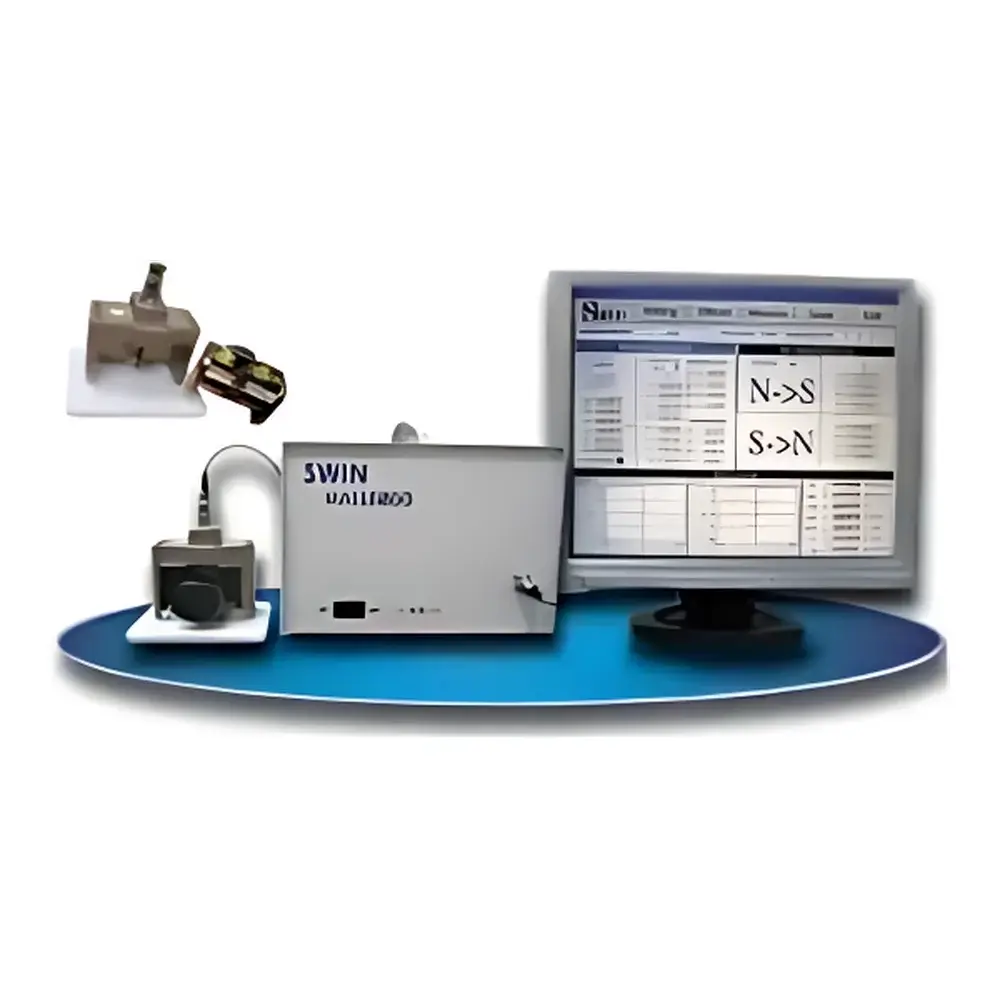
SWIN HL8800 Hall Effect Measurement System
| Brand | SWIN |
|---|---|
| Origin | Taiwan |
| Model | HL8800 |
| Operating Temperature | Ambient & Liquid Nitrogen (77 K) |
| Magnetic Field Strength | 0.65 T / 1 T (selectable) |
| Constant Current Source Range | 2 nA – 100 mA |
| Voltage Measurement Range | ±2000 V |
| Maximum Applied Voltage | 200 V |
| Carrier Concentration Range | 1 × 10⁷ – 1 × 10²¹ cm⁻³ |
| Mobility Range | 1 – 1 × 10⁷ cm²/(V·s) |
| Resistivity Range | 1 × 10⁻⁶ – 1 × 10⁷ Ω·cm |
| Sample Compatibility | Bulk and thin-film semiconductors (n- and p-type) |
| Hall Coefficient Accuracy | < ±0.5% typical |
| Voltage Resolution | ≤1 nV |
| Current Resolution | ≤2 nA |
| Dimensions (W × D × H) | 260 × 220 × 180 mm |
| Weight | 6 kg |
Overview
The SWIN HL8800 Hall Effect Measurement System is a precision-engineered, dual-temperature (ambient and 77 K liquid nitrogen) instrument designed for quantitative characterization of semiconductor electronic properties using the van der Pauw method. It operates on the physical principle of the Hall effect—where a transverse voltage develops across a current-carrying conductor under an applied perpendicular magnetic field—to extract fundamental transport parameters including bulk and sheet carrier concentration, Hall mobility, resistivity, Hall coefficient, and semiconductor type (n or p). Engineered for reproducibility in academic research labs, R&D centers, and semiconductor process development environments, the HL8800 delivers traceable measurements compliant with ASTM F76–22 (Standard Test Method for Measuring Resistivity of Silicon Wafers by the Four-Point Probe Method) and ISO/IEC 17025–2017 requirements for measurement uncertainty management. Its compact benchtop architecture supports rapid deployment in controlled cleanroom or teaching lab settings without requiring external cryostat integration.
Key Features
- High-stability constant-current source with programmable output from 2 nA to 100 mA—enabling accurate characterization of semi-insulating materials (e.g., GaN substrates, SiC wafers) and low-conductivity films.
- Ultra-low-noise voltmeter with ±2000 V range and sub-nanovolt resolution (≤1 nV), optimized for both high-resistance bulk samples and low-resistance epitaxial layers (e.g., AlGaN/GaN HEMT channels).
- Integrated dual-field electromagnet system offering selectable 0.65 T and 1 T configurations—calibrated and certified per IEC 61000-4-8 for magnetic field uniformity (< ±1.5% over 10 mm Ø sample area).
- Proprietary spring-loaded four-point probe fixture eliminates conventional Hall bar patterning; supports direct measurement of as-grown wafers, sputtered films, MBE/MOCVD epitaxial layers, and flexible substrates without lithographic processing.
- Real-time I–V curve acquisition across all four van der Pauw contacts (A–B, B–C, C–D, D–A) to evaluate ohmic contact quality prior to Hall analysis—critical for validating device-grade material interfaces.
- Single-screen GUI with embedded calculation engine: all user inputs (magnetic field value, current magnitude, temperature mode, geometry correction factor) are entered on one interface; results—including carrier type, bulk/sheet concentration, mobility, resistivity, and Hall coefficient—are computed and displayed simultaneously with uncertainty propagation.
Sample Compatibility & Compliance
The HL8800 accommodates rigid and flexible semiconductor specimens up to 50 mm in diameter, including Si, Ge, SiC, GaAs, InP, GaN, ZnO, SiGe, and InGaAs—both n-type and p-type, bulk crystals, polished wafers, and sputtered or epitaxially grown thin films (≥10 nm). Its van der Pauw-compatible fixture satisfies ASTM F1529–21 (Standard Guide for Electrical Characterization of Semiconductor Materials Using Van der Pauw Geometry) and supports GLP-compliant workflows via optional audit-trail logging (21 CFR Part 11–ready configuration available). All electrical calibrations are NIST-traceable; magnetic field calibration certificates are supplied with each system.
Software & Data Management
The HL8800 Control Suite runs on Windows 10/11 (64-bit) and provides export-ready data in CSV, TXT, and MATLAB .mat formats. Raw voltage/current/time stamps are logged at ≥1 kHz sampling rate during sweep sequences. The software includes built-in statistical analysis tools for repeatability assessment (3σ standard deviation reporting per parameter), batch processing for multi-sample comparison, and customizable report templates aligned with internal QA documentation standards. Optional networked license enables centralized instrument monitoring and remote data archiving via secure SFTP or local NAS integration.
Applications
- Process qualification of LED epiwafers: quantifying two-dimensional electron gas (2DEG) density and mobility in AlGaN/GaN HEMT heterostructures.
- Photovoltaic R&D: correlating carrier lifetime and doping uniformity in perovskite and silicon solar cell absorber layers.
- Compound semiconductor foundry support: monitoring dopant activation efficiency across SiC power device wafers pre- and post-annealing.
- Academic teaching labs: hands-on demonstration of quantum transport phenomena, including sign reversal of Hall coefficient in degenerate semiconductors.
- Failure analysis: identifying interfacial charge trapping or compensation effects in gate dielectric stacks via temperature-dependent Hall mobility extraction.
FAQ
Does the HL8800 support low-temperature measurements below 77 K?
No—the system is configured for ambient and liquid nitrogen (77 K) operation only. Cryogenic stages for <40 K operation require third-party integration and are not supported out-of-the-box.
Can the HL8800 measure insulating oxides like Al₂O₃ or HfO₂?
Not directly: the instrument requires measurable conduction (resistivity ≤10⁷ Ω·cm). For highly resistive dielectrics, supplementary leakage current analysis or impedance spectroscopy is recommended.
Is the van der Pauw correction factor automatically applied?
Yes—the software computes geometry correction based on user-input sample thickness and measured contact resistance ratios, adhering to the iterative algorithm defined in ASTM F76 Annex A3.
What calibration standards are included with shipment?
Each unit ships with a NIST-traceable 1 kΩ precision resistor, a calibrated Hall sensor for magnetic field verification, and a Si reference wafer with certified carrier concentration (±3% uncertainty).
Is firmware upgrade support provided after purchase?
Yes—SWIN offers free firmware updates for the lifetime of the instrument, delivered via secure download portal with version-controlled release notes and validation test reports.