
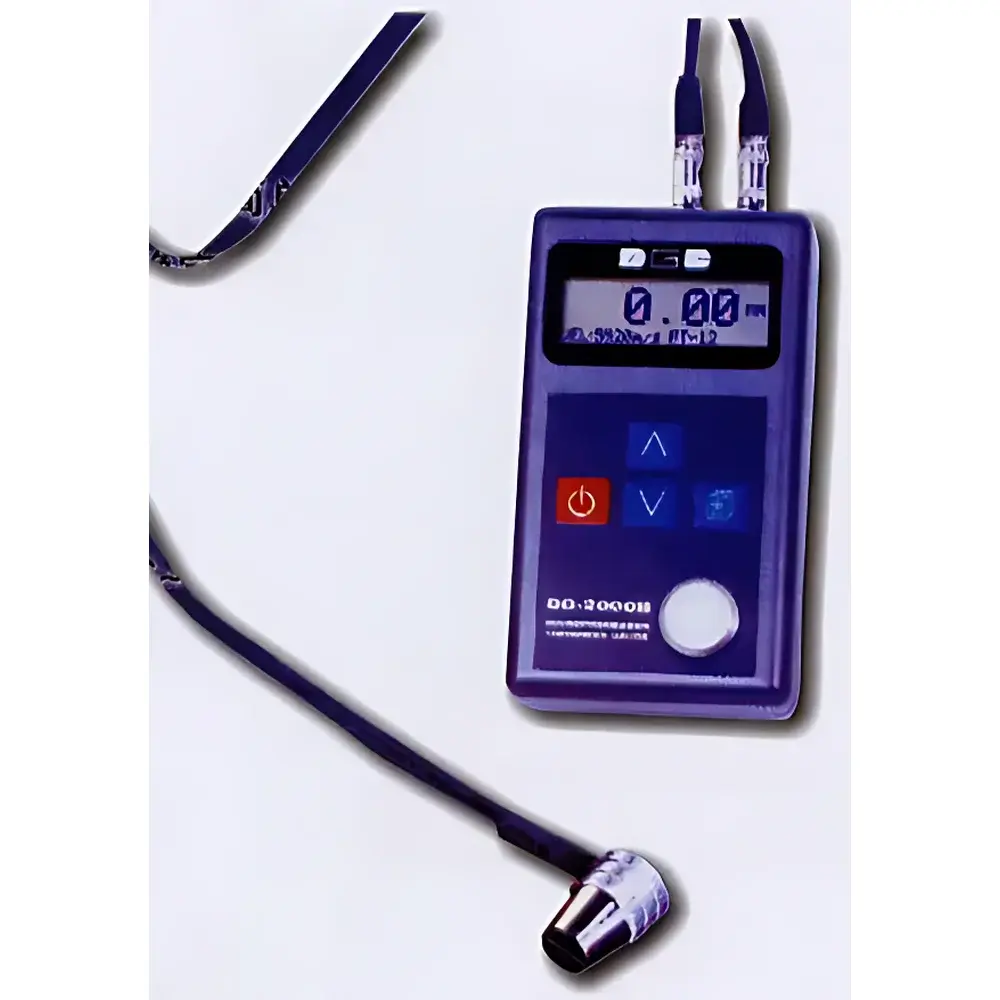
SYCS DC-1000B Ultrasonic Thickness Gauge
| Brand | SYCS |
|---|---|
| Model | DC-1000B |
| Measurement Range | 0.8–200 mm |
| Display Resolution | 0.1 mm |
| Sound Velocity Range | 1000–9999 m/s |
| Dimensions | 108 × 61 × 25 mm |
| Power Supply | 220 V, 50 Hz |
| Display | Backlit LCD with Chinese menu |
| Auto Power-Off | Yes |
Overview
The SYCS DC-1000B Ultrasonic Thickness Gauge is a precision handheld instrument engineered for non-destructive thickness measurement of metallic and non-metallic materials using pulse-echo ultrasonic principle. It operates by transmitting a high-frequency ultrasonic pulse (typically 1–10 MHz) through the test material via a piezoelectric transducer; the time-of-flight between the initial pulse and the echo reflected from the back surface is measured and converted into thickness based on the material’s acoustic velocity. This method enables accurate, contact-based evaluation of wall thickness without requiring access to both sides of the specimen—making it ideal for in-service inspection of pipelines, pressure vessels, storage tanks, ship hulls, and structural steel components. Designed for field and workshop use, the DC-1000B features a robust industrial housing, ergonomic grip, and intuitive interface optimized for technicians performing routine QA/QC, preventive maintenance, or corrosion monitoring per ASTM E797 and ISO 2400 standards.
Key Features
- Pulse-echo ultrasonic measurement with dual-gain adjustment for optimal signal-to-noise ratio across varying surface conditions and material types
- Backlit LCD display with Chinese-language menu system—enabling rapid navigation without external documentation
- Auto power-off function (configurable delay) to extend battery life during intermittent use
- Real-time sound velocity calibration capability: users may input known velocity values or perform two-point calibration using reference blocks of known thickness
- Compact, lightweight design (108 × 61 × 25 mm; <200 g) with IP54-rated enclosure for resistance to dust and light splashing water
- Integrated data hold and min/max tracking functions for dynamic scanning applications
Sample Compatibility & Compliance
The DC-1000B supports thickness measurement on homogeneous, isotropic materials including carbon steel, stainless steel, aluminum, copper, brass, cast iron, plastics (e.g., PVC, PE), glass, and ceramics—provided the material exhibits sufficient acoustic coupling and minimal internal scattering. Surface preparation requirements include removal of heavy rust, paint layers >0.1 mm, or loose scale prior to measurement; couplant (e.g., glycerin or specialized ultrasonic gel) must be applied between transducer and test surface to ensure efficient energy transfer. The instrument complies with general safety and electromagnetic compatibility requirements per IEC 61326-1 (industrial environment). While not certified for hazardous area operation, its low-power electronics and absence of intrinsic ignition sources render it suitable for most non-explosive industrial settings. For regulated industries (e.g., oil & gas, power generation), measurement records may be documented manually to support API RP 570 or EN 15317 traceability frameworks.
Software & Data Management
The DC-1000B operates as a standalone field instrument without onboard memory or PC connectivity—consistent with its role as a dedicated, ruggedized thickness verification tool. All measurements are displayed in real time and require manual transcription into inspection logs, spreadsheets, or CMMS platforms. This architecture eliminates firmware update dependencies, reduces cybersecurity exposure, and ensures long-term operational consistency—particularly valuable in environments where IT policy restricts peripheral device integration. For organizations requiring digital recordkeeping, third-party data capture solutions (e.g., mobile apps with camera-assisted annotation or Bluetooth-enabled logging adapters) may be deployed externally, though SYCS does not supply or validate such integrations. The device supports GLP-aligned workflows when used with controlled procedures, calibrated reference standards, and documented operator training.
Applications
- Corrosion mapping of piping systems in chemical processing plants and refineries
- In-service wall thickness assessment of boiler tubes and heat exchanger shells
- Quality assurance during fabrication of welded joints and rolled plate components
- Verification of coating-substrate thickness in duplex stainless steel cladding
- Monitoring erosion wear in centrifugal pump casings and impellers
- Educational laboratory use for demonstrating ultrasonic propagation principles and material property relationships
FAQ
What materials can be measured with the DC-1000B?
It measures thickness of uniform, solid materials that transmit ultrasound efficiently—including metals, rigid plastics, glass, and ceramics. Porous, fibrous, or highly attenuative materials (e.g., concrete, rubber, composites with voids) are generally unsuitable.
Is calibration required before each use?
Daily verification using a certified thickness standard (e.g., steel block of known dimension) is recommended. Full calibration—performed by an accredited lab—is advised annually or after mechanical shock or extreme environmental exposure.
Can the instrument measure through paint or coatings?
No. Paint, enamel, or thermal spray coatings must be removed at the measurement point unless their thickness and acoustic impedance are precisely characterized and compensated—a capability not supported by the DC-1000B.
Does it meet FDA or ISO 13485 requirements for medical device manufacturing?
The DC-1000B is not designed or validated for medical device production environments. Its specifications align with industrial NDT practice, not regulatory-grade metrology traceable to NIST or UKAS.
What transducer options are compatible?
The DC-1000B uses a standard 5 MHz single-element contact transducer (included). Optional probes—including high-temperature (up to 300 °C), small-diameter (for curved surfaces), and delay-line types—may be interfaced if electrically matched and mechanically mounted per SYCS mechanical interface specifications.
Related Products



