
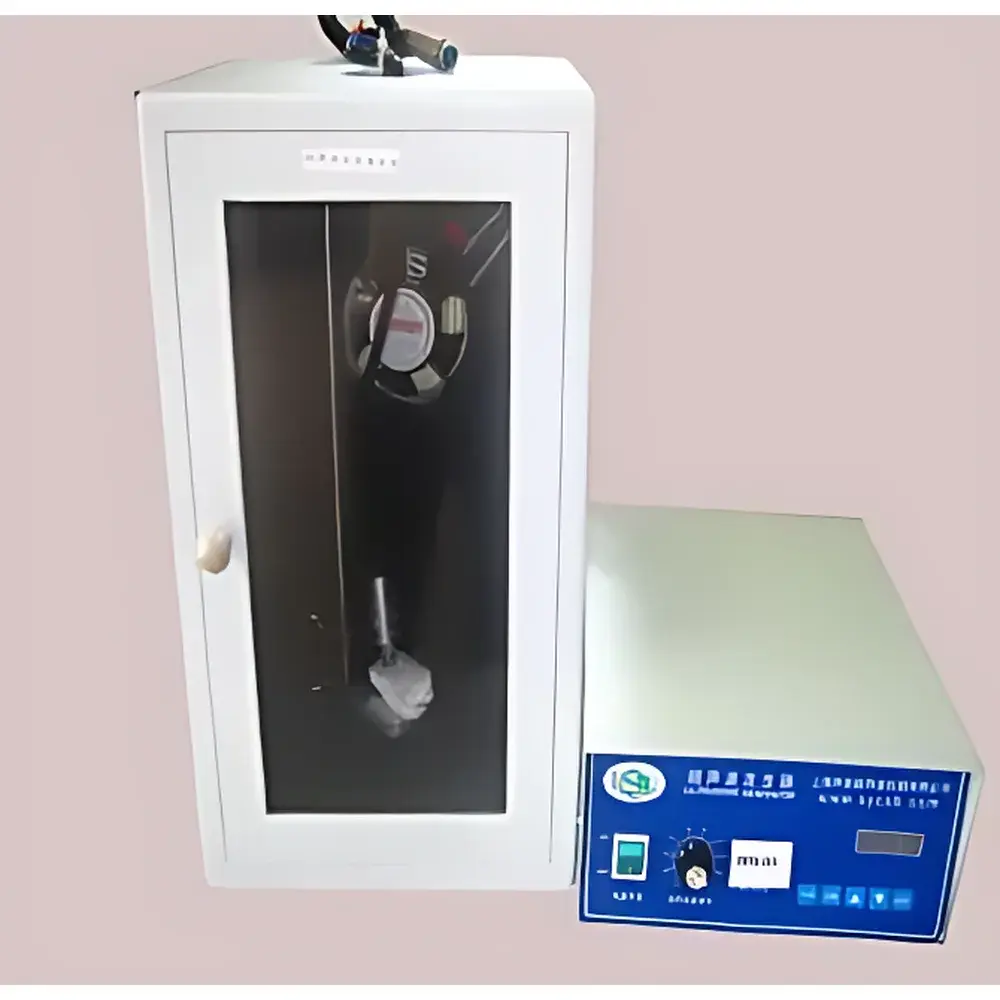
SYCS SCQ-1200F High-Power Ultrasonic Cell Disruptor
| Brand | SYCS |
|---|---|
| Origin | Shanghai, China |
| Model | SCQ-1200F |
| Ultrasonic Power Output | 1200 W |
| Frequency | 20 kHz / 25 kHz (switchable) |
| Probe Tip Diameters Available | 5–30 mm (selectable) |
| Sample Volume Range | 0.5–1200 mL |
| Timer Range | 1 s to 9 h 59 min 59 s (programmable) |
| Warranty | 1 year (main unit), 6 months (ultrasonic probe) |
Overview
The SYCS SCQ-1200F is a high-power benchtop ultrasonic cell disruptor engineered for reproducible, scalable lysis of biological materials via controlled acoustic cavitation. It operates on the principle of piezoelectric transduction, converting electrical energy into high-frequency mechanical vibrations (20 or 25 kHz) transmitted through a titanium alloy probe into liquid media. This generates transient microcavities that collapse violently—producing localized shockwaves, shear forces, and extreme temperature/pressure gradients—resulting in efficient disruption of cell membranes, organelles, and microbial structures without significant thermal denaturation when operated with appropriate duty cycles and cooling. Designed for laboratory-scale R&D and pilot production workflows, the SCQ-1200F supports both continuous and pulsed sonication modes, enabling precise control over energy input to preserve labile biomolecules such as enzymes, nucleic acids, and membrane proteins.
Key Features
- 1200 W nominal ultrasonic power output with real-time amplitude regulation (0–100% in 1% increments), ensuring consistent energy delivery across variable sample volumes and viscosities.
- Dual-frequency operation (20 kHz / 25 kHz) optimized for different applications: 20 kHz delivers higher cavitation intensity for robust tissue or spore lysis; 25 kHz offers finer dispersion and reduced foaming for sensitive protein or exosome isolation.
- Interchangeable titanium alloy probes with standardized tip diameters (5, 8, 10, 15, 20, 25, and 30 mm), each calibrated for impedance matching and thermal stability—enabling scalability from microliter lysates to liter-scale homogenization.
- Precision digital timer with resolution down to 1 second and maximum duration of 9 hours 59 minutes 59 seconds, supporting complex multi-step protocols with automatic start/stop and pause functions.
- Integrated safety interlocks including overtemperature protection, overload detection, and probe detachment sensing to prevent transducer damage during operation.
- Modular design compatible with optional external cooling circulators (via standard 6 mm quick-connect ports) and acoustic isolation enclosures (sold separately) meeting ISO 140-3 sound pressure level requirements.
Sample Compatibility & Compliance
The SCQ-1200F accommodates a broad range of biological and non-biological matrices—including mammalian and plant tissues, bacterial cultures (E. coli, Bacillus spp.), yeast, spores, biofilms, nanomaterial dispersions, and polymer emulsions. Its open-bath and probe-based architecture allows direct immersion in aqueous, organic, or mixed-phase solvents (e.g., RIPA, Trizol, ethanol/water mixtures). All wetted components comply with USP Class VI biocompatibility standards. The instrument meets IEC 61000-6-3 (EMC emission) and IEC 61000-6-2 (immunity) requirements. When used in regulated environments, it supports GLP-compliant documentation through external data logging systems; full 21 CFR Part 11 compliance requires integration with validated third-party software platforms for electronic signatures and audit trails.
Software & Data Management
The SCQ-1200F operates via an embedded 4.3-inch capacitive touchscreen interface with intuitive icon-driven navigation and multilingual support (English, German, French, Japanese, Chinese). All operational parameters—including amplitude %, frequency selection, elapsed time, remaining time, and real-time power feedback—are logged internally with timestamping (up to 10,000 cycle records). Data export is supported via USB 2.0 port (CSV format) for traceability and integration into LIMS or ELN systems. Optional PC-based SYCS ControlSuite v3.2 provides remote monitoring, protocol library management, automated report generation (PDF/Excel), and statistical process control (SPC) charting for batch consistency validation.
Applications
- Cell lysis and subcellular fractionation in proteomics and transcriptomics workflows, including nuclear extraction and mitochondrial isolation.
- Preparation of antigenic lysates for monoclonal antibody development and vaccine research.
- Nanoparticle synthesis and stabilization—e.g., liposome formation, metal oxide dispersion, and graphene exfoliation.
- Enhancement of enzymatic digestion efficiency in FFPE tissue processing and chromatin immunoprecipitation (ChIP).
- Rapid solvent extraction of secondary metabolites (alkaloids, flavonoids, terpenes) from botanical matrices under ambient or chilled conditions.
- Deagglomeration of ceramic, catalyst, and battery electrode slurries for rheological and electrochemical characterization.
FAQ
What is the recommended maintenance interval for the ultrasonic probe?
Probes should be inspected visually before each use for pitting or cracking. Titanium probes require periodic cleaning with acetone or isopropanol followed by ultrasonic bath decontamination. Under typical usage (≤4 h/day), annual calibration verification against reference load is advised.
Can the SCQ-1200F be integrated into automated liquid handling platforms?
Yes—RS-232 and TTL-level digital I/O ports enable synchronization with robotic arms and process controllers for unattended batch processing. Custom API integration is available upon request.
Is temperature control built-in?
No internal heating or cooling elements are included; however, the unit features dual 6 mm coolant ports compatible with external recirculating chillers (recommended for >5 min continuous operation or heat-sensitive samples).
How does probe diameter affect lysis efficiency?
Smaller tips (5–10 mm) generate higher localized energy density suitable for small-volume, high-yield nucleic acid recovery; larger tips (20–30 mm) distribute energy more broadly for viscous suspensions or large-volume homogenization with reduced shear stress per unit volume.
Does SYCS provide application-specific validation protocols?
Yes—application notes covering E. coli lysis optimization, exosome isolation, and nanoparticle dispersion are available upon registration at sy-cs.com/resources. GMP-aligned validation templates (IQ/OQ/PQ) can be licensed separately.



