
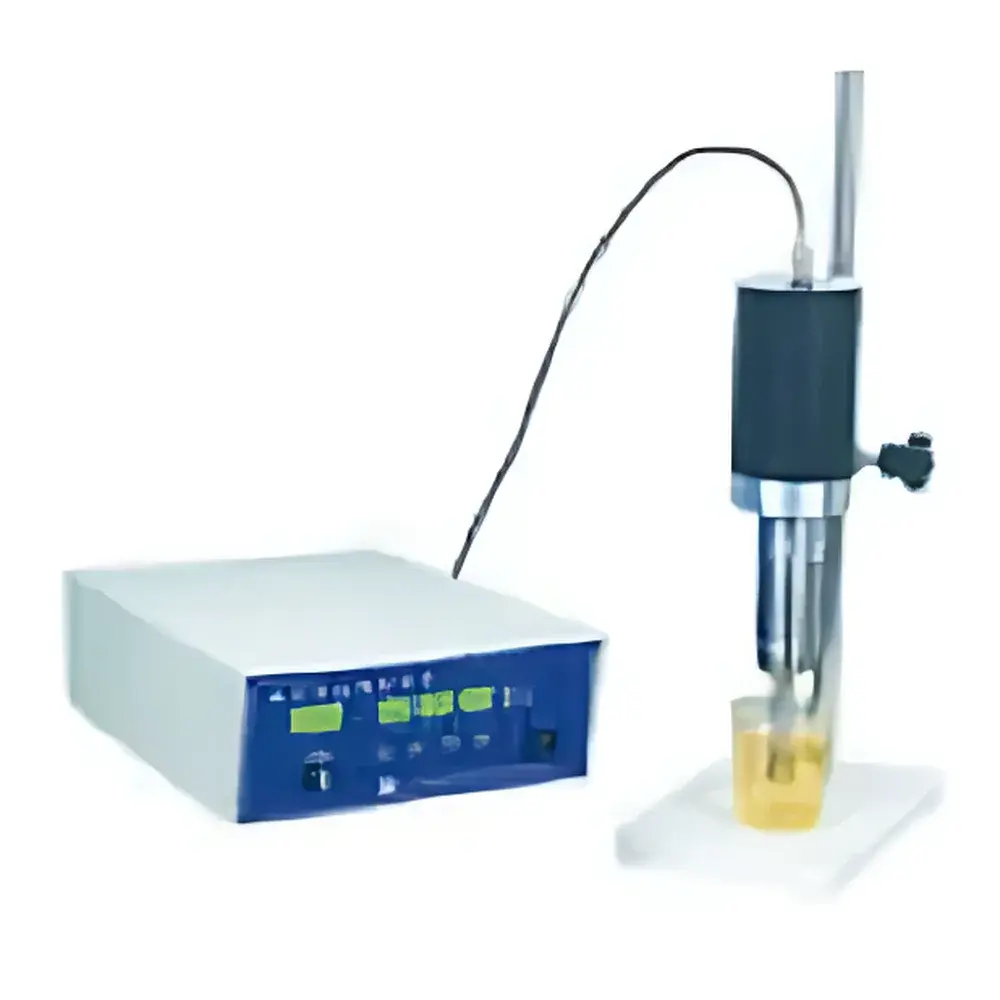
SYCS SCQ-250F Ultrasonic Cell Disruptor
| Brand | SYCS |
|---|---|
| Origin | Shanghai, China |
| Model | SCQ-250F |
| Output Power | 250 W |
| Frequency | 20 kHz or 25 kHz (selectable) |
| Probe Tip Diameters Available | 5 mm, 8 mm, 10 mm, 15 mm, 20 mm, 25 mm, 30 mm |
| Sample Volume Range | 0.5–250 mL |
| Timer Range | 1 s to 9 h 59 min 59 s (user-programmable) |
| Warranty | 1 year on main unit |
Overview
The SYCS SCQ-250F Ultrasonic Cell Disruptor is a benchtop high-intensity ultrasonic processor engineered for reliable and reproducible cell lysis, tissue homogenization, and nanoscale dispersion in life science and bioprocessing laboratories. It operates on the principle of acoustic cavitation: high-frequency mechanical vibrations (20 or 25 kHz) are transmitted through a titanium alloy probe into liquid samples, generating transient microbubbles that collapse violently—producing localized shockwaves, shear forces, and extreme temperature/pressure gradients. This physical mechanism enables efficient disruption of membranes and cellular structures without chemical additives or thermal degradation, making it suitable for sensitive biomolecules such as proteins, nucleic acids, and organelles. Designed for routine use in academic research, pharmaceutical development, and QC labs, the SCQ-250F delivers consistent energy delivery across variable sample volumes—from microliter-scale lysates to 250 mL reaction batches—while maintaining structural integrity under continuous operation.
Key Features
- Adjustable output power (0–100% in 1% increments) ensures precise control over sonication intensity for delicate or robust samples.
- Dual-frequency operation (20 kHz / 25 kHz) allows optimization for different sample viscosities and particle sizes—20 kHz favors higher cavitation energy for tough tissues; 25 kHz offers finer control for low-volume, heat-sensitive applications.
- Interchangeable titanium alloy probes with standardized tip diameters (5–30 mm) enable scalability from microcentrifuge tubes to beakers, supporting both focused energy delivery and bulk processing.
- Programmable digital timer with resolution down to 1 second supports complex protocols—including pulse mode (on/off cycling), multi-step sequences, and long-duration extractions up to 9 hours 59 minutes 59 seconds.
- Integrated safety interlock prevents operation without probe immersion or lid closure; real-time overload protection safeguards transducer and generator electronics.
- Compact, corrosion-resistant housing with integrated cooling fan ensures stable performance during extended runs; optional acoustic isolation chamber (600 mm wide) reduces ambient noise and contains aerosols.
Sample Compatibility & Compliance
The SCQ-250F accommodates diverse biological and material systems: mammalian and plant cells, bacterial cultures (including Gram-positive strains), spores, yeast, subcellular fractions, and synthetic nanoparticles. It supports preparation of lysates compliant with downstream workflows including Western blotting, qPCR, RNA-seq library construction, and protein purification. While not certified for GMP manufacturing environments, its operational repeatability aligns with GLP documentation requirements when paired with validated SOPs. The device meets CE electromagnetic compatibility (EMC) standards (EN 61326-1) and conforms to IEC 61000-4 series immunity testing protocols. For regulated applications involving human-derived materials, users must implement additional biosafety controls per ISO 22196 and CLSI M29-A3 guidelines.
Software & Data Management
The SCQ-250F operates via an embedded microcontroller interface with non-volatile memory for storing up to 10 user-defined protocols. All parameter settings—including amplitude, duration, pulse ratio, and frequency selection—are logged with timestamped metadata in internal memory. Optional RS-232 or USB connectivity enables integration with LIMS or ELN platforms for automated audit trail generation. Though the base model does not include FDA 21 CFR Part 11-compliant electronic signatures, configuration files can be exported for external validation and version-controlled archiving. Data export formats include CSV and plain-text logs compatible with Python-based analysis pipelines (e.g., Pandas, SciPy) used in method development and DOE studies.
Applications
- Cell lysis for total protein or genomic DNA extraction from cultured cells, blood, or solid tissues.
- Preparation of subcellular fractions (mitochondria, nuclei) with minimal contamination.
- Nanoparticle dispersion and deagglomeration of metal oxides, carbon nanotubes, and liposomal formulations.
- Accelerated solvent extraction of phytochemicals, alkaloids, and polyphenols from botanical matrices.
- Emulsification of immiscible liquids (e.g., oil-in-water nanoemulsions for drug delivery).
- Surface cleaning and degassing of microfluidic devices prior to bonding or functionalization.
- Inactivation of endotoxins and viral particles in buffer solutions for sterile filtration validation.
FAQ
What is the recommended maintenance schedule for the SCQ-250F?
Probe tips should be inspected visually before each use for pitting or cracking; clean with ethanol after every session. Replace probes every 6–12 months depending on usage frequency and sample abrasiveness. Transducer coupling grease should be reapplied annually.
Can the SCQ-250F be used in cold rooms or with chilled samples?
Yes—operational temperature range is 5–40°C ambient. For cryogenic applications, use pre-chilled probes and limit continuous duty cycle to ≤30% to prevent condensation-induced electrical hazards.
Is probe calibration traceable to NIST standards?
No—amplitude calibration is factory-set and verified using laser vibrometry against ISO 18437-1 reference methods. Users may perform relative amplitude verification using calorimetric assays per ASTM E2433.
How does pulse mode improve sample integrity?
Pulse mode (e.g., 5 s ON / 5 s OFF) dissipates heat between cycles, reducing thermal denaturation and free radical formation—critical for preserving enzyme activity or native protein conformation.
Does the SCQ-250F support remote monitoring or IoT integration?
Not natively—but third-party hardware gateways (e.g., Modbus-to-MQTT bridges) can interface with the RS-232 port for cloud-based telemetry and predictive maintenance alerts.




