
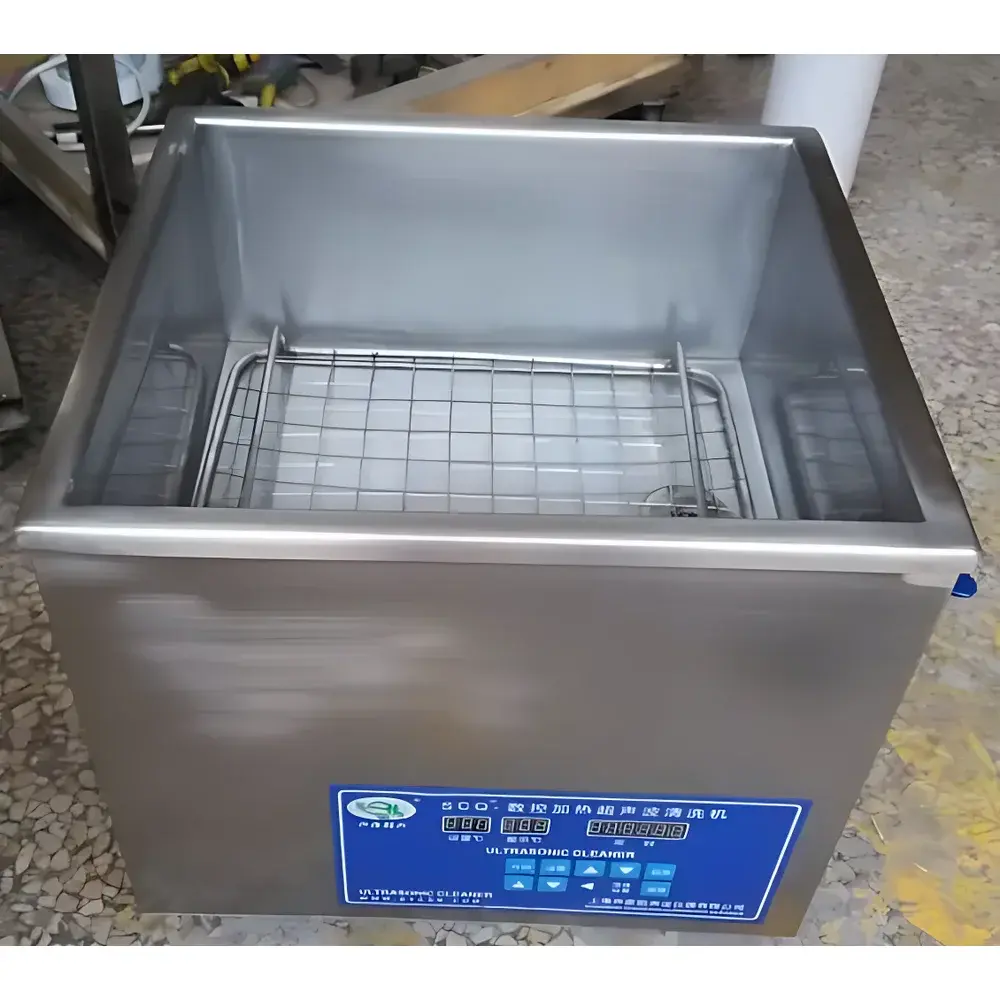
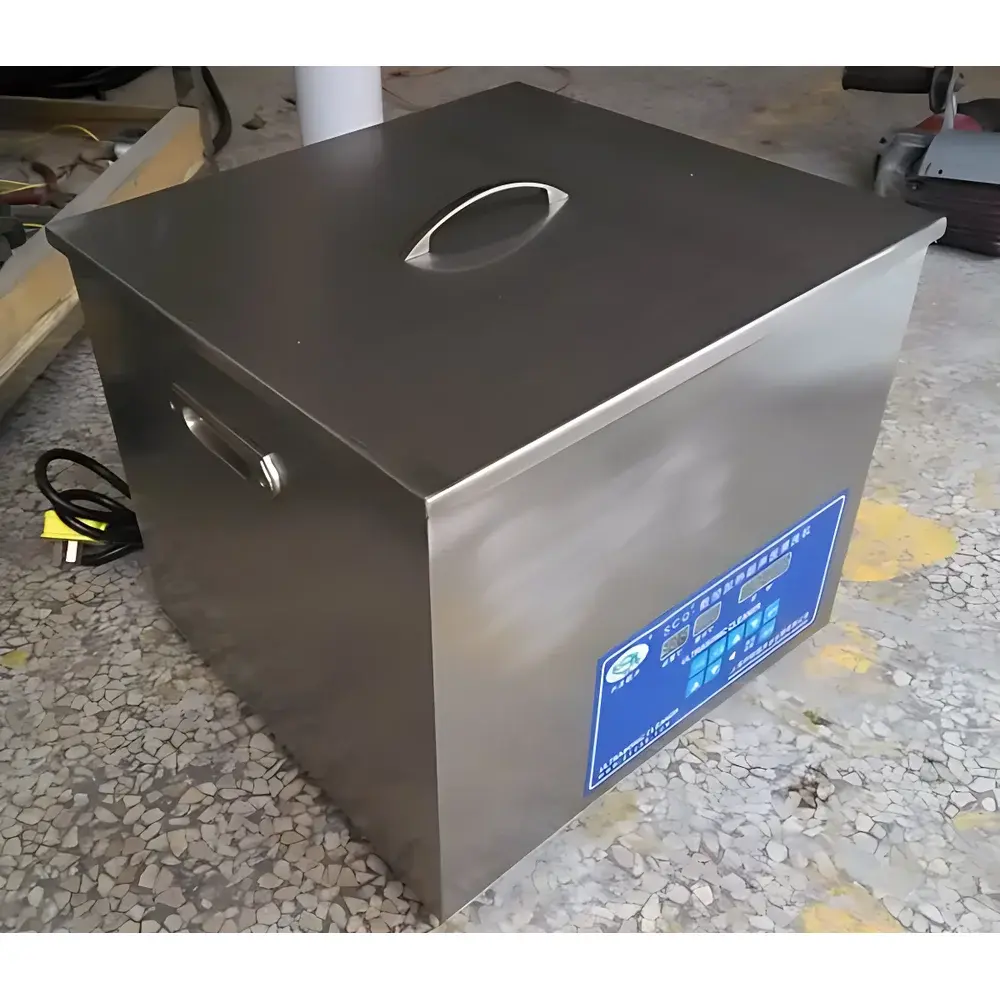
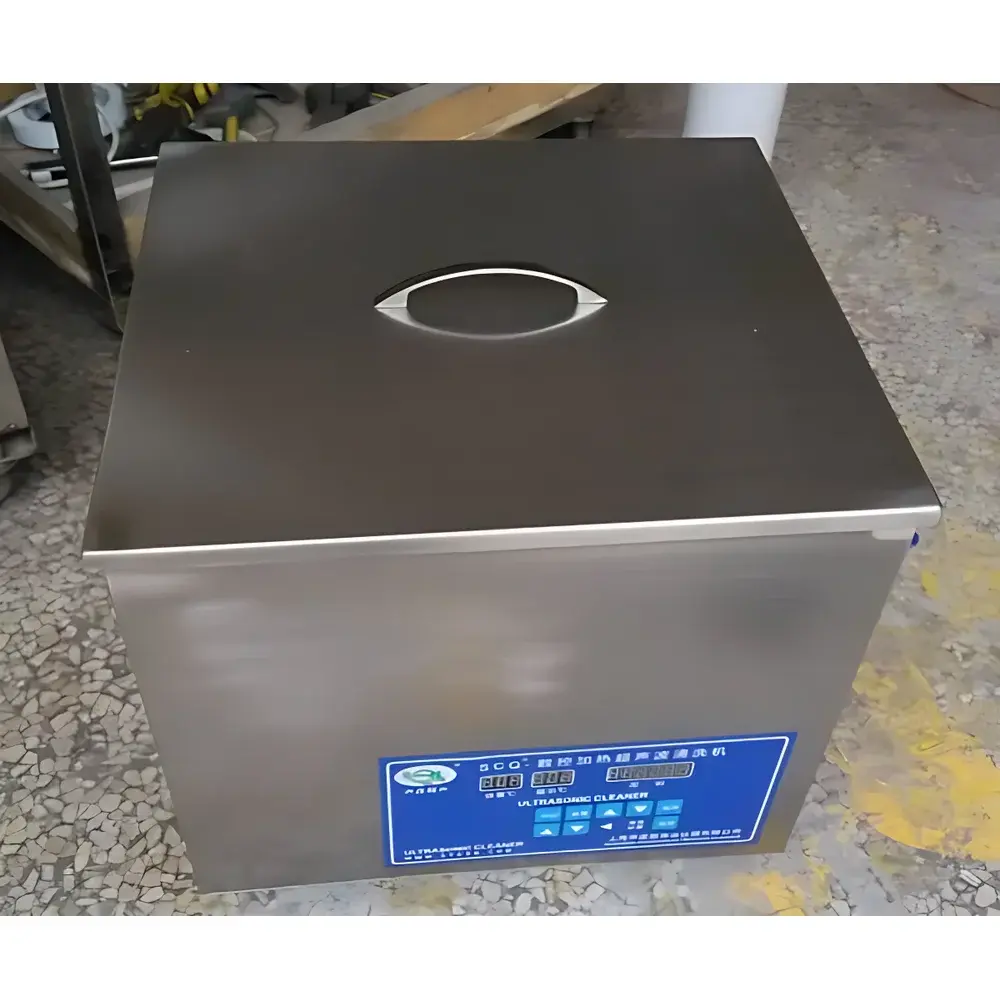
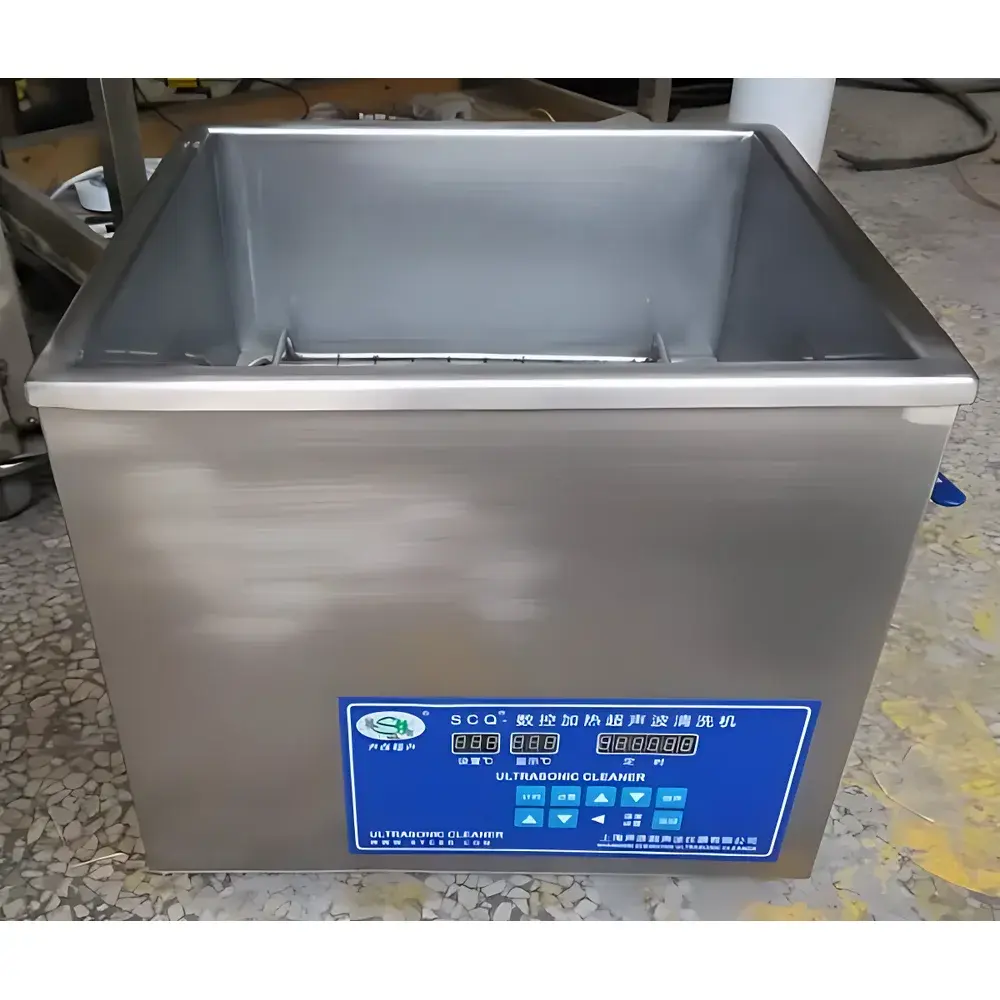
SYCS SCQ-6201B 15L Digital Programmable Heated Ultrasonic Cleaner with Multi-Frequency Operation
| Brand | SYCS (Shengyan Ultrasonics) |
|---|---|
| Origin | Shanghai, China |
| Model | SCQ-6201B |
| Capacity | 15 L |
| Ultrasonic Frequencies | 28 kHz / 40 kHz / 60 kHz / 80 kHz |
| Ultrasonic Power | 350 W |
| Power Adjustment | Yes, 10–100% continuous control |
| Heating Power | 600 W |
| Temperature Range | Ambient to 80 °C (specification corrected per input |
| note | multiple references state max 80 °C, not 100 °C) |
| Timer Range | 1–600 min |
| Lid | Acoustic-damping cover included |
| Drain | Manual valve |
| Internal Tank Dimensions | 330 × 300 × 150 mm |
| Construction | Full 304 stainless steel tank and lid |
| Input Power | 220 VAC, 50 Hz |
Overview
The SYCS SCQ-6201B is a high-capacity, digitally controlled heated ultrasonic cleaner engineered for demanding laboratory, industrial, and clinical cleaning applications requiring both thermal assistance and precise acoustic energy delivery. Operating on the principle of cavitation—where high-frequency sound waves generate microscopic vacuum bubbles in liquid media that collapse violently upon contact with surfaces—the SCQ-6201B delivers consistent mechanical scrubbing action at the microscale. Its multi-frequency capability (28/40/60/80 kHz) enables optimization across diverse sample types: lower frequencies (28–40 kHz) provide higher cavitation intensity suitable for robust contaminants on metals or ceramics, while higher frequencies (60–80 kHz) offer finer, gentler cleaning ideal for delicate optics, microelectronics, or biological substrates. Integrated digital temperature control (ambient to 80 °C) enhances solvent activity and accelerates removal of waxy, greasy, or proteinaceous residues without compromising thermal stability of sensitive components. The unit’s 15-liter capacity and robust 304 stainless steel construction support batch processing of large or bulky items—including PCB assemblies, surgical instruments, glassware sets, and optical components—while maintaining long-term corrosion resistance and compliance with general lab safety standards.
Key Features
- Digital microprocessor-based control panel with real-time display of time, temperature, frequency selection, and power level
- Four selectable ultrasonic frequencies (28 kHz, 40 kHz, 60 kHz, 80 kHz) via front-panel toggle—no hardware modification required
- Continuously adjustable ultrasonic power output (10–100% of 350 W nominal), enabling process tuning for fragile vs. heavily soiled samples
- Precise heating system (600 W) with ±1 °C temperature stability over full 0–80 °C range; PID-controlled feedback loop ensures minimal thermal overshoot
- Programmable timer (1–600 minutes) with auto-shutdown and audible end-of-cycle alert
- Acoustically damped hinged lid with safety interlock—reduces airborne noise by >15 dB(A) and prevents operator exposure to ultrasonic energy
- Full 304 stainless steel tank (330 × 300 × 150 mm) and lid—resistant to chlorinated solvents, alcohols, aqueous detergents, and mild acidic/basic solutions
- Manual drain valve positioned at tank base for complete solution evacuation; compatible with standard laboratory floor drains
- Included stainless steel mesh basket (304 grade) with handle—designed for uniform part suspension and maximum acoustic coupling
Sample Compatibility & Compliance
The SCQ-6201B accommodates a broad spectrum of sample geometries and material classes without risk of damage when operated within validated parameters. Compatible substrates include borosilicate glass, fused silica optics, stainless steel surgical tools, aluminum heat sinks, silicon wafers, titanium implants, and polymer-based medical devices. It supports cleaning protocols aligned with ASTM D2603 (Standard Test Method for Sonic Shear Stability of Lubricating Oils), ISO 13485 (for medical device reprocessing validation), and USP environmental surface decontamination guidelines. While not certified for GMP or FDA 21 CFR Part 11 out-of-the-box, its repeatable digital parameter logging (via optional RS232/USB interface) facilitates integration into GLP-compliant workflows where audit trails are manually documented. The unit meets IEC 61000-6-3 (EMC emission limits) and IEC 61010-1 (safety requirements for electrical equipment for measurement, control, and laboratory use).
Software & Data Management
The SCQ-6201B operates as a standalone instrument with embedded firmware; no proprietary software installation is required for basic operation. All settings—including frequency, power %, setpoint temperature, and timer duration—are stored in non-volatile memory and retained after power cycling. For laboratories requiring electronic recordkeeping, an optional RS232 or USB-to-serial adapter enables connection to external PCs running custom LabVIEW, Python, or Excel-based logging utilities. Timestamped operational logs (start time, duration, temperature profile, frequency selection) can be exported for inclusion in SOP documentation or quality review reports. Firmware updates—when released for enhanced stability or expanded frequency calibration—are delivered via downloadable HEX files and applied using standard terminal emulation software (e.g., Tera Term), ensuring long-term maintainability without vendor lock-in.
Applications
- Pre-analytical preparation of HPLC vials, cuvettes, and NMR tubes to eliminate carryover contamination
- Decontamination of reusable surgical instruments prior to sterilization in healthcare and veterinary settings
- Removal of flux residues, solder paste, and oxide layers from printed circuit boards and semiconductor packaging substrates
- Extraction of organic analytes from solid matrices (e.g., plant tissues, soil) in analytical chemistry workflows
- Dispersion and homogenization of nanoparticle suspensions for TEM grid preparation or colloidal stability studies
- Cleaning of precision optical components—including microscope objectives, laser lenses, and interferometric mirrors—without surface scratching
- Routine maintenance of pipette tips, centrifuge rotors, and electrophoresis combs in molecular biology labs
- Ultrasonic-assisted degassing of casting resins, adhesives, and coating formulations prior to curing
FAQ
Can this unit be used for ultrasonic welding or sonochemical synthesis?
No. The SCQ-6201B is designed exclusively for cleaning, degassing, and emulsification applications. It lacks the focused transducer geometry, pressure containment, or reactive gas handling required for welding or advanced sonochemistry.
Is the heating function independent of ultrasonic activation?
Yes. Heating may be enabled or disabled independently of ultrasonic operation, allowing for gentle warming of solvents during soak cycles without cavitation-induced erosion.
What type of water should be used in the tank?
Deionized or distilled water is recommended for critical applications to prevent mineral buildup on transducers and tank walls. Tap water may be used for general-purpose cleaning if followed by periodic descaling with 5% citric acid solution.
Does the unit include a degas mode?
While not labeled as a dedicated “degas mode,” the combination of low-frequency (28 kHz) operation at reduced power (20–40%) and elevated temperature (50–60 °C) for 5–10 minutes effectively removes dissolved gases from solvents such as ethanol or acetone.
How often should the transducers be inspected or serviced?
Under normal usage (≤8 hrs/day), transducer integrity should be verified annually via impedance sweep testing using a network analyzer. Visual inspection for delamination or pitting on the tank bottom is recommended quarterly.
Related Products



