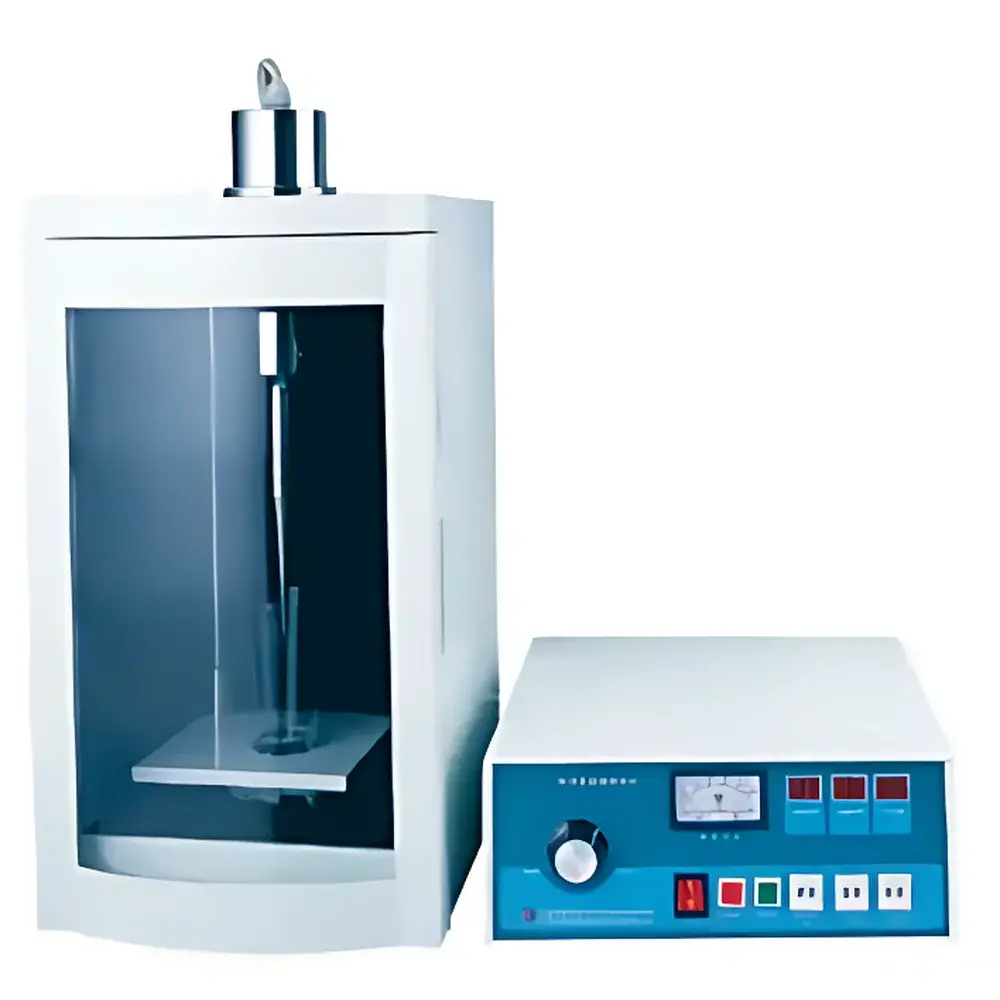
SYCS SCQ-900F Ultrasonic Cell Disruptor
| Brand | SYCS |
|---|---|
| Origin | Shanghai, China |
| Model | SCQ-900F |
| Ultrasonic Power Output | 900 W |
| Frequency | 20 kHz or 25 kHz (user-selectable) |
| Probe Tip Diameters Available | 5, 8, 10, 15, 20, 25, 30 mm |
| Sample Volume Range | 0.5–900 mL |
| Digital Timer | 1 s to 9 h 59 min 59 s (programmable) |
| Warranty | 1 year on main unit |
Overview
The SYCS SCQ-900F Ultrasonic Cell Disruptor is a high-performance benchtop sonicator engineered for precise, reproducible cell lysis and sample homogenization in life science laboratories. It operates on the principle of high-intensity ultrasonic cavitation—generating rapid pressure fluctuations in liquid media that induce microbubble formation, growth, and violent collapse. This transient energy release produces localized shear forces, microstreaming, and shockwaves sufficient to disrupt cellular membranes, disintegrate subcellular structures, and facilitate efficient extraction of intracellular components. Designed for routine and demanding applications in molecular biology, microbiology, biopharmaceutical development, and nanomaterial synthesis, the SCQ-900F delivers consistent amplitude control and stable power output across its full operating range, ensuring experimental repeatability essential for GLP-compliant workflows.
Key Features
- 900 W continuous ultrasonic power output with real-time amplitude regulation (0–100% in 1% increments), enabling fine-tuned energy delivery for sensitive or resilient samples.
- Dual-frequency operation at 20 kHz or 25 kHz—selectable via front-panel interface—optimized for different sample viscosities and target particle sizes.
- Interchangeable titanium alloy probes (horn tips) with standardized diameters: 5, 8, 10, 15, 20, 25, and 30 mm—each calibrated for acoustic impedance matching and thermal stability during extended operation.
- High-resolution digital timer supporting programmable durations from 1 second to 9 hours, 59 minutes, and 59 seconds—ideal for time-dependent lysis protocols and unattended overnight processing.
- Rugged aluminum-alloy transducer housing with integrated cooling fins and forced-air ventilation to maintain thermal equilibrium during prolonged use.
- Comprehensive safety architecture including automatic overload protection, probe detachment detection, and overtemperature cutoff to safeguard both operator and instrument integrity.
Sample Compatibility & Compliance
The SCQ-900F accommodates a broad spectrum of biological and non-biological matrices: mammalian and plant tissues, bacterial and yeast cultures (including Gram-positive strains and spores), viral suspensions, organelles, and synthetic nanoparticles. Its variable probe geometry allows optimization for low-volume microsamples (e.g., 0.5 mL lysates in PCR tubes) as well as high-throughput processing (up to 900 mL in jacketed beakers). The system supports common laboratory solvents (aqueous buffers, ethanol, isopropanol, chloroform) and is compatible with cryogenic operation when used with external cooling baths. While not certified to IEC 61000-4 electromagnetic compatibility standards out-of-box, the instrument meets general electrical safety requirements per GB 4793.1–2007 (equivalent to IEC 61010-1). For regulated environments, users may implement procedural controls aligned with ISO/IEC 17025 documentation practices and FDA 21 CFR Part 11 data integrity guidelines when paired with validated third-party logging software.
Software & Data Management
The SCQ-900F operates via an embedded microcontroller with a backlit LCD interface and tactile membrane keypad—designed for glove-compatible operation in biosafety cabinets. All parameter settings (frequency, amplitude, duration, pulse mode) are stored in non-volatile memory and recalled at power-up. Though the base model does not include PC connectivity, optional RS-232 or USB-to-serial adapters enable integration with LabVIEW, Python-based automation scripts, or LIMS platforms for audit-trail generation. Users can export timestamped operation logs—including start/stop times, cumulative runtime, and fault codes—for internal quality review. When deployed in GMP-aligned processes, the device supports traceability through manual logbooks or electronic batch records referencing instrument ID, probe serial number, and calibration date.
Applications
- Cell lysis for protein, DNA, RNA, and metabolite extraction from cultured cells, tissue homogenates, and microbial pellets.
- Preparation of subcellular fractions (e.g., mitochondria, nuclei) requiring mechanical disruption without enzymatic degradation.
- Nanoparticle dispersion and deagglomeration in colloidal suspensions for drug delivery systems and catalyst formulations.
- Accelerated solvent extraction (ASE) of phytochemicals, alkaloids, and polyphenols from botanical matrices.
- Emulsification of immiscible liquids (e.g., oil-in-water nanoemulsions) for food science and cosmetic R&D.
- Ultrasonic cleaning of microfluidic devices, TEM grids, and optical components prior to imaging or analysis.
- Enhancement of enzymatic reaction kinetics via acoustic activation in biocatalysis studies.
FAQ
What is the recommended maintenance schedule for the SCQ-900F?
Perform visual inspection of probe threads and tip surface before each use; clean with ethanol after contact with biological material. Replace titanium probes every 200–300 hours of cumulative operation or immediately upon visible pitting or cracking.
Can the SCQ-900F be used in a cold room or with ice baths?
Yes—external temperature control is supported. Avoid direct submersion of the transducer housing. Use insulated probe sleeves and circulate coolant through jacketed vessels to maintain sample temperatures below 10 °C.
Is pulse mode available, and how is it configured?
Yes—duty cycle (on/off ratio) and interval timing are adjustable independently of total duration, allowing controlled energy input to minimize thermal denaturation.
Does the instrument comply with international electrical safety standards?
It conforms to China’s GB 4793.1–2007, which aligns substantially with IEC 61010-1 for laboratory equipment. CE marking is not applied; users requiring EU conformity must conduct independent Notified Body assessment.
How is amplitude calibrated, and is NIST-traceable calibration available?
Amplitude is factory-calibrated using laser vibrometry against reference transducers. SYCS provides a certificate of conformance with each unit; NIST-traceable recalibration services are offered annually through authorized service centers.