
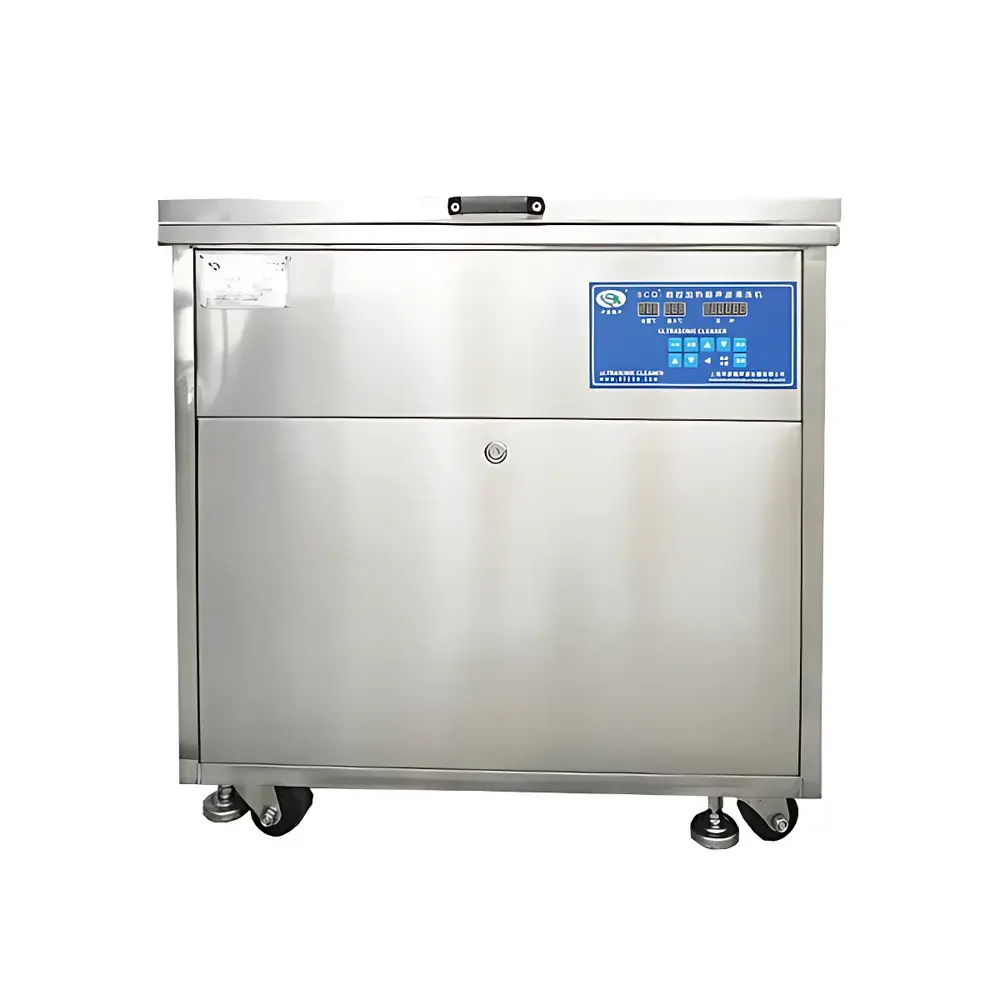
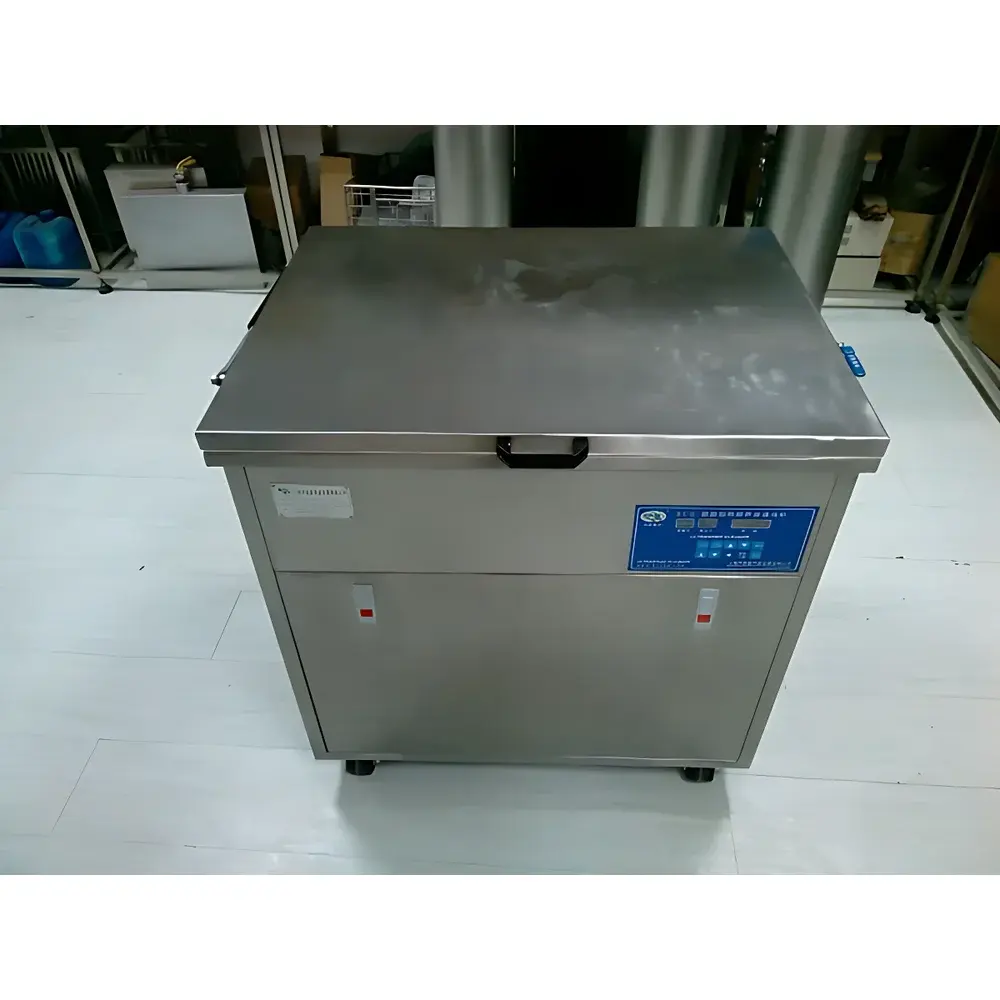
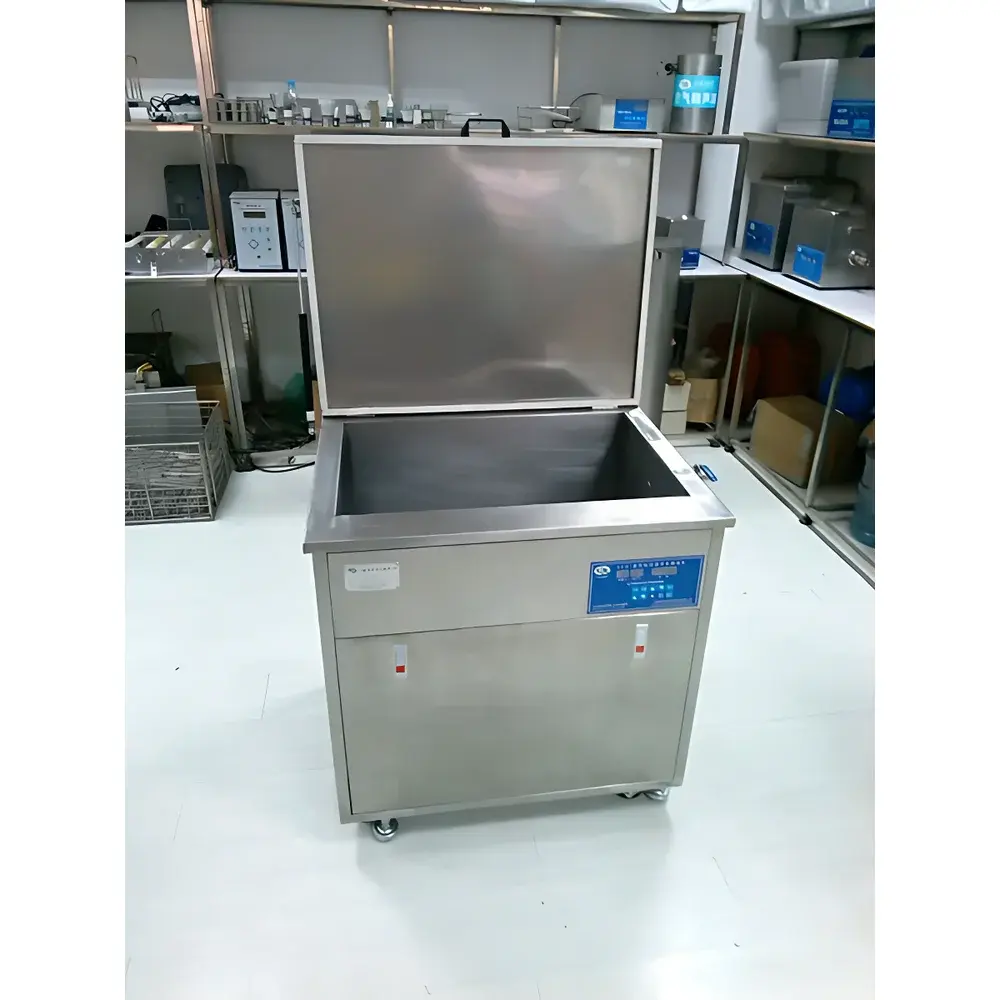
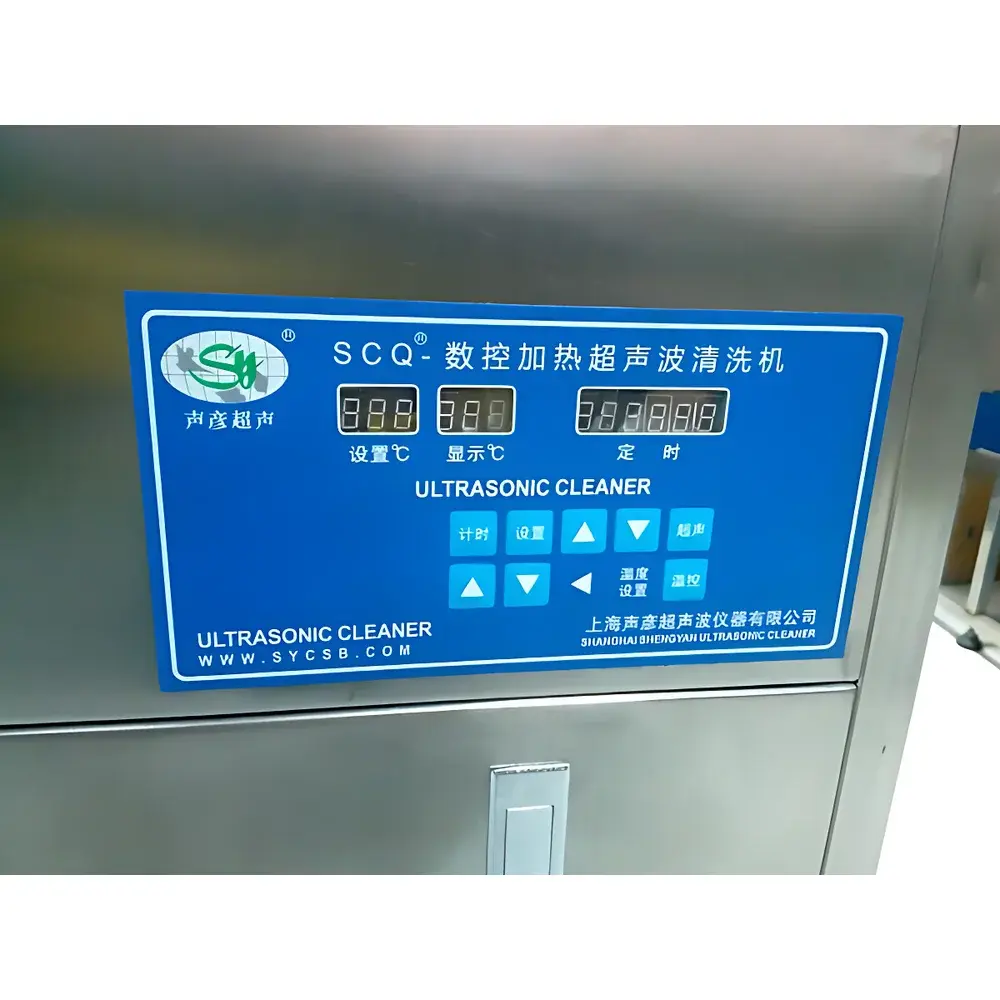
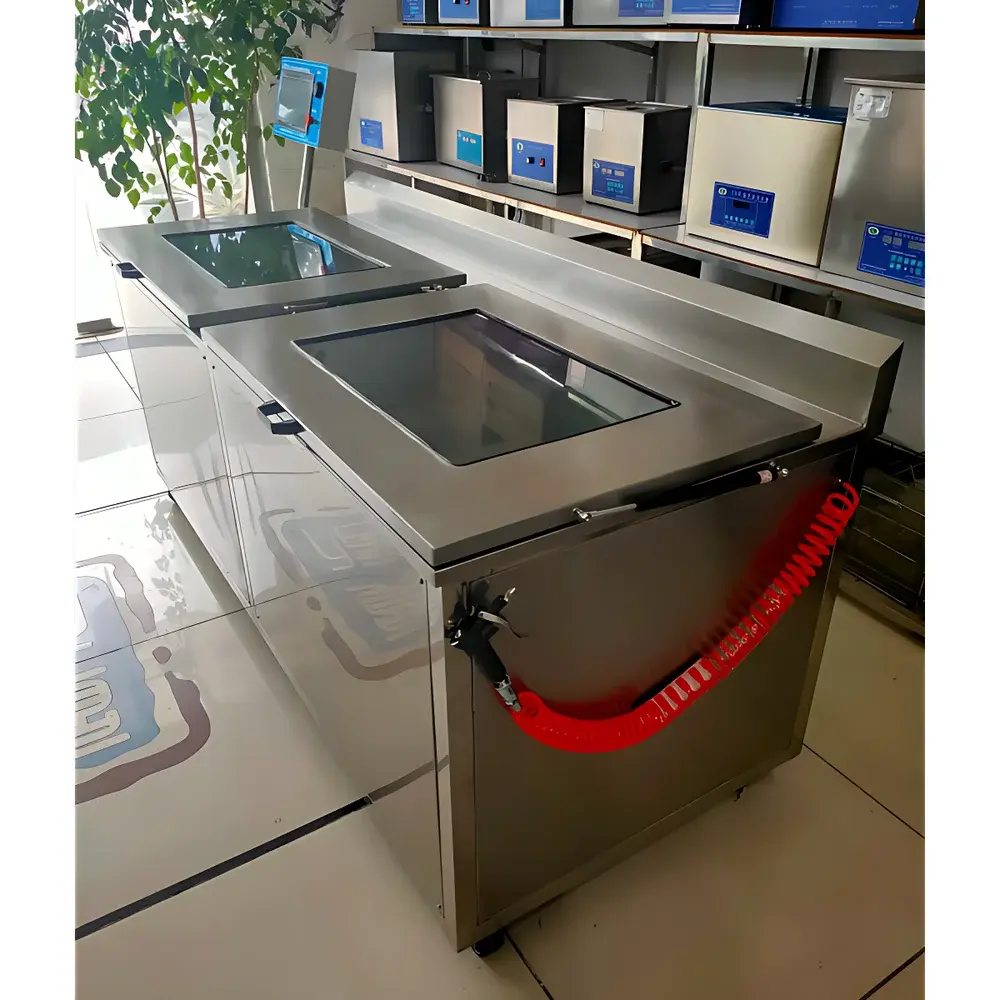
SYCSCQ-168 Digital Programmable Heated Ultrasonic Cleaner
| Brand | SYCS (Shengyan Ultrasonics) |
|---|---|
| Origin | Shanghai, China |
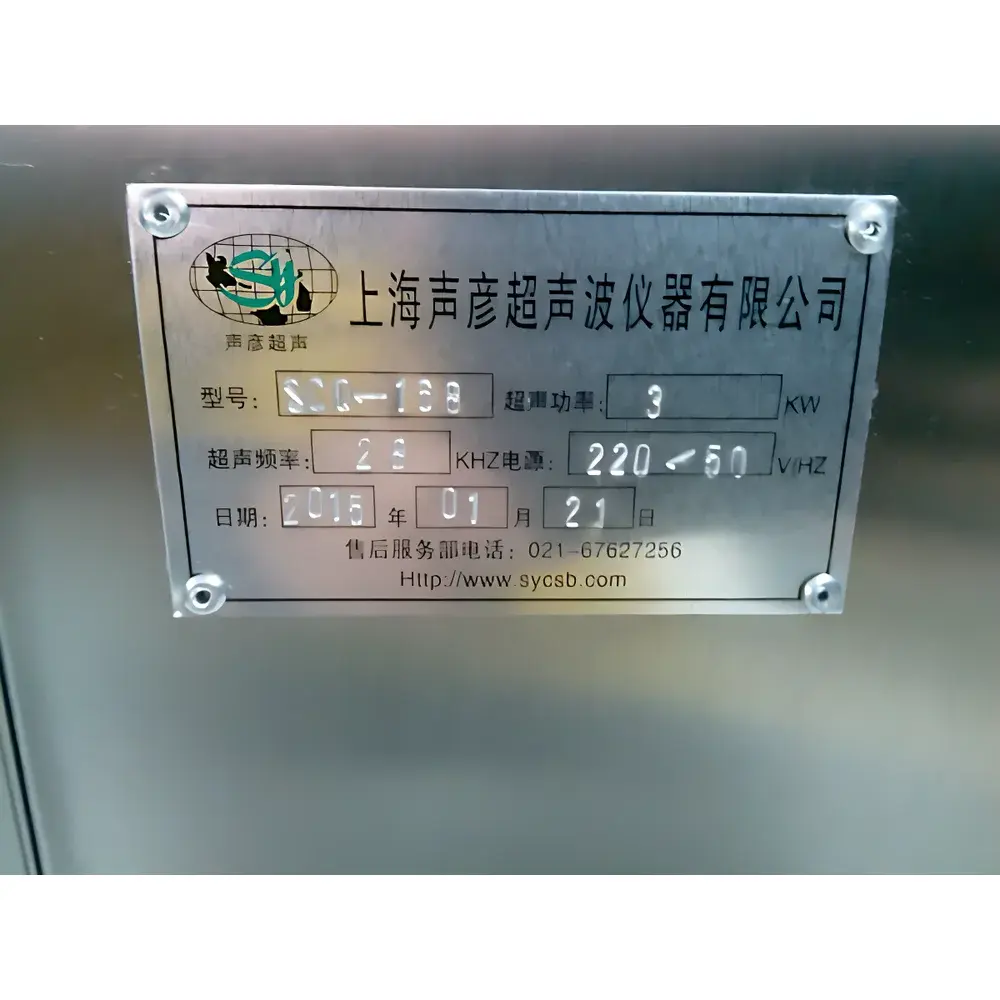
| Model | SCQ-168 |
| Tank Capacity | 168 L |
| Ultrasonic Frequency | 28 kHz (single-frequency) |
| Ultrasonic Power Output | 3000 W |
| Heating Range | Ambient to 80 °C |
| Timer Range | 1–600 min |
| Tank Material | SUS304 stainless steel (2.0 mm thickness inner tank, 1.0 mm outer shell) |
| Internal Dimensions | 700 × 480 × 500 mm |
| Overall Dimensions (approx.) | 750 × 520 × 800 mm |
| Power Supply | 220 V AC, 50 Hz |
| Lid with Sound-Dampening Design | Yes |
| Manual Fill/Drain Ports | Yes |
| Temperature & Time Digital Display & Control | Yes |
| Over-Temp/Over-Current/Over-Voltage Protection | Yes |
| Low-Level Fluid Detection & Auto-Shutoff | Yes |
| Application Type | General-purpose industrial and laboratory ultrasonic cleaner |
Overview
The SYCSCQ-168 Digital Programmable Heated Ultrasonic Cleaner is an industrial-grade, benchtop-to-floor-standing cleaning system engineered for high-reproducibility removal of particulate, organic, and inorganic contaminants from complex geometries—including blind holes, micro-channels, threaded surfaces, and porous substrates. It operates on the principle of acoustic cavitation: a 28 kHz ultrasonic generator drives piezoelectric transducers bonded to the tank bottom and lateral walls, inducing longitudinal pressure waves in the cleaning medium. These waves generate transient microbubbles during rarefaction cycles; subsequent collapse in compression phases produces localized shockwaves exceeding 1000 atm and microjets with velocities >400 m/s—mechanically dislodging adherent residues without mechanical abrasion or thermal degradation. Unlike higher-frequency cleaners optimized for delicate optics or MEMS devices, the 28 kHz frequency provides deeper penetration and higher energy density per cycle, making it especially effective for heavy-duty degreasing, rust removal, carbon deposit dissolution, and pre-treatment prior to plating, coating, or bonding.
Key Features
- Robust 168 L capacity tank fabricated from 2.0 mm-thick SUS304 stainless steel—resistant to corrosion from aqueous, alkaline, acidic, and mild organic solvent-based cleaning solutions.
- Triple-wall transducer configuration (bottom + two side panels) ensures uniform energy distribution and eliminates dead zones across large-volume loads.
- Digital microprocessor control with real-time display of elapsed time, set time (1–600 min), actual and set temperature (ambient to 80 °C), and system status alerts.
- Integrated safety architecture: automatic shutdown triggered by low liquid level detection, over-temperature (>85 °C), over-current, or over-voltage conditions.
- Acoustically damped hinged lid minimizes airborne noise emission (<75 dB(A) at 1 m) and prevents solvent evaporation during heated operation.
- Manual inlet and drain ports enable flexible integration into closed-loop rinse stations or solvent recovery workflows.
- No adjustable power output—fixed 3000 W nominal output ensures consistent energy delivery calibrated for optimal cavitation efficiency at 28 kHz.
Sample Compatibility & Compliance
The SCQ-168 accommodates diverse sample types—including metal components (stainless steel, aluminum, titanium alloys), glassware (volumetric flasks, cuvettes, condensers), ceramic substrates, silicone molds, and polymer-based fixtures—without compromising dimensional stability or surface integrity. Its non-contact cleaning mechanism avoids scratching, pitting, or electrochemical etching associated with manual scrubbing or aggressive chemical immersion. The unit complies with IEC 61000-6-3 (EMC emissions) and IEC 61000-6-2 (immunity) standards. While not certified to UL/CSA or CE for standalone medical device reprocessing, it supports GLP-compliant cleaning protocols when used with validated detergents and documented SOPs—particularly in QC labs handling reusable surgical instruments, optical assemblies, or precision machined parts prior to metrology or assembly. Heating and timing functions meet basic requirements for ASTM D2299 (cleaning verification) and ISO 15883-5 (washer-disinfector validation guidance).
Software & Data Management
This model features embedded firmware with no external PC interface or proprietary software dependency. All operational parameters—including cumulative runtime, temperature setpoints, and fault logs—are retained in non-volatile memory and accessible via front-panel navigation. While lacking network connectivity or FDA 21 CFR Part 11-compliant electronic signatures, its digital display and hardware-enforced safety interlocks support audit-ready documentation when paired with lab notebook entries or LIMS-integrated process logs. For regulated environments, users may implement periodic calibration checks using traceable thermistors and stopwatch verification against timer accuracy (±0.5% tolerance per IEC 60751). Firmware updates are not field-serviceable; revision history is maintained by the manufacturer for traceability.
Applications
The SCQ-168 serves as a primary cleaning platform across multiple technical domains: semiconductor fabrication (wafer carriers, chuck plates, mask frames), electroplating facilities (anode baskets, racking fixtures), medical device manufacturing (stainless steel orthopedic implants, endoscope channels), optics production (lens barrels, prism mounts), and academic research (extraction of plant metabolites, cell lysis for protein isolation, degassing of casting resins). Its thermal capability enables accelerated cleaning kinetics for waxy soils, solder flux residues, and polymerized lubricants—reducing cycle times versus ambient-only systems. In analytical labs, it supports sample preparation for SEM/EDS, XRD, and ICP-MS by eliminating adsorbed carbonaceous films that contribute to spectral interference or detector contamination.
FAQ
Is the ultrasonic frequency adjustable?
No—the SCQ-168 operates exclusively at 28 kHz. Frequency selection is fixed at time of manufacture to optimize transducer resonance and cavitation yield for heavy-duty industrial cleaning.
Can this unit be used with flammable solvents?
Not recommended. The heater and internal electronics are not explosion-proof. Only aqueous or flashpoint >60 °C solutions should be used.
What is the maximum recommended solution volume?
Fill level must remain ≥50 mm below the tank rim to ensure stable cavitation and prevent overflow during active degassing. At full 168 L capacity, the working depth is approximately 450 mm.
Does the unit include a basket or rack?
A standard SUS304 mesh basket is supplied; custom fixtures (e.g., component-specific holders or multi-tier racks) are available as optional accessories.
How often should transducers be inspected?
Visual inspection for delamination or corrosion is advised every 500 operating hours. Performance verification—via aluminum foil erosion test per ASTM E1755—should be conducted quarterly in high-utilization settings.



