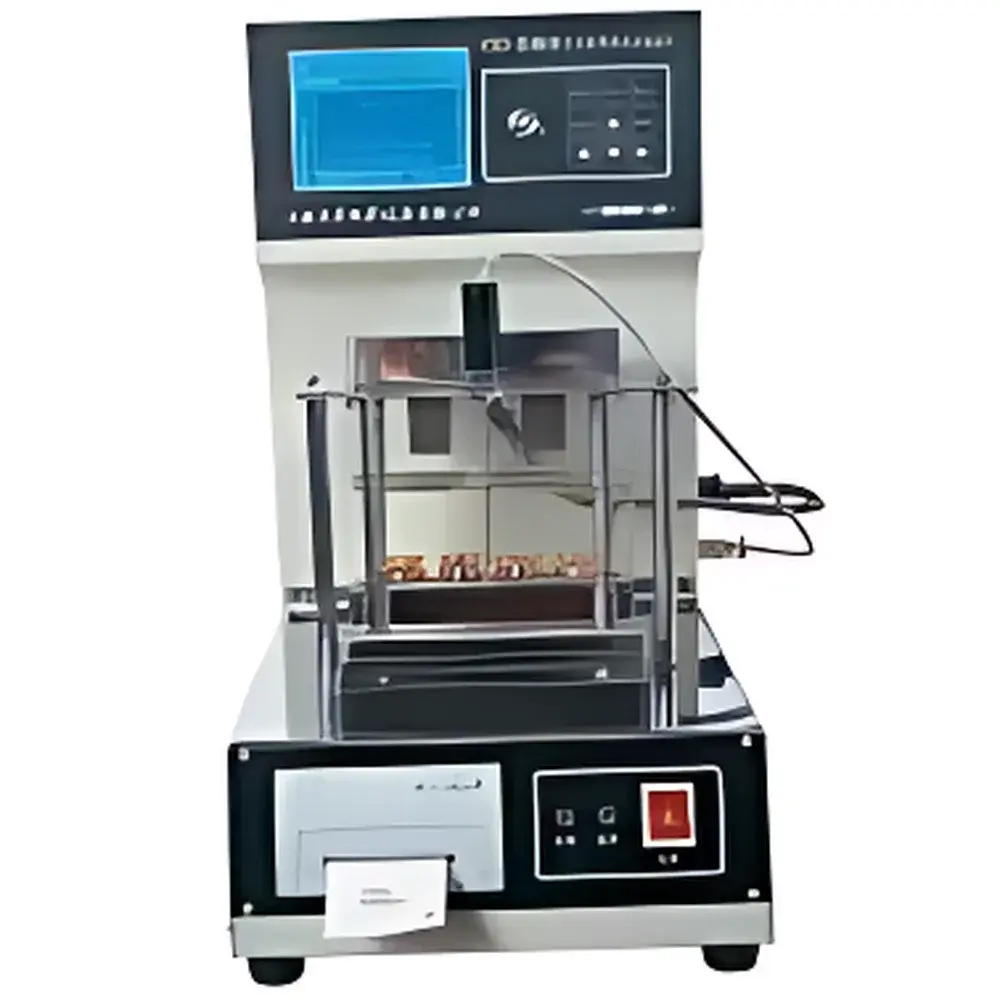
SYD-2806H Automatic Asphalt Softening Point Tester
| Origin | Shanghai |
|---|---|
| Manufacturer Type | Distributor |
| Origin Category | Domestic (China) |
| Model | SYD-2806H |
| Pricing | Upon Request |
Overview
The SYD-2806H Automatic Asphalt Softening Point Tester is an engineered precision instrument designed in strict accordance with internationally referenced standard methodologies, including GB/T 4507 (Petroleum Bitumen – Determination of Softening Point), and JTG E20–2011 T 0606–2011 (Highway Engineering – Test Methods for Bitumen and Bituminous Mixtures – Softening Point Test, Ring-and-Ball Method). It implements the classical ring-and-ball softening point principle—where a steel ball rests on a bitumen-filled brass ring suspended over a heating bath; the temperature at which the softened sample allows the ball to descend a defined distance (25.4 mm) under gravity is recorded as the softening point. This thermomechanical measurement is critical for quality assurance in asphalt production, pavement material specification compliance, and R&D validation across highway infrastructure projects. The SYD-2806H delivers fully automated thermal ramping, real-time digital monitoring, and objective endpoint detection—eliminating operator subjectivity while ensuring repeatability compliant with ASTM D36 and ISO 4625 requirements.
Key Features
- Microprocessor-controlled linear heating system with automatic rate regulation: after initial stabilization, the unit maintains a precise (5.0 ± 0.5) °C/min ramp from the third minute onward—fully aligned with GB/T 4507 and ASTM D36 thermal protocol mandates.
- Dual-media thermal bath configuration: distilled water (5–80 °C) for low-melting bitumens; glycerol (32–160 °C) for high-softening-point materials such as oxidized or polymer-modified asphalts.
- Quartz square glass beaker (1000 mL effective volume) ensures optical clarity, thermal stability, and chemical inertness—critical for long-term calibration integrity and resistance to thermal shock.
- Simultaneous four-sample testing capability with independent ring-and-ball assemblies; configurable for dual-sample operation to accommodate smaller batch workflows.
- Integrated RS-232C serial interface enables traceable data export to LIMS or QA documentation systems—supporting audit readiness under GLP and GMP frameworks.
- Backlit LCD display with tactile keypad interface provides intuitive local operation; built-in thermal printer delivers immediate hard-copy results with timestamp and test identifier.
- Dedicated manual mode allows user-defined ramp profiles or endpoint override—essential for method development, troubleshooting, or non-standard resin-based materials (custom configuration available upon order specification).
Sample Compatibility & Compliance
The SYD-2806H is validated for use with road-grade petroleum bitumen, coal tar pitch, cutback and emulsified bitumens, and modified binders containing SBS, EVA, or crumb rubber. Its mechanical geometry—including standardized brass rings (15.9 mm inner diameter, 6.4 mm height), 9.53 mm steel balls (3.5 g mass), and suspension wire specifications—conforms precisely to GB/T 4507, ASTM D36, ISO 4625, and EN 1427. Environmental operating constraints require ambient temperatures below 35 °C with minimal air convection and relative humidity ≤85% to prevent condensation-induced thermal gradient errors. Calibration verification is supported via NIST-traceable reference standards (e.g., certified paraffin waxes with assigned softening points).
Software & Data Management
While the SYD-2806H operates autonomously via embedded firmware, its RS-232C port facilitates bidirectional communication with external PCs running custom or laboratory-wide data acquisition software. Exported datasets include time-stamped temperature readings, detected softening point values (°C), ramp rate confirmation flags, and pass/fail status against user-defined acceptance criteria. When integrated into regulated environments, the system supports 21 CFR Part 11-compliant electronic records when paired with validated host software—enabling secure user authentication, audit trails, and electronic signatures for QA/QC reporting.
Applications
- Quality control in asphalt refineries and blending plants verifying conformance to SHRP PG grading and EN 13924 specifications.
- Materials testing laboratories supporting highway agency certification (e.g., FHWA, AASHTO TP 70) and construction site acceptance testing.
- University and national research institutes conducting binder aging studies (RTFOT, PAV), modifier dispersion analysis, and rheological correlation modeling.
- Technical service centers performing failure analysis of rutting-prone pavements or evaluating rejuvenator efficacy in recycled asphalt mixtures.
FAQ
What heating media are required—and how is selection determined?
Distilled water is used for samples with expected softening points ≤80 °C; glycerol (USP grade) is mandatory for >80 °C measurements to ensure thermal stability and avoid boiling artifacts.
Does the instrument meet international regulatory requirements for accredited testing labs?
Yes—the mechanical design, thermal performance, and procedural automation comply with ASTM D36, ISO 4625, and GB/T 4507; when coupled with validated software and documented calibration, it supports ISO/IEC 17025 accreditation.
Can the SYD-2806H be used for non-asphalt materials such as rosin or thermoplastic elastomers?
With optional configuration (specified at order), the unit can be adapted for resinous or synthetic polymer softening point determination—subject to verification of thermal bath compatibility and mechanical load limits.
Is remote monitoring or network connectivity supported?
The native RS-232C interface supports local PC connection; Ethernet or Wi-Fi integration requires third-party serial-to-network converters and is not natively embedded.
What maintenance protocols ensure long-term measurement fidelity?
Daily cleaning of quartz bath and brass components with isopropanol; quarterly verification of temperature sensor linearity using certified reference thermometers; annual full calibration by authorized service provider per ISO 17025 procedures.