
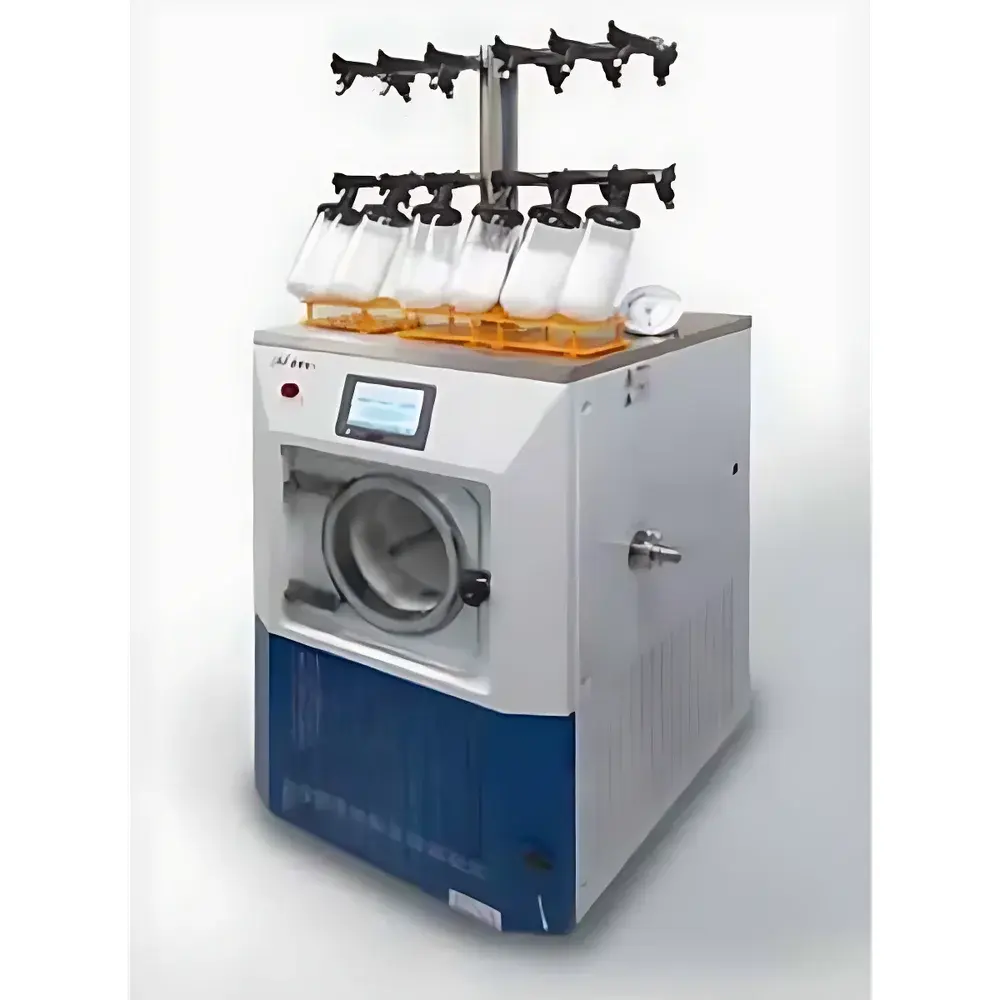
SYFD-18T-24 Benchtop Manifold Freeze Dryer by SONGYUAN HUAXING
| Brand | SONGYUAN HUAXING |
|---|---|
| Origin | Shanghai, China |
| Model | SYFD-18T-24 |
| Cold Trap Temperature | ≤ −85 °C (optional −110 °C) |
| Manifold Type | T-shaped stainless steel manifold with 3-way valves per port |
| Control Interface | 7-inch industrial touch screen with real-time lyophilization curve display and data logging |
| Defrost System | Low-voltage electric cold trap defrost |
| Gas Inlet | Integrated nitrogen (or inert gas) purge valve |
| Data Export | USB flash drive interface |
| Vacuum Pump | Dedicated oil-free or dry scroll vacuum pump (model-specific) |
| Compliance | Designed to meet FDA 21 CFR Part 11 data integrity requirements and current GMP (Annex 1 & ICH Q5C) operational standards |
Overview
The SYFD-18T-24 Benchtop Manifold Freeze Dryer is an engineered solution for controlled, small-to-medium batch lyophilization of heat-sensitive biological and pharmaceutical samples. Based on the fundamental principles of sublimation under high vacuum and low-temperature condensation, this system removes water from frozen specimens without passing through the liquid phase—preserving structural integrity, bioactivity, and long-term stability of labile compounds. Unlike shelf-based freeze dryers, the SYFD-18T-24 employs a manifold configuration, where individual sample vials or flasks are connected directly to the cold trap via a T-shaped stainless steel manifold. This architecture enables independent processing of heterogeneous samples—including bacterial cultures, fungal spores, synthetic peptides, and microbial consortia—without cross-contamination or thermal interference between vessels. Its design prioritizes reproducibility, operator safety, and regulatory traceability, making it suitable for R&D labs, QC/QA environments, and preclinical manufacturing settings operating under GLP or GMP frameworks.
Key Features
- Stainless steel T-shaped manifold fabricated using orbital welding technology to ensure leak-tight integrity and eliminate dead volumes in internal tubing pathways
- Modular 3-way valve system per port allows real-time connection or disconnection of lyophilization flasks without breaking vacuum or halting the process
- Cold trap capable of reaching ≤ −85 °C standard (−110 °C optional), optimized for efficient water vapor capture during primary drying of aqueous and buffer-based formulations
- Integrated nitrogen or inert gas purge valve supports secondary drying under controlled atmosphere and facilitates oxygen-sensitive sample handling
- 7-inch industrial-grade capacitive touch screen with embedded controller for real-time monitoring of chamber pressure, cold trap temperature, and time-temperature-pressure profiles
- On-board data logging compliant with ALCOA+ principles: all critical parameters timestamped, user-annotated, and exportable via USB to secure external storage
- Low-voltage (≤24 V AC/DC) electric defrost system minimizes downtime and eliminates risk of thermal shock to cold trap components
- Compatible with optional cryogenic rotary evaporator modules for integrated solvent removal and freeze-drying workflows
Sample Compatibility & Compliance
The SYFD-18T-24 accommodates standard lyophilization glassware (e.g., 10–500 mL round-bottom flasks, serum vials, and scintillation vials) mounted on interchangeable T-manifold arms. It supports both aqueous and organic co-solvent systems when used with appropriate cold trap configurations. All wetted surfaces contact-grade 316L stainless steel or borosilicate glass, ensuring chemical resistance and cleanability per ISO 14644-1 Class 5 (ISO Class 5) environmental control requirements. The system’s firmware architecture supports audit trail generation, electronic signatures, and role-based access control—features aligned with FDA 21 CFR Part 11, EU Annex 11, and ICH GCP/GMP data governance expectations. Validation documentation packages (IQ/OQ/PQ templates) are available upon request for laboratory qualification.
Software & Data Management
The embedded control software records all process-critical variables at configurable intervals (1–60 seconds), generating time-stamped CSV files containing pressure (mbar), cold trap temperature (°C), elapsed time (hh:mm:ss), and valve status. Data files include automatic file naming conventions incorporating date, operator ID, and batch identifier. USB export maintains original file structure and metadata integrity, supporting seamless integration into LIMS or ELN platforms. Optional PC-based software (sold separately) provides advanced curve analysis, deviation alerts, and comparative batch trending—enabling root cause assessment during process optimization or out-of-specification investigations.
Applications
- Stabilization of thermolabile biologics: monoclonal antibodies, recombinant enzymes, and viral vectors
- Long-term preservation of clinical microbiological isolates and reference strains
- Preparation of peptide libraries for high-throughput screening assays
- Drying of nanosuspensions and liposomal formulations prior to reconstitution studies
- Processing of botanical extracts and natural product fractions requiring minimal oxidative degradation
- Supporting DOE-driven lyophilization cycle development in early-phase formulation development
FAQ
Can the SYFD-18T-24 be validated for GMP production use?
Yes—the system’s hardware architecture, firmware traceability features, and documentation support IQ/OQ/PQ execution per ASTM E2500 and ISPE GAMP 5 guidelines.
Is remote monitoring supported?
Local Ethernet connectivity is available; remote access requires integration with facility SCADA or third-party IoT gateways (not included).
What vacuum pump models are recommended?
SONGYUAN HUAXING specifies dry scroll or diaphragm pumps rated for ≤0.005 mbar ultimate pressure and compatible with water vapor load typical of 24-flask manifold operation.
Does the system support automatic stoppering?
No—this is a manifold-only configuration; automatic stoppering requires shelf-type freeze dryers with hydraulic stoppering mechanisms.
How often does the cold trap require maintenance?
Under normal operation (≤8 hrs/day, ambient RH <60%), inspection and cleaning are recommended every 6 months; frequency increases with high-salt or volatile buffer usage.



