
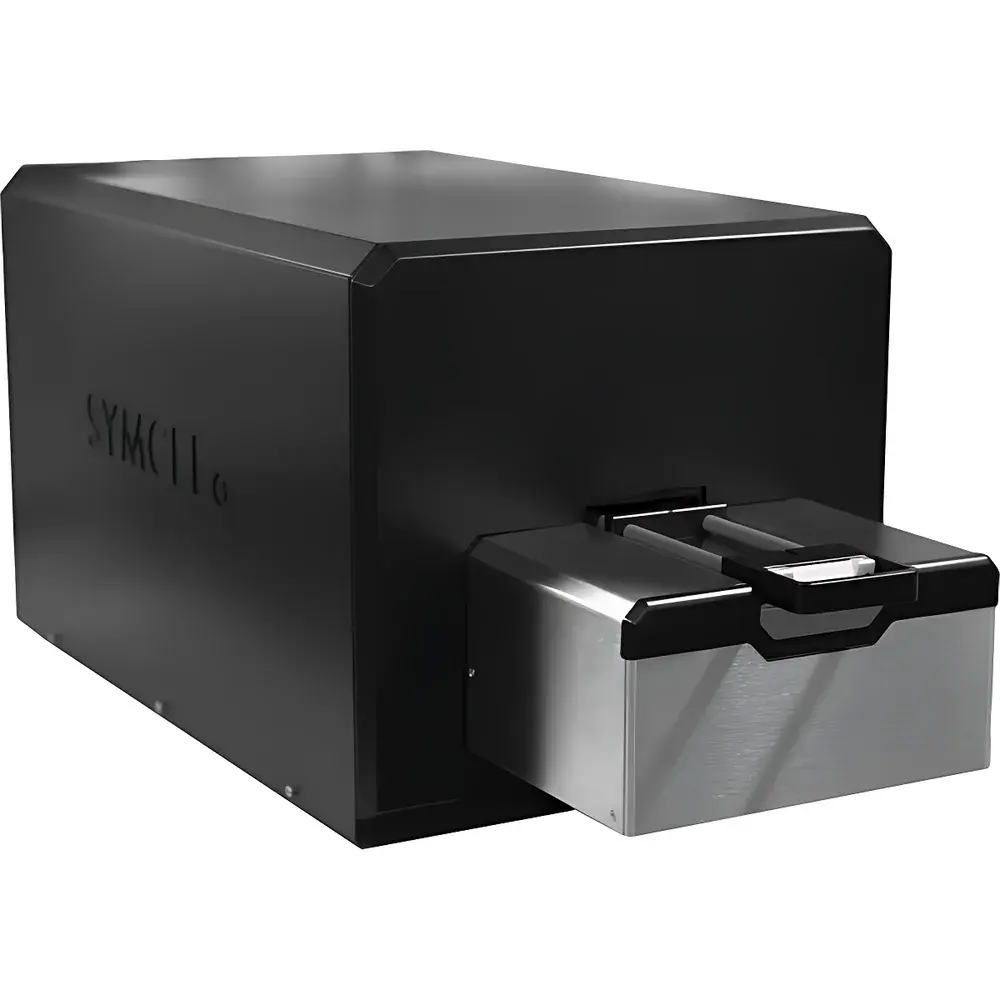
SYMCEL CalScreener Microcalorimeter for Real-Time Cellular Metabolic Activity Analysis
| Brand | SYMCEL |
|---|---|
| Origin | Sweden |
| Model | CalScreener |
| Detection Principle | Isothermal Titration Microcalorimetry (ITC) / Heat Flow Calorimetry |
| Channel Capacity | Up to 32 parallel samples |
| Sensitivity | <50 nW thermal resolution |
| Output Unit | µW (microwatt heat flow) |
| Sample Format | Suspensions, tissue explants, adherent & suspension cells, opaque or turbid media |
| Label-Free Operation | Yes |
| Real-Time Kinetic Data Acquisition | Continuous, unlimited duration |
| Compliance | Designed for GLP-compliant workflows |
Overview
The SYMCEL CalScreener is an isothermal microcalorimeter engineered for label-free, real-time quantification of cellular metabolic heat flow. Unlike optical or fluorescent assays that infer activity indirectly, the CalScreener directly measures the minute thermal power (in µW) generated by living biological systems as a consequence of biochemical reactions—including oxidative phosphorylation, glycolysis, amino acid catabolism, and membrane transport. This thermodynamic readout reflects the integrated, functional status of the entire cell or tissue without perturbation. The instrument operates on the principle of high-precision heat conduction calorimetry, where temperature differentials across thermopile sensors are converted into quantitative heat flow signals with sub-50 nW resolution. Its design eliminates reliance on reporter genes, dyes, substrates, or genetic modification—making it uniquely suited for primary cells, co-cultures, organoids, and heterogeneous clinical isolates where labeling is impractical or physiologically disruptive.
Key Features
- True label-free operation: No exogenous reagents, probes, or genetic constructs required—preserves native cellular physiology.
- 32-channel parallel measurement architecture: Enables high-throughput comparative studies across dose gradients, time points, or compound libraries.
- Uninterrupted kinetic acquisition: Supports experiments lasting hours to days with continuous data logging at user-defined intervals (e.g., 1–60 sec resolution).
- Minimal sample consumption: Compatible with ≤10⁴–10⁶ cells per well or ≤5 mg tissue explants—ideal for scarce primary or patient-derived samples.
- Robust tolerance for optical opacity: Functions reliably with turbid suspensions, viscous media, collagen gels, and intact tissue fragments—no centrifugation, filtration, or clarification needed.
- Non-destructive output: Recovered samples retain viability and molecular integrity for downstream genomics, proteomics, or metabolomics analysis.
- Integrated thermal regulation: Maintains ±0.01 °C stability across all channels during extended runs, critical for reproducible basal metabolic rate assessment.
Sample Compatibility & Compliance
The CalScreener accepts diverse biological matrices without preprocessing: mammalian and microbial suspension cultures, adherent monolayers (via detachable microcarriers), spheroids, intestinal organoids, insect cell lines, yeast, bacteria (including anaerobes in sealed vials), and excised tissue biopsies. It accommodates standard 96-well microplate formats with custom sensor-integrated wells. From a regulatory standpoint, the system’s architecture supports traceable, ALCOA+ compliant data handling when paired with validated electronic lab notebooks (ELNs) or LIMS platforms. Its passive detection modality aligns with ICH M7 and USP <1058> guidance for analytical instrument qualification, particularly for metabolic phenotyping in early-stage drug development. While not pre-certified for GMP manufacturing, its operational parameters meet foundational requirements for GLP-compliant toxicology screening and mechanistic pharmacology studies per OECD Test Guidelines 455 and 456.
Software & Data Management
The CalScreener Control & Analysis Suite provides intuitive experiment setup, real-time heat flow visualization, and post-acquisition modeling tools. Raw thermal power traces (µW vs. time) are exported in ASCII or HDF5 format for integration with Python-based analysis pipelines (e.g., SciPy, Pandas) or commercial platforms like MATLAB and GraphPad Prism. Built-in algorithms enable baseline correction, peak integration, cumulative heat summation, and comparative kinetic profiling (e.g., time-to-peak, slope analysis, area-under-curve normalization). Audit trail functionality logs all user actions, parameter changes, and calibration events—meeting essential criteria for FDA 21 CFR Part 11 compliance when deployed within a validated IT environment. Data backups follow ISO/IEC 27001-aligned encryption and retention protocols.
Applications
- Antibiotic mode-of-action profiling: Differentiate bacteriostatic vs. bactericidal effects via real-time thermal response kinetics.
- Drug-induced mitochondrial toxicity screening: Detect subtle uncoupling or inhibition before cytotoxicity manifests.
- Immunometabolism studies: Quantify metabolic shifts in T-cell activation or macrophage polarization without cytokine stimulation artifacts.
- Bioprocess optimization: Monitor metabolic flux in CHO or HEK293 cultures during fed-batch bioreactor runs using representative miniaturized samples.
- Environmental toxicology: Assess ecotoxicological impact on algal or bacterial consortia under realistic exposure conditions.
- Parasitology research: Characterize energy metabolism in Toxoplasma gondii or Plasmodium strains resistant to conventional antifolates.
- Lead compound triage: Rank small-molecule libraries by metabolic potency rather than binding affinity alone—identifying functionally active hits missed by target-based assays.
FAQ
How does CalScreener differ from Seahorse XF analyzers?
Unlike extracellular flux (XF) platforms that infer metabolism from O₂ and pH changes, CalScreener measures total heat production—the ultimate thermodynamic output of all enzymatic and transport activity—providing a holistic, untargeted view.
Can CalScreener detect apoptosis or necrosis in real time?
Yes. Distinct thermal signatures emerge during early apoptosis (transient hypermetabolism) and late-stage necrosis (rapid thermal decay), enabling temporal staging without caspase staining.
Is calibration traceable to international standards?
Thermal calibration uses NIST-traceable Joule heating references; temperature sensors are certified per ISO/IEC 17025 accredited procedures.
What is the minimum viable cell number for reliable detection?
Detection threshold is ~5,000 viable mammalian cells per well (depending on metabolic rate); bacterial cultures require ≥10⁶ CFU/mL for robust signal-to-noise.
Does the system support automated liquid handling integration?
Yes—via standardized API and third-party robotic interface modules compatible with Hamilton STAR, Tecan Fluent, and Opentrons OT-2 platforms.





