
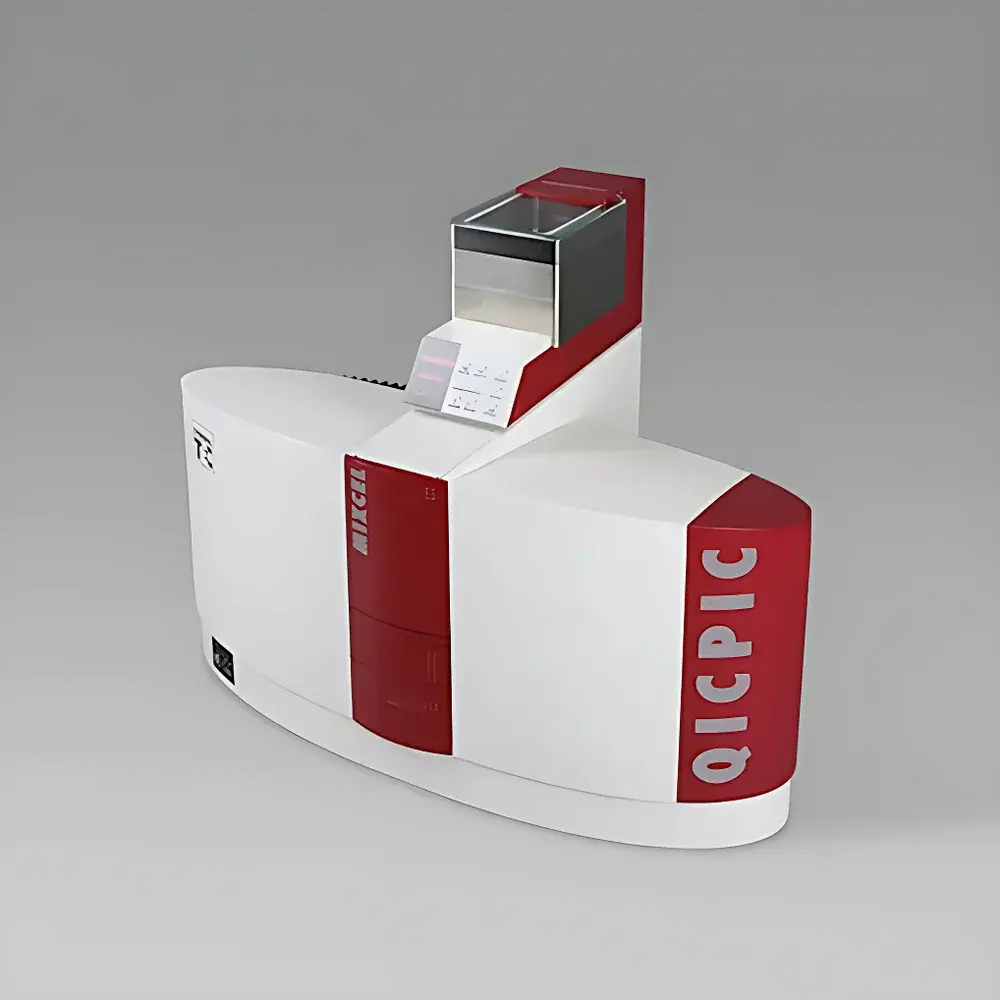
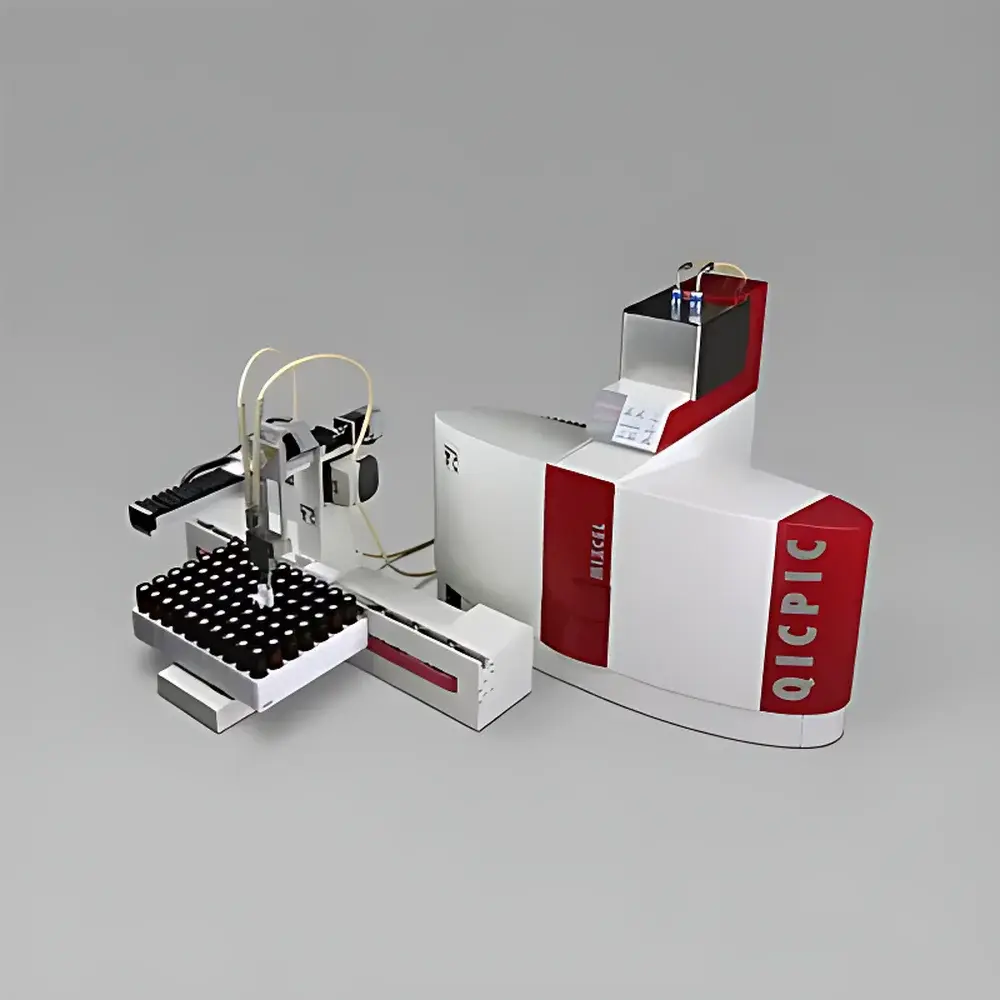
SYMPATEC QICPIC & MIXCEL Automated Wet-Dispersion Dynamic Image Analysis System
| Brand | SYMPATEC |
|---|---|
| Origin | Germany |
| Manufacturer | SYMPATEC GmbH |
| Product Type | Imported |
| Model | QICPIC & MIXCEL |
| Instrument Category | Dynamic Image-Based Particle Analyzer |
| Number of Lenses | 6 |
| Measurement Range | 1–3000 µm |
| Dispersion Method | Wet Dispersion |
| Camera Resolution | 4.2 MP |
| Measured Parameters | Chord Length, Feret Diameter (max/min/mean), Fiber Length, Fiber Diameter, Equivalent Circular Diameter, Sphericity, Aspect Ratio, Convexity, Straightness, Elongation, Perimeter Equivalent Diameter (PED), LEFI, DIFI, VBFD |
Overview
The SYMPATEC QICPIC & MIXCEL is an automated, high-throughput dynamic image analysis system engineered for precise, statistically robust characterization of particle size and shape in wet-dispersed suspensions. Operating on the principle of pulsed backlight illumination and high-speed digital imaging, the system captures sharp silhouette images of individual particles as they pass through a defined measurement zone at controlled flow velocity. A patented optical train—comprising six synchronized lenses and parallel-pulse illumination—ensures uniform contrast, minimal motion blur, and optimal depth-of-field across the full 1–3000 µm range. Unlike static image analysis or ensemble-averaging techniques (e.g., laser diffraction), QICPIC delivers true single-particle resolution with morphological fidelity, enabling quantification of anisotropic, fibrous, or irregular geometries that are critical in advanced material development and quality control.
Key Features
- Integrated MIXCEL wet dispersion module with ultrasonic deagglomeration, dual counter-rotating impellers, and programmable recirculation flow rate (0.5–6 L/min) for stable suspension of high-density or fast-settling particles.
- Modular flow cell design: interchangeable cells (standard and extended pathlength options), tool-free disassembly, and chemical-resistant sealing options (EPDM, FKM, or perfluoroelastomer FFKM) for compatibility with organic solvents, acidic/basic media, and pharmaceutical excipients.
- Intelligent liquid handling: dual-level optical sensors enable fully automated fill/drain cycles; user-defined dispersion volume (250–1000 mL) ensures method reproducibility across batches and operators.
- High-fidelity imaging: 4.2 MP global-shutter CMOS sensor synchronized to microsecond-duration LED pulses, delivering sub-pixel edge definition and <1% measurement uncertainty for chord-based metrics under ISO 13322-2 compliance.
- Real-time processing engine capable of analyzing >10 million particles per minute—enabling representative statistical sampling even for ultra-low-concentration or polydisperse systems.
Sample Compatibility & Compliance
The QICPIC & MIXCEL accommodates a broad spectrum of particulate materials—including nitrocellulose fibers, cathode/anode active materials (e.g., NMC, graphite, silicon composites), metal powders (Al, Ti, Ni alloys), ceramic precursors, and pharmaceutical granules—in aqueous or non-aqueous dispersions. Its wet-dispersion architecture meets key regulatory expectations for method validation: traceable calibration using NIST-traceable particle standards, documented system suitability checks (e.g., repeatability <3% RSD for D50), and audit-ready metadata logging aligned with FDA 21 CFR Part 11 requirements when paired with SYMPATEC’s optional GLP-compliant software package. The system supports ISO 9276-6 (representation of particle shape), ISO 13322-2 (dynamic image analysis), and ASTM E2457 (particle shape characterization by digital imaging) test protocols.
Software & Data Management
SYMPATEC’s WINDOX 7 software provides a unified environment for acquisition, real-time visualization, and multidimensional data interrogation. Each measurement generates a searchable particle image library, time-stamped video clips of particle transit, cumulative and differential distributions (size, shape, aspect ratio), and cross-parameter scatter plots (e.g., sphericity vs. equivalent diameter). Users define custom filters—by size threshold, shape class (fiber vs. blocky), convexity range, or elongation index—to isolate and export subsets for further morphological clustering or correlation with downstream performance data (e.g., electrode packing density, dissolution rate). All raw images, metadata, and processing history are stored in encrypted, version-controlled project files compliant with ALCOA+ principles.
Applications
The QICPIC & MIXCEL serves as a primary metrology tool in R&D and QC environments where particle geometry directly influences functional behavior. In battery materials development, it quantifies flake aspect ratio and surface roughness of graphite anodes—parameters strongly correlated with slurry rheology and electrode calendering response. For propellants and explosives, fiber length distribution and curl index of nitrocellulose govern burn rate consistency and mechanical integrity. In metallurgy, it detects satellite formation and dendritic branching in gas-atomized powders used in additive manufacturing—critical inputs for predicting melt pool stability and porosity. Pharmaceutical applications include monitoring crystal habit evolution during antisolvent precipitation and verifying granule sphericity for improved capsule fill weight uniformity.
FAQ
How does QICPIC differ from laser diffraction for particle sizing?
Laser diffraction reports an intensity-weighted equivalent spherical diameter based on ensemble scattering models. QICPIC measures actual projected dimensions and shape descriptors for each particle—providing orthogonal, physically grounded data essential for understanding anisotropic behavior.
Can the system analyze transparent or semi-transparent particles?
Yes—using optimized backlight pulse duration, gain, and contrast enhancement algorithms, QICPIC reliably resolves edges of low-refractive-index particles (e.g., polymers, sugars) without staining or coating.
Is method transfer possible between different QICPIC instruments?
Absolutely—WINDOX 7 enforces standardized calibration routines, lens-specific distortion correction maps, and identical image segmentation algorithms, ensuring inter-instrument comparability within ±1.5% for Dv50 across global installations.
What maintenance is required for long-term operational reliability?
Routine cleaning of flow cells and ultrasonic transducers; annual verification of optical alignment and camera sensor linearity using SYMPATEC-certified reference standards—documented in the system’s built-in maintenance log.
Does the system support integration into automated lab workflows?
Yes—via Ethernet/IP and OPC UA interfaces, QICPIC & MIXCEL can be orchestrated by LIMS or MES platforms for unattended batch testing, automatic report generation, and real-time SPC dashboard updates.



