
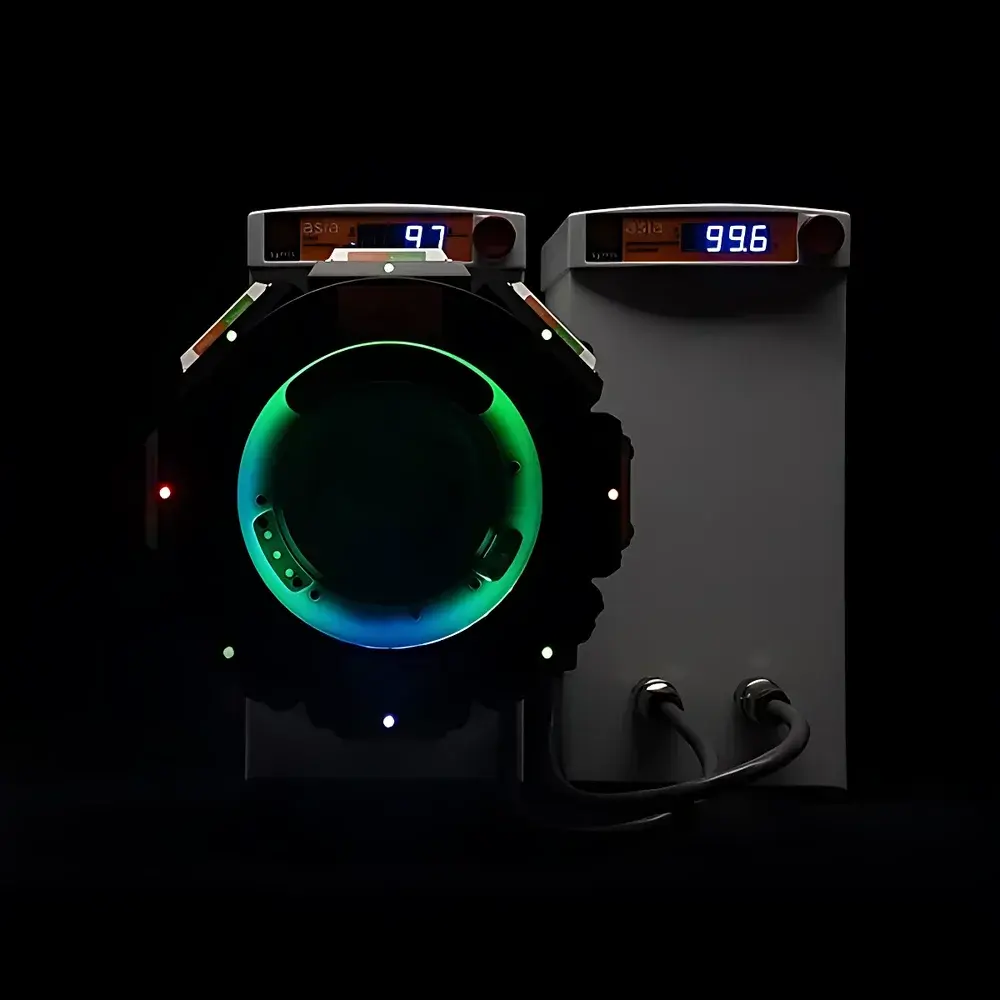
Syrris Asia Flow Photochemical Reactor
| Brand | Syrris |
|---|---|
| Origin | United Kingdom |
| Model | Asia Flow Photochemical Reactor |
| Temperature Range | −40 °C to +80 °C (requires optional Asia Heater or Asia Cryo Controller) |
| Temperature Setpoint Accuracy | ±1 °C, Display Resolution: 0.1 °C |
| LED Module Capacity | Up to 8 interchangeable modules per reactor |
| Wavelength Options | 365, 385, 405, 420, 450, and 525 nm (monochromatic, high-power LEDs) |
| Reaction Volumes | 4 mL or 16 mL |
| Light Power Output | Adjustable from 10% to 100% (up to 120 W total optical output) |
| Safety | Fully interlocked housing with zero-light-leak design |
| Compatibility | Integrates natively with Syrris Asia flow chemistry platforms |
Overview
The Syrris Asia Flow Photochemical Reactor is an engineered solution for precise, scalable, and reproducible photochemical synthesis under continuous flow conditions. It leverages monochromatic, high-intensity LED illumination coupled with tightly regulated thermal control to enable photoreactions that are difficult or unsafe to perform in batch reactors. Unlike conventional photochemistry relying on broadband UV lamps or uncontrolled irradiation, this system implements a modular, wavelength-specific photon delivery architecture based on the principles of controlled photon flux and residence-time-defined reaction kinetics. Designed for integration into modern flow chemistry workflows, it supports both exploratory screening and process intensification — from milligram-scale discovery to multi-gram hourly throughput — while maintaining strict compliance with laboratory safety and operational traceability standards.
Key Features
- Modular LED array supporting up to eight independently controllable, hot-swappable light sources per reactor unit
- Monochromatic high-power LEDs at six discrete wavelengths (365, 385, 405, 420, 450, and 525 nm), enabling selective excitation of specific chromophores
- Optical power output continuously adjustable from 10% to 100%, with peak total irradiance up to 120 W — eliminating need for auxiliary lamps or external cooling
- Precision temperature control from −40 °C to +80 °C using Syrris Asia Heater or Asia Cryo Controller; setpoint accuracy ±1 °C, display resolution 0.1 °C
- Zero-light-leak, fully interlocked reactor housing compliant with IEC 61000-6-4 and EN 61000-6-3 electromagnetic compatibility requirements
- Thermally optimized LED mounting and passive/active heat dissipation architecture — no external chiller required even at maximum optical load
- Two standard reaction volumes: 4 mL (for rapid screening) and 16 mL (for extended residence time or higher throughput)
Sample Compatibility & Compliance
The Asia Flow Photochemical Reactor accommodates a broad range of organic, organometallic, and photocatalytic substrates compatible with standard fluoropolymer (e.g., PFA, FEP) and stainless-steel fluidic components. Its sealed optical chamber and interlock-driven power cutoff meet ISO 13857 safety distance requirements and align with OSHA 1910.147 lockout/tagout protocols. When operated within Syrris’ Asia platform, full audit trail generation — including LED intensity logs, temperature profiles, pump flow rates, and timestamped event records — supports GLP and GMP environments. The system’s firmware complies with FDA 21 CFR Part 11 for electronic record integrity where configured with user authentication and electronic signature modules.
Software & Data Management
Control and monitoring are executed via Syrris’s intuitive Asia Software Suite (v5.2+), which provides synchronized parameter logging across all connected modules — light intensity (% output), photon flux (µmol·m⁻²·s⁻¹, calculated per wavelength), reactor temperature, and flow rate. Real-time graphing, exportable CSV/TXT data dumps, and automated method saving facilitate DOE-based optimization and regulatory documentation. Optional API integration enables third-party LIMS or ELN connectivity for centralized data governance. All configuration changes and operational events are time-stamped and logged with user ID attribution — satisfying traceability requirements for ISO/IEC 17025-accredited laboratories.
Applications
- Visible-light-mediated C–N, C–O, and C–C bond formations (e.g., aryl aminations, decarboxylative couplings)
- Photoredox catalysis using Ir(III), Ru(II), or organic dyes (e.g., 4CzIPN, Eosin Y)
- UV-triggered [2+2] cycloadditions, Norrish-type cleavages, and radical halogenations
- Scale-up of photobiocatalytic transformations requiring narrow-band activation
- High-throughput wavelength screening to identify optimal excitation conditions for new photocatalysts
- Multi-step telescoped syntheses combining photochemical and thermal steps in a single integrated flow sequence
FAQ
Can the Asia Flow Photochemical Reactor operate without Syrris pumps or controllers?
Yes — it functions as a standalone irradiation module with analog/digital I/O for external PLC or SCADA integration.
Is calibration of LED intensity traceable to NIST standards?
Integrated photodiode sensors provide relative intensity tracking; absolute photon flux calibration is performed using NIST-traceable spectroradiometric measurement services (optional add-on).
What materials contact the reaction stream inside the reactor?
All wetted parts are constructed from chemically inert PFA or 316 stainless steel — compatible with common organic solvents, acids, and bases below 100 °C.
How is temperature uniformity maintained across the illuminated zone?
A combination of microchannel heat exchange geometry and distributed thermal mass ensures ±0.5 °C axial and radial uniformity during steady-state operation.
Does the system support dynamic wavelength switching during a single run?
No — wavelength selection is fixed per installed LED module; sequential irradiation requires manual or automated module swapping between runs.



