
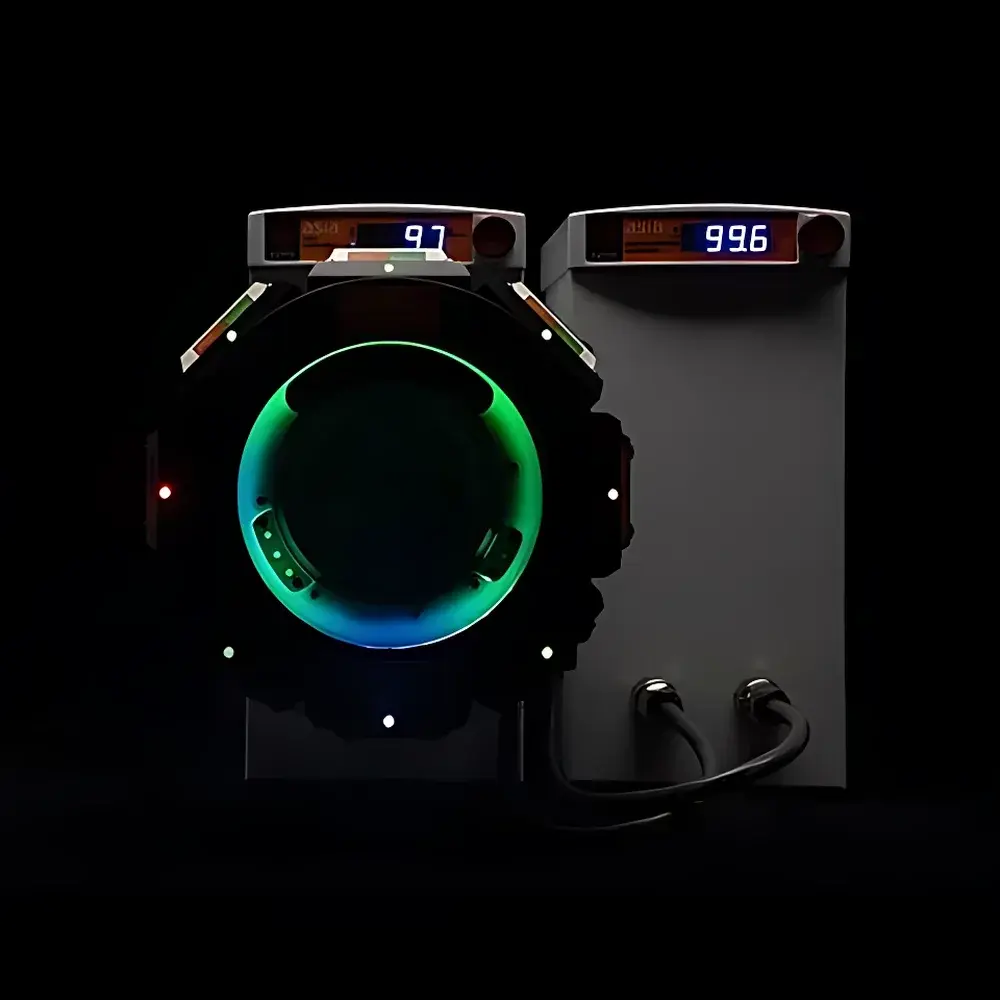
Syrris Asia Flow Photochemical Reactor
| Brand | Syrris |
|---|---|
| Origin | United Kingdom |
| Manufacturer Type | Authorized Distributor |
| Origin Category | Imported |
| Model | Asia Flow Photochemical Reactor |
| Price | Upon Request |
| Temperature Range | −40 °C to +80 °C (requires optional Asia Heater or Asia Cryo Controller) |
| Temperature Control Accuracy | Setpoint accuracy ±1 °C, Display resolution 0.1 °C |
| Reaction Modules | Up to 8 interchangeable high-power LED modules (monochromatic, multi-wavelength, or blank) |
| Wavelength Options | 365, 385, 405, 420, 450, and 525 nm |
| Reaction Volume | 4 mL or 16 mL per module |
| Light Power Output | Adjustable from 10% to 100%, up to 120 W total system output |
| Photonic Flux Monitoring | Real-time intensity and photon flux display |
| Safety | Fully interlocked housing with zero-light-leak design |
| Compatibility | Standalone operation or integrated into Syrris Asia flow chemistry platform |
Overview
The Syrris Asia Flow Photochemical Reactor is an engineered solution for precise, scalable, and reproducible photochemical synthesis under continuous-flow conditions. Leveraging the fundamental principles of photolysis—where photons of defined energy initiate bond cleavage or radical formation—the reactor enables controlled irradiation of flowing reaction streams within transparent, chemically resistant microfluidic channels. Unlike conventional batch photochemistry, which suffers from inconsistent light penetration, thermal gradients, and poor scalability, this system delivers uniform photon flux across the entire reaction volume via collimated, high-intensity LED illumination. Its modular architecture supports both exploratory screening and process development, making it suitable for academic laboratories investigating new photocatalytic mechanisms as well as industrial R&D teams implementing GLP-compliant photoreaction workflows. Designed in accordance with ISO 14644 cleanroom-compatible mechanical standards and aligned with ICH Q5A recommendations for photochemical stability testing, the reactor operates reliably across a broad thermal envelope without requiring external chillers or cryogenic utilities.
Key Features
- Modular LED array supporting up to eight independently controllable light sources per reactor unit—each configurable as monochromatic (365, 385, 405, 420, 450, or 525 nm), mixed-wavelength, or optically inert blank modules.
- Real-time photonic flux monitoring with calibrated intensity readout (mW/cm²) and calculated photon flux (μmol/m²·s), traceable to NIST-traceable radiometric standards.
- Integrated temperature control interface compatible with Syrris Asia Heater (for +10 °C to +80 °C) and Asia Cryo Controller (for −40 °C to +25 °C), delivering setpoint accuracy of ±1 °C and display resolution of 0.1 °C.
- Zero-light-leak safety enclosure featuring dual redundant hardware interlocks: disconnection of any optical or electrical component triggers immediate LED shutdown.
- Thermally optimized reactor blocks fabricated from anodized aluminum and PTFE-lined quartz flow cells, ensuring minimal thermal lag and chemical compatibility with common organic solvents, acids, and bases.
- Scalable reaction throughput from milligram- to multi-gram-per-hour levels, validated across residence times ranging from seconds to minutes using standard 4 mL and 16 mL flow cell configurations.
Sample Compatibility & Compliance
The Asia Flow Photochemical Reactor accommodates a wide range of substrates, including aryl halides, diazonium salts, metal complexes (e.g., Ir(ppy)₃, Ru(bpy)₃²⁺), and small-molecule photocatalysts. It supports solvent systems such as acetonitrile, DMF, THF, methanol, and aqueous buffers—provided they exhibit acceptable UV–vis transmission at selected wavelengths. All wetted materials comply with USP Class VI biocompatibility requirements and meet ASTM D543 resistance classifications for chemical exposure. The system adheres to IEC 61000-6-3 (EMC emission) and IEC 61000-6-2 (immunity) standards. For regulated environments, audit trails, user access logs, and electronic signature support are available when operated through Syrris’s ASIA Software v4.x under FDA 21 CFR Part 11-compliant configuration.
Software & Data Management
Control and data acquisition are managed via Syrris ASIA Software, a Windows-based platform offering synchronized logging of temperature, LED power output, flow rate, pressure, and real-time photonic flux metrics. Experimental protocols—including wavelength sequencing, ramped irradiation profiles, and conditional temperature–light coupling—are programmable and exportable in CSV and XML formats. Raw sensor data is timestamped with microsecond precision and stored locally with SHA-256 hash verification for integrity assurance. Optional integration with LIMS platforms (e.g., LabVantage, Thermo Fisher SampleManager) enables automated metadata tagging and electronic batch record generation compliant with GMP Annex 11 and ISO/IEC 17025 documentation requirements.
Applications
- Visible-light-mediated C–N, C–O, and C–S cross-coupling reactions using heterogeneous or homogeneous photocatalysts.
- Photoinduced decarboxylative functionalizations and radical addition cascades under mild thermal conditions.
- Photoredox-driven asymmetric transformations with chiral iridium or ruthenium complexes.
- High-throughput screening of wavelength-dependent quantum yields and action spectra for mechanistic studies.
- Stability-indicating photodegradation assays per ICH Q1B guidelines for pharmaceutical intermediates and APIs.
- Continuous-flow synthesis of photoactive polymers and conjugated small molecules for OLED and OPV applications.
FAQ
Can the Asia Flow Photochemical Reactor be used without Syrris pumping or control hardware?
Yes—it operates as a standalone irradiation module with external flow inputs and outputs, accepting standard 1/16″ OD PTFE or stainless-steel tubing connections.
Is calibration of LED intensity traceable to national standards?
Each LED module includes factory-applied radiometric calibration certificates traceable to NPL (UK) or PTB (Germany) reference detectors.
What maintenance is required for long-term LED performance?
No routine recalibration is needed; lifetime expectancy exceeds 10,000 hours at 80% nominal power, with built-in thermal derating to preserve spectral stability.
Does the system support dynamic wavelength switching during a single run?
Yes—ASIA Software allows real-time modulation of individual LED intensities and on/off states within sub-second intervals.
Are custom wavelengths available beyond the standard six options?
Syrris offers OEM integration of customer-specified narrowband LEDs (±5 nm FWHM) upon request, subject to minimum order quantities and lead time validation.



