
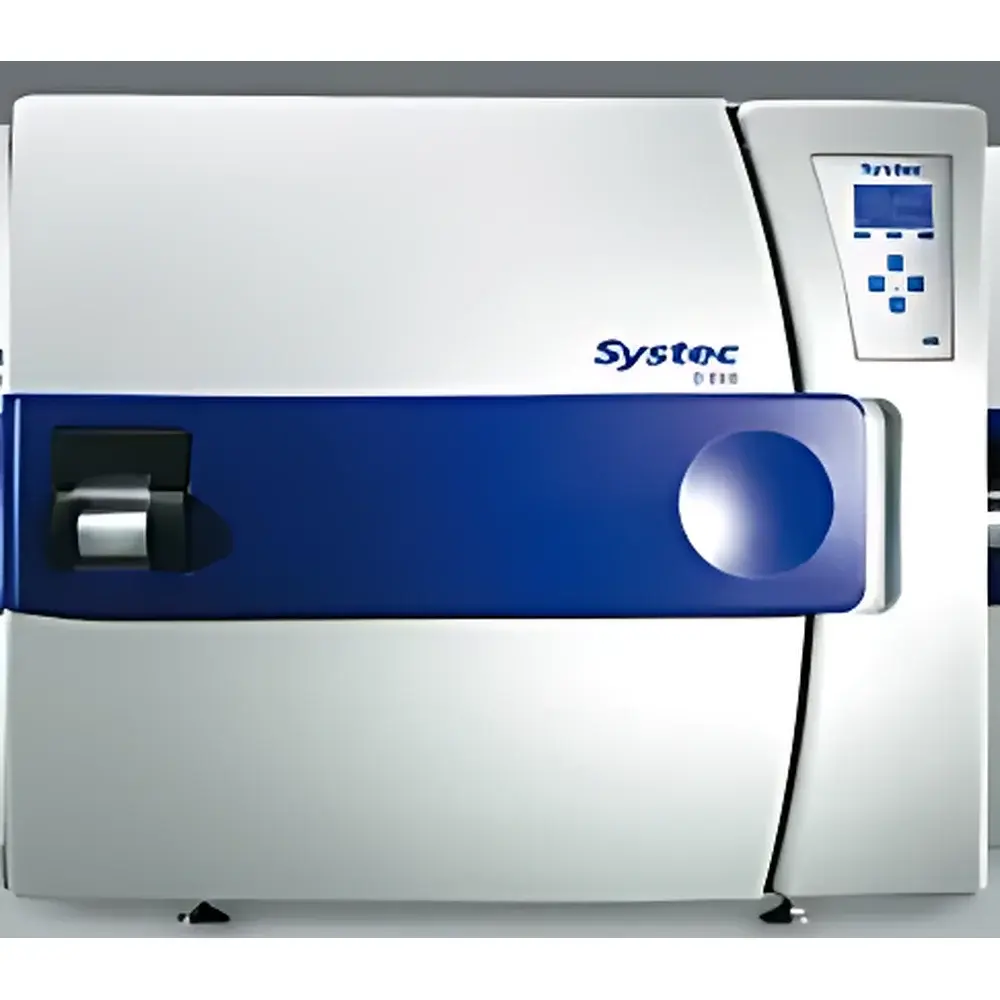
Systec D-Series Benchtop Steam Sterilizer
| Brand | Systec |
|---|---|
| Origin | Germany |
| Model | D-Series |
| Instrument Type | Benchtop Sterilizer |
| Max Temperature | 140 °C |
| Max Pressure | 4 bar |
| Chamber Dimensions | 500 × 750 mm (D-150/D-200) |
| External Dimensions | 850 × 730 × 1300 mm |
| Chamber Volume | 200 L (D-200) |
| Power Supply | D-45: 220–240 V, 50/60 Hz, 16 A |
| D-65 to D-200 | 380–400 V, 50/60 Hz, 16 A |
| Construction | Fully stainless steel (AISI 304) chamber, outer casing and support frame |
| Control System | Microprocessor-based with LCD interface, 25 programmable cycles (DX), 12 (DE), or 4 (DB) |
| Data Logging | Up to 500 sterilization cycles stored internally |
| Connectivity | RS-232 and RS-485 ports for network integration |
| Safety Compliance | EN 285, EN 61010-1, PED 2014/68/EU, CE-marked |
Overview
The Systec D-Series Benchtop Steam Sterilizer is a fully integrated, microprocessor-controlled Class B vacuum-assisted steam sterilization system engineered for precision, repeatability, and regulatory compliance in research laboratories, clinical diagnostics, pharmaceutical QC labs, and university core facilities. Based on the principles of saturated steam under pressure—governed by the internationally recognized EN 285 standard—the D-Series delivers validated thermal lethality (F0) across diverse load types including wrapped instruments, porous loads, liquids, and biohazardous waste. Its modular architecture supports three distinct configurations—DX (full-featured), DE (mid-tier), and DB (entry-level)—each calibrated to meet ISO 13485-aligned workflows and GLP/GMP documentation requirements. All models incorporate an internal steam generator, eliminating dependency on external boiler infrastructure, and feature dual PT-100 temperature sensing (chamber + exhaust condenser) for real-time thermodynamic verification throughout the sterilization cycle.
Key Features
- Fully stainless steel construction (AISI 304) for chamber, outer casing, and structural frame—resistant to corrosion from repeated exposure to saturated steam and cleaning agents
- Integrated electric steam generator with automatic deionized water dosing—ensures consistent steam quality and eliminates manual refilling
- Dual independent temperature monitoring: primary PT-100 sensor in chamber and secondary sensor at exhaust condenser for validation-grade thermal profiling
- Microprocessor-based control system with high-contrast LCD display and intuitive touch-sensitive interface supporting multilingual operation (English, German, French, Spanish)
- Programmable cycle library: up to 25 customizable sterilization protocols (DX), including liquid cooling control, pulse vacuum air removal, F0-based dwell calculation, and BD test routines
- Automated post-cycle functions: controlled door opening, condensate-cooled discharge line, and temperature-maintained liquid hold phase to prevent boil-over
- Comprehensive data integrity: internal non-volatile memory stores up to 500 complete cycle logs—including time-stamped temperature/pressure profiles, operator ID, and alarm events
- Secure access management with multi-level password protection (administrator, technician, operator) aligned with FDA 21 CFR Part 11 audit trail requirements
Sample Compatibility & Compliance
The D-Series accommodates a broad spectrum of laboratory materials: solid instruments (wrapped/unwrapped), textile packs, pipette tips, culture media, aqueous solutions, and regulated biological waste. Chamber dimensions scale across the series—from 45 L (D-45) to 200 L (D-200)—with standardized 500 mm diameter cross-sections enabling uniform steam penetration and minimizing cold-spot risk. Each model conforms to EN 285 (large steam sterilizers), EN 61010-1 (electrical safety), and the Pressure Equipment Directive (PED 2014/68/EU). Vacuum-assisted models (DX and DE) support ISO 11140-compliant Bowie-Dick (BD) testing and vacuum leak detection—critical for validating air removal in porous and hollow load sterilization. Optional validation packages include IQ/OQ documentation templates compatible with ISO/IEC 17025-accredited calibration services.
Software & Data Management
Data export and remote supervision are enabled via dual serial interfaces: RS-232 (point-to-point) and RS-485 (multi-drop bus), both supporting Modbus RTU protocol for seamless integration into laboratory information management systems (LIMS) or building automation networks. Cycle logs include timestamped pressure/temperature curves, phase durations (pre-vacuum, heating, sterilization, exhaust, drying), operator credentials, and deviation flags. Internal memory retains full cycle metadata—including F0 integral calculations—for retrospective analysis and audit readiness. Optional PC software provides graphical trend visualization, PDF report generation, and electronic signature capture—fully compliant with ALCOA+ data integrity principles and EU Annex 11 requirements for computerized systems.
Applications
- Routine sterilization of glassware, metal instruments, and polymer labware in academic and industrial research labs
- Preparation of sterile culture media and buffers in microbiology and cell culture facilities
- Decontamination of biohazardous waste (e.g., agar plates, used pipette tips) prior to autoclave-compatible disposal
- Validation support for cleanroom gowning protocols and aseptic processing training environments
- Quality control release testing in pharmaceutical manufacturing, per USP <797> and <1211> guidelines
- Regulatory submission support through traceable, tamper-evident cycle records meeting MHRA, EMA, and FDA expectations
FAQ
What is the difference between DX, DE, and DB configurations?
The DX series offers full functionality—including 25 programmable cycles, pulse vacuum, BD testing, and F0 calculation—designed for GxP environments. The DE series provides 12 cycles and core vacuum capabilities for mid-volume labs. The DB series is a streamlined 4-cycle configuration optimized for basic instrument and liquid sterilization without vacuum functions.
Does the D-Series require external steam supply?
No—all models integrate an electric steam generator and automatically dose deionized water, eliminating dependence on central boiler systems or external steam lines.
How is temperature uniformity validated across the chamber?
Each unit undergoes factory thermal mapping per EN 285 Annex C, with optional user-performed qualification using calibrated Class N or Class S probes per ISO 17665-1.
Can cycle data be exported for regulatory audits?
Yes—via RS-232/RS-485, raw cycle files (CSV/XML) and signed PDF reports can be retrieved, supporting 21 CFR Part 11 and EU Annex 11 compliance.
Is maintenance documentation included?
Yes—comprehensive service manuals, spare parts lists, and preventive maintenance schedules are provided with each unit, along with optional extended warranty and certified technician support contracts.



