
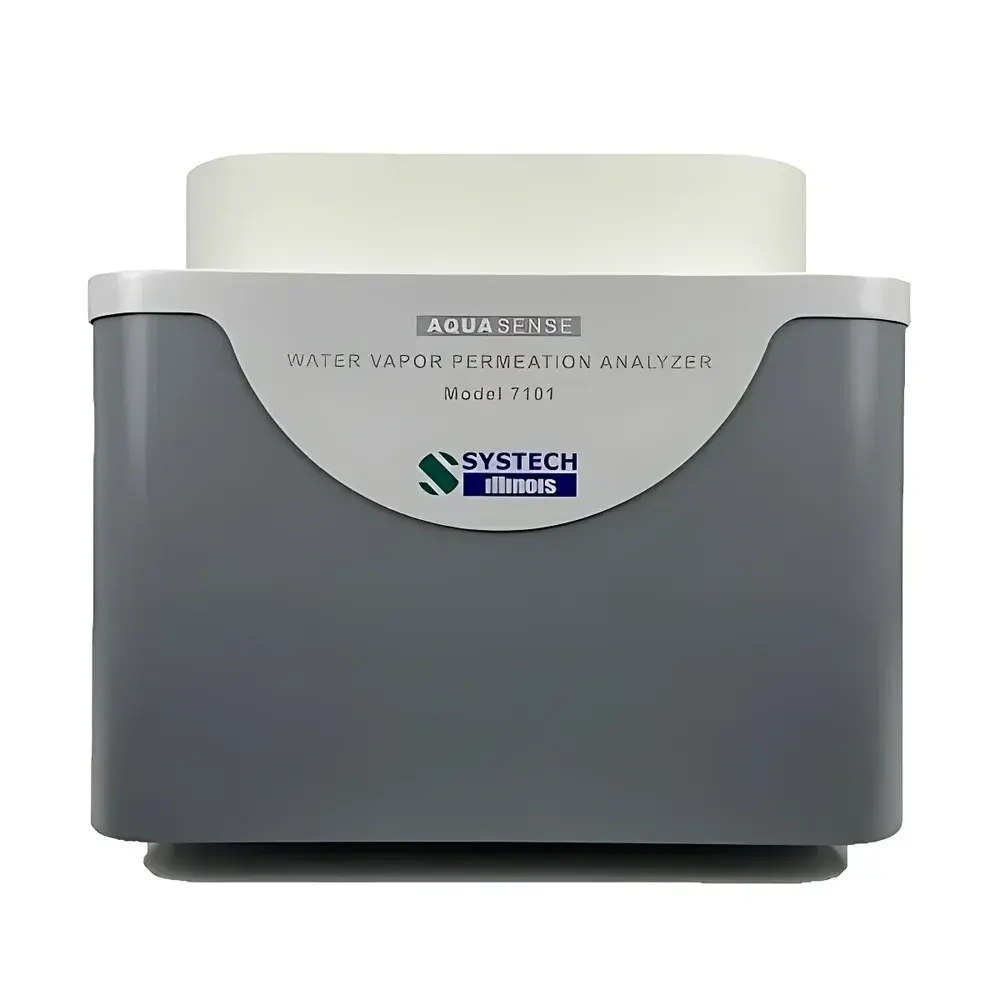
Systech Illinois 7101 Water Vapor Transmission Rate (WVTR) Analyzer
| Brand | Systech Illinois |
|---|---|
| Origin | United Kingdom |
| Manufacturer Type | Authorized Distributor |
| Origin Category | Imported |
| Model | 7101 |
| Pricing | Available Upon Request |
| Measurement Range | 0.002–70 g/(m²·d) (unmasked) |
| Temperature Control Range | 10–40 °C (50–104 °F) |
| Relative Humidity Control Range | 20–90 % RH |
| Sample Area | 50 cm² (adapters available for smaller specimens) |
| Sensor Technology | High-sensitivity Coulometric P₂O₅ sensor |
| Compliance | ASTM F3299–18 |
Overview
The Systech Illinois 7101 Water Vapor Transmission Rate (WVTR) Analyzer is a precision-engineered gravimetric-coulometric instrument designed for the quantitative determination of water vapor permeation through flexible barrier materials used in pharmaceutical, food, medical device, and electronics packaging. It operates on the principle of coulometric detection—where water vapor permeating through a test specimen is quantitatively absorbed by phosphorus pentoxide (P₂O₅) in a dry carrier gas stream, electrolytically decomposed into hydrogen and oxygen, and measured via Faraday’s law of electrolysis. This method delivers absolute, calibration-free mass-based quantification with high reproducibility and long-term stability—critical for regulatory submissions and comparative barrier performance studies.
Key Features
- High-sensitivity coulometric P₂O₅ sensor with no routine calibration required—ensures traceable, drift-free measurement over extended operational life.
- Dual-screw sample chamber locking mechanism replaces legacy sliding-lock systems, enabling rapid, repeatable, and leak-tight sealing without mechanical wear or alignment drift.
- Anti-Surge protection circuitry automatically throttles carrier gas flow and adjusts sensor bias when transient water vapor loads exceed design thresholds—preventing irreversible sensor saturation or chemical degradation.
- Integrated temperature and relative humidity control across 10–40 °C and 20–90 % RH, respectively, with independent PID-regulated zones for both upstream (dry side) and downstream (wet side) chambers—enabling precise simulation of real-world storage conditions.
- Gas Validation protocol using NIST-traceable moisture standards (e.g., certified PermaPure® or Vaisala HUMICAP® reference gases), allowing full system performance verification in under four hours—fully compliant with ISO/IEC 17025 internal verification requirements.
- Remote diagnostic capability via secure TLS-encrypted connection; authorized Systech engineers may perform firmware updates, sensor diagnostics, and parameter validation remotely—minimizing instrument downtime and eliminating travel-related service delays.
Sample Compatibility & Compliance
The 7101 accommodates flat, non-porous, and semi-crystalline barrier substrates including polyethylene (PE), polypropylene (PP), ethylene-vinyl alcohol (EVOH), aluminum-laminated films, metallized PET, paperboard laminates, and pharmaceutical blister foils. Standard test area is 50 cm², with optional adapters supporting specimens as small as 12.6 cm² (4 cm diameter). All measurements conform to ASTM F3299–18 (“Standard Test Method for Water Vapor Transmission Rate of Packaging Materials Using a Coulometric Sensor”), and support supplementary alignment with ISO 15106-3, DIN 53122-2, and JIS Z 0237. The system architecture supports 21 CFR Part 11-compliant audit trails when integrated with Systech’s optional LabManager™ software suite—including electronic signatures, user role management, and immutable data archiving.
Software & Data Management
The 7101 interfaces natively with Systech’s LabManager™ v5.x software (Windows 10/11 compatible), providing real-time WVTR trending, multi-point RH/temperature profiling, automated pass/fail reporting against specification limits, and export to CSV, PDF, or XML formats. Raw sensor output, environmental logs, and validation records are timestamped and digitally signed. Audit trail functionality meets GLP and GMP documentation requirements, with configurable retention policies and database-level encryption. All data files include embedded metadata (operator ID, method version, environmental setpoints, sensor serial number) to satisfy traceability mandates in regulated environments.
Applications
- Development and qualification of high-barrier pharmaceutical blister packaging for moisture-sensitive APIs (e.g., lyophilized biologics, low-dose peptides).
- Comparative WVTR screening of multilayer coextruded films during formulation optimization.
- Accelerated aging studies correlating permeation kinetics with Arrhenius-based shelf-life modeling.
- QC release testing of incoming roll stock or finished pouches per internal specifications or customer-facing datasheets.
- Root cause analysis of delamination, blooming, or potency loss linked to moisture ingress pathways.
- Supporting ICH Q5C stability protocols requiring controlled humidity exposure conditions.
FAQ
Does the 7101 require periodic sensor recalibration?
No. The coulometric P₂O₅ sensor is inherently absolute and does not require calibration against reference standards. Routine Gas Validation using NIST-traceable moisture sources is recommended every 90 days or after maintenance events.
Can the instrument operate at 0% RH or 100% RH?
No. The system is validated for stable operation between 20–90% RH. Operation outside this range risks condensation, membrane saturation, or insufficient vapor gradient—violating ASTM F3299–18 boundary conditions.
Is the 7101 suitable for testing breathable medical fabrics?
Yes—provided the material exhibits measurable but non-saturating transmission within the instrument’s dynamic range. For highly permeable textiles, masked-mode operation (0.02–1,000 g/m²/d) ensures accurate capture without sensor overload.
What sample thickness limitations apply?
There is no strict upper limit; however, specimens exceeding 2 mm in thickness may require extended equilibration time (>24 h) to achieve steady-state diffusion. Thin films (<12 µm) must be handled with electrostatic-free tweezers to avoid microtears affecting edge seal integrity.
How is data integrity ensured during remote diagnostics?
All remote sessions initiate only upon explicit user authorization via one-time token authentication. No data is modified or deleted remotely; diagnostics are read-only, and firmware updates are cryptographically signed and version-locked to prevent unauthorized revisions.






