
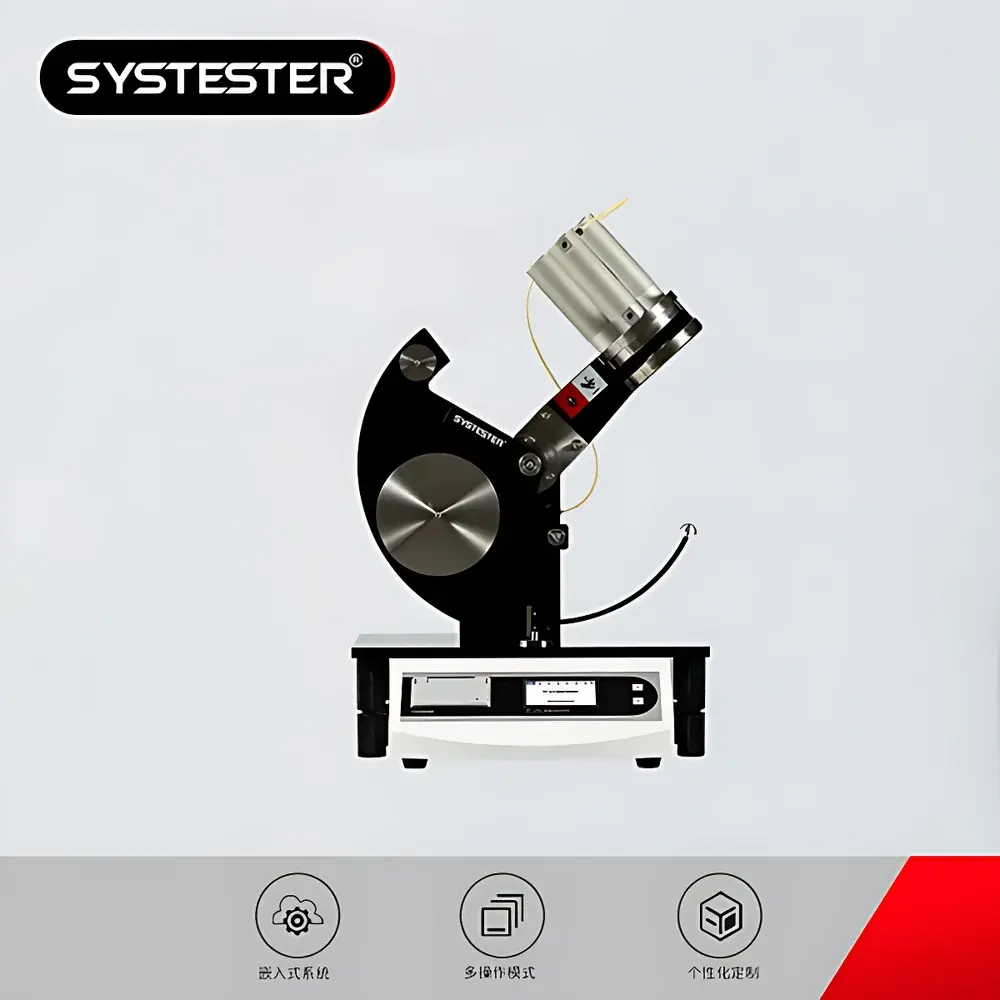
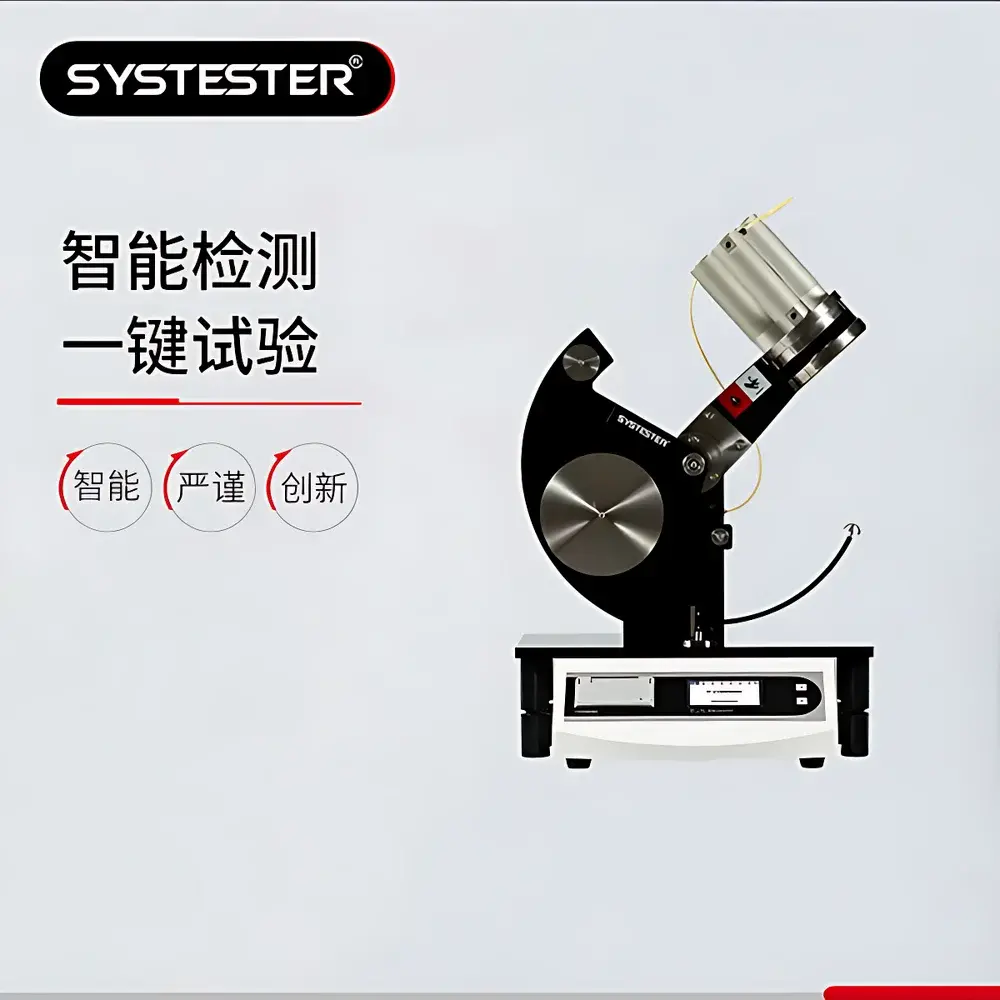
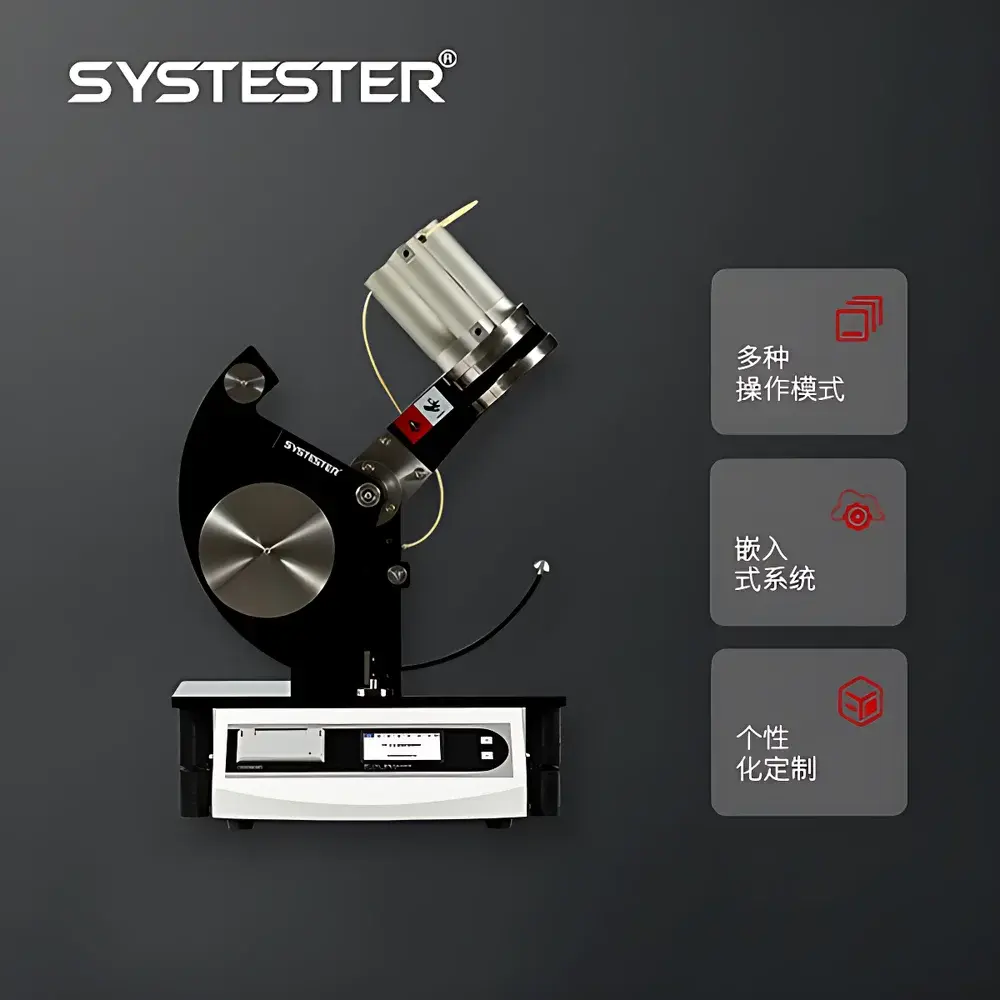
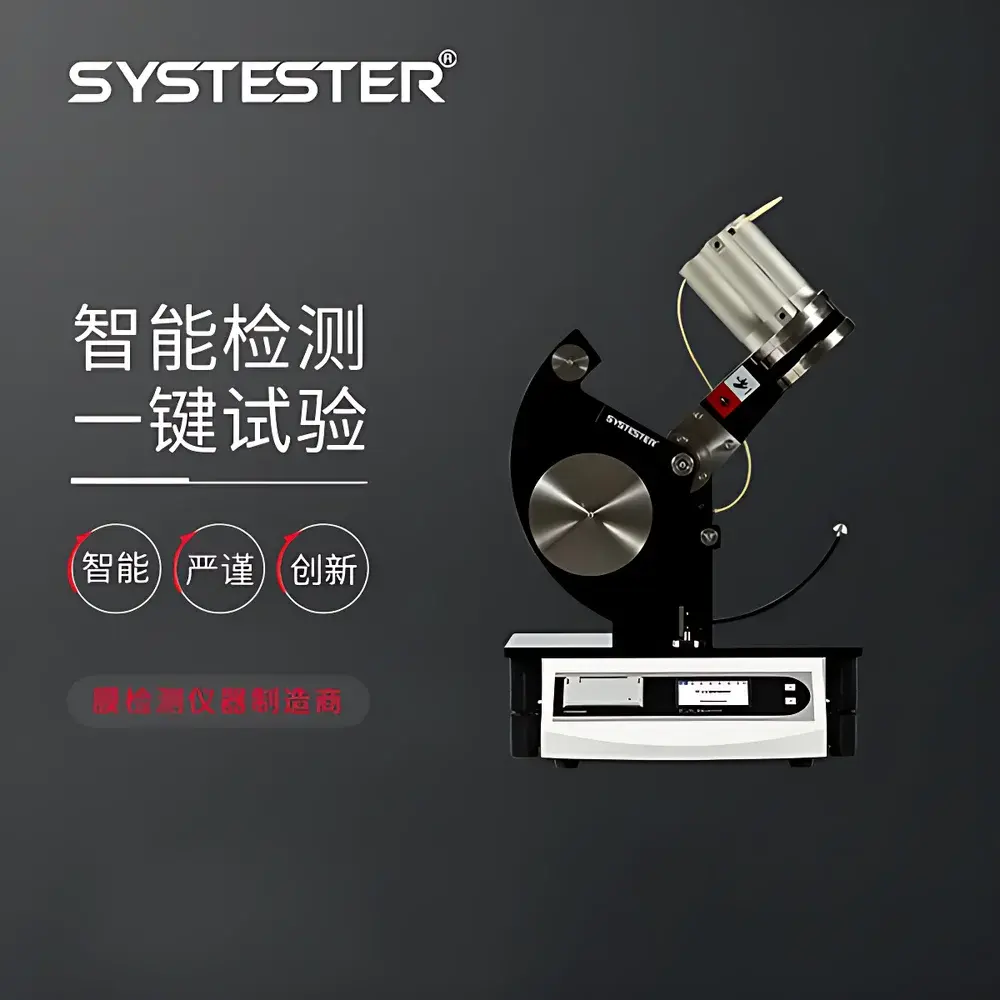
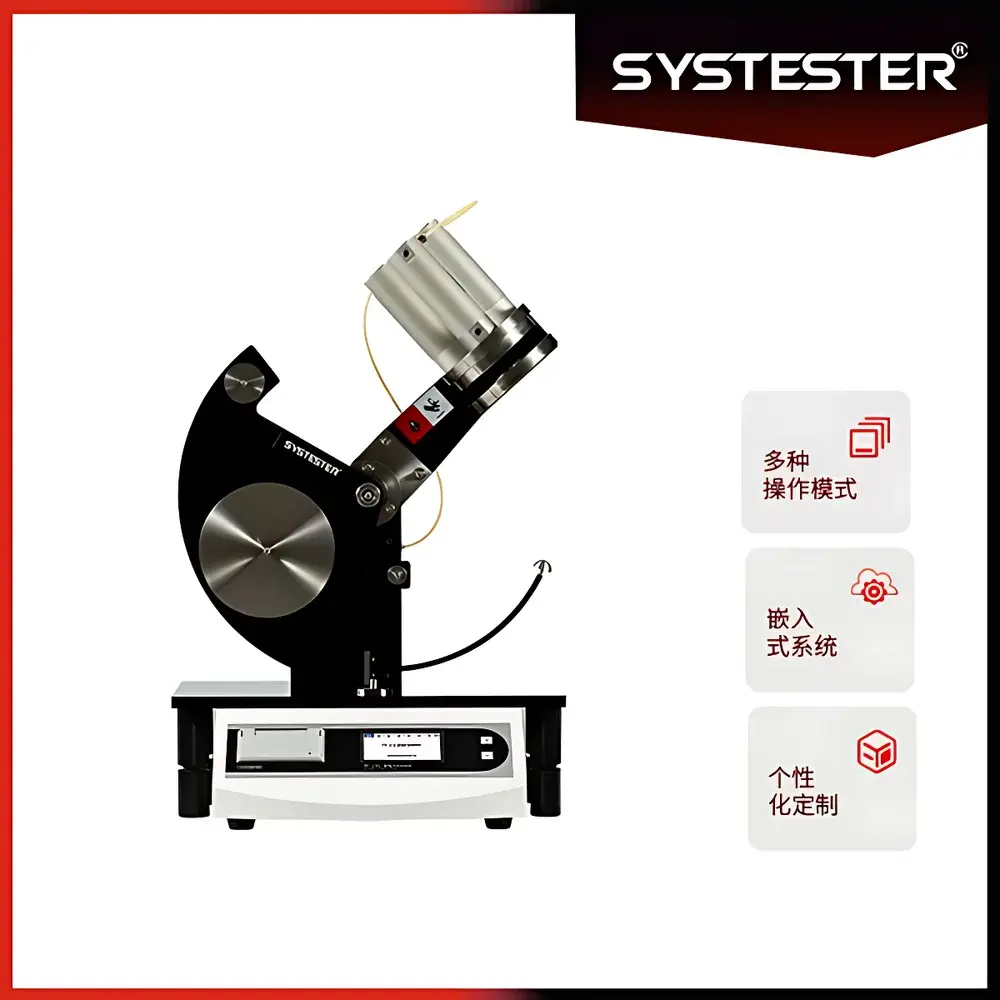
SYSTESTER GB 8809-1988 Pendulum Impact Tester for Thin Films and Flexible Packaging Materials
| Brand | SYSTESTER |
|---|---|
| Origin | Shandong, China |
| Model | GB 8809-1988 Pendulum Impact Tester |
| Impact Energy Options | 1 J, 2 J, 3 J, 5 J (selectable) |
| Resolution | 0.001 J |
| Impact Head Diameter | Ø25.4 mm, Ø19 mm, Ø12.7 mm |
| Clamp Aperture | Ø89 mm, Ø60 mm |
| Specimen Size | 100 mm × 100 mm or Ø100 mm |
| Pneumatic Pressure Range | 0.3–1.5 MPa |
| Power Supply | AC 220 V, 50 Hz |
| Dimensions (L×W×H) | 492 × 383 × 752 mm |
| Net Weight | 44 kg |
| Compliance | GB/T 8809–1988, ASTM D3420, NF T54-116 |
Overview
The SYSTESTER GB 8809-1988 Pendulum Impact Tester is an electromechanical instrument engineered for precise quantification of impact resistance in thin, flexible sheet materials—primarily plastic films, laminates, aluminum foils, coated papers, and composite packaging substrates. It operates on the principle of pendulum impact energy absorption, where a calibrated swinging arm with interchangeable masses strikes a horizontally clamped specimen under controlled pneumatic release. The energy absorbed during fracture—or partial deformation—is calculated from the angular displacement of the pendulum post-impact, measured via high-resolution optical encoder technology (0.001 J resolution). This method aligns with standardized Charpy-type impact mechanics adapted specifically for low-energy, high-sensitivity applications in packaging R&D and quality control laboratories. Unlike drop-weight systems, the pendulum configuration delivers consistent impact velocity and defined kinetic energy profiles, minimizing variability from release timing and enabling high reproducibility across operator shifts and instrument installations.
Key Features
- Electronically controlled pendulum release and data acquisition system with real-time energy calculation
- Industrial-grade TFT touchscreen interface featuring a flat, zero-nesting UI architecture for intuitive navigation and reduced training time
- True-color LCD display showing immediate test results—including absorbed energy, peak force analog (if calibrated), and pass/fail status against user-defined thresholds
- Pneumatically actuated specimen clamping (Ø60 mm and Ø89 mm apertures) ensuring uniform stress distribution and eliminating manual torque variation
- Pneumatic pendulum locking and trigger release mechanism, synchronized to ISO-compliant timing tolerances (< ±1 ms)
- Onboard statistical engine computing mean, min, max, standard deviation, and coefficient of variation across up to 99 test cycles
- Integrated non-volatile memory supporting chronological storage of ≥10,000 test records with timestamp, operator ID, and environmental metadata (optional)
- Built-in thermal printer for immediate hardcopy output compliant with GLP documentation requirements
- Standard RS-232 and optional USB/RS-485 interfaces supporting bidirectional communication with LIMS and DSM laboratory data management platforms
- Modular impact head system with three interchangeable diameters (Ø12.7 mm, Ø19 mm, Ø25.4 mm) to accommodate varying stiffness and failure mode requirements per material class
Sample Compatibility & Compliance
The instrument accommodates specimens measuring either 100 mm × 100 mm squares or Ø100 mm discs, compatible with thicknesses ranging from 12 µm to 500 µm. It supports single-layer polymers (e.g., PET, BOPP, LDPE), metallized films, paperboard laminates, and barrier-coated substrates used in pharmaceutical blister packaging and food-grade pouches. All mechanical configurations and calibration procedures conform to the metrological traceability requirements of GB/T 8809–1988, while cross-referenced validation protocols satisfy ASTM D3420 (Standard Test Method for Impact Resistance of Plastic Film by the Pendulum Method) and French standard NF T54-116. Optional calibration certificates are available with NIST-traceable reference standards and uncertainty budgets compliant with ISO/IEC 17025.
Software & Data Management
The tester integrates seamlessly with SYSTESTER’s DSM Laboratory Data Management System—a secure, audit-ready platform supporting 21 CFR Part 11 compliance through electronic signatures, role-based access control, and immutable audit trails. Raw sensor data, calibration logs, and user activity histories are stored in encrypted SQLite databases with automatic daily backup to network drives. Customizable report templates generate PDF outputs containing graphical energy distribution histograms, Weibull failure probability plots, and batch-level summary statistics. API endpoints allow integration with SAP QM, LabWare LIMS, and Oracle Clinical for automated QC release workflows.
Applications
This instrument serves critical functions across packaging development, supplier qualification, and regulatory submission support. Typical use cases include: evaluating seal integrity of heat-sealed pouches; benchmarking puncture resistance of medical device pouches against ISO 11607-1; validating shelf-life stability of barrier films under accelerated aging conditions; assessing brittleness transitions in recycled-content films; and generating comparative datasets for FDA-submitted biocompatibility dossiers. Its precision and repeatability make it suitable for internal specification setting, incoming inspection of rollstock, and collaborative round-robin testing with contract research organizations.
FAQ
What standards does this instrument directly support?
GB/T 8809–1988, ASTM D3420–2021, and NF T54-116 are fully implemented in test method templates, calibration routines, and reporting logic.
Is pneumatic supply included with the system?
No—users must provide a clean, oil-free compressed air source delivering 0.3–1.5 MPa via Ø6 mm polyurethane tubing; a desiccant filter is recommended for long-term reliability.
Can the system be validated for GMP environments?
Yes—IQ/OQ documentation packages are available, including installation checklists, operational boundary verification, and performance qualification protocols aligned with Annex 11 and EU GMP Annex 15.
How is traceability maintained for impact energy calibration?
Each pendulum mass and impact head is serialized and certified with individual calibration certificates referencing national metrology institutes; recalibration intervals follow ISO 17025 guidelines (typically annually or after 5,000 impacts).
Does the software support multi-user environments with permission tiers?
Yes—DSM supports hierarchical user roles (Admin, Technician, Reviewer, Auditor) with configurable permissions for data export, method editing, and report approval workflows.





