
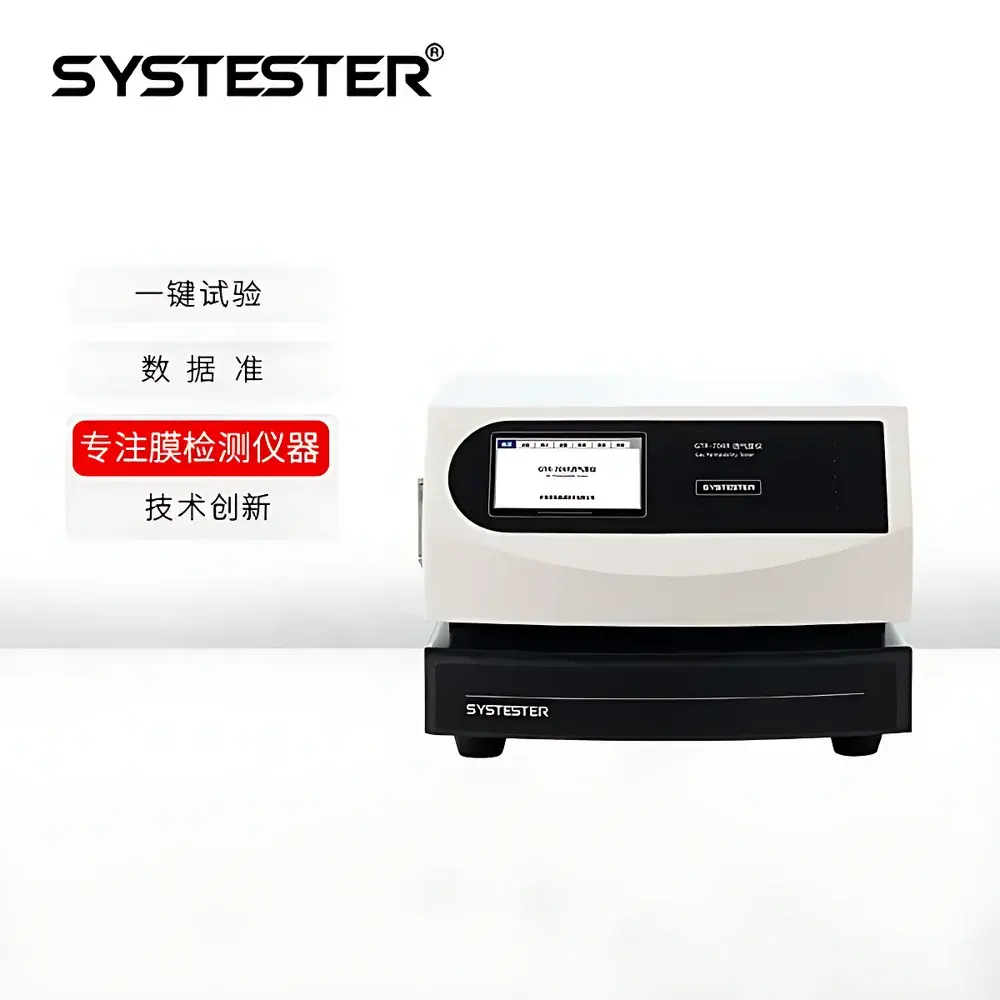
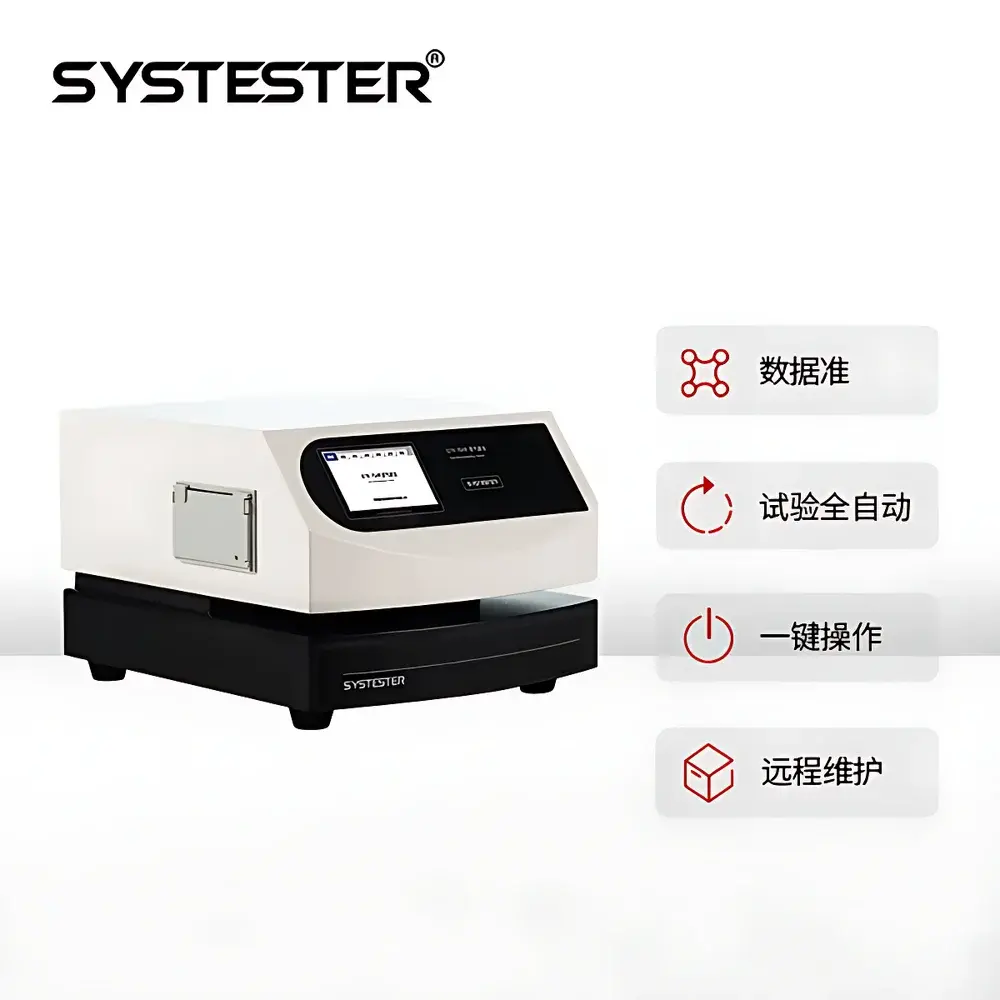
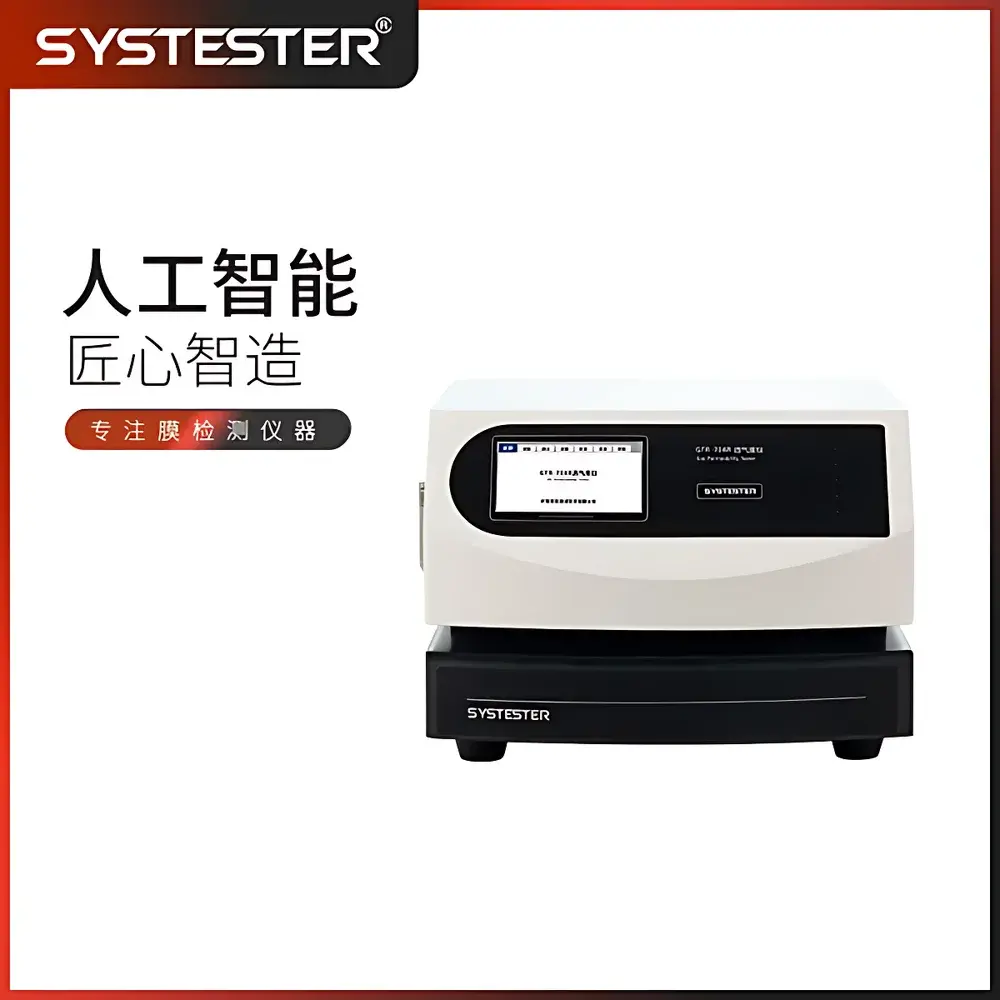
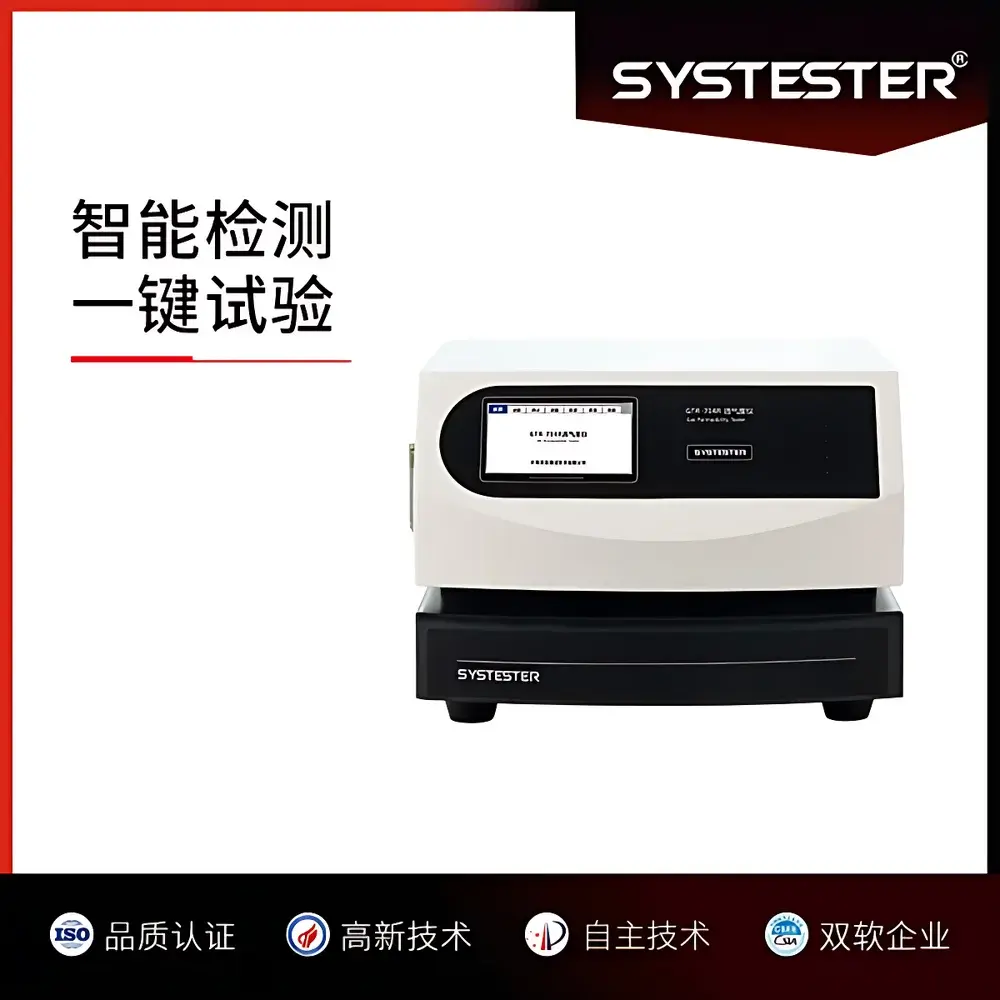
SYSTESTER GTR-704R Air Permeability Tester for Lithium Battery Separators
| Brand | SYSTESTER |
|---|---|
| Origin | Shandong, China |
| Model | GTR-704R |
| Test Range | 10–15,000 s/100 mL |
| Resolution | 0.1 s/100 mL |
| Sample Area | 1.0 in² (0.25 in² / 0.1 in² optional) |
| Pressure Range | 20 kPa |
| Pressure Accuracy | ±0.01 kPa |
| Max Sample Thickness | ≤5 mm |
| Gas Supply | Clean compressed air (0.3–1.0 MPa) |
| Interface | Ø6 mm pneumatic fitting |
| Power | AC 220 V, 50 Hz |
| Dimensions | 370 × 320 × 220 mm (L×D×H) |
| Weight | 20 kg |
| Compliance | ISO 5636-5, ASTM D726, TAPPI T460, GB/T 36363–2018 |
Overview
The SYSTESTER GTR-704R Air Permeability Tester is a precision-engineered instrument designed specifically for quantitative evaluation of gas permeability in thin, porous functional materials critical to lithium-ion battery manufacturing and related advanced material R&D. It operates on the principle of Gurley-type airflow resistance measurement—determining the time required for a fixed volume (100 mL) of air to pass through a standardized sample area under controlled differential pressure (20 kPa). This method provides a direct, reproducible metric (s/100 mL) widely accepted across battery separator qualification protocols, membrane development workflows, and quality control labs adhering to international standards including ISO 5636-5, ASTM D726, and GB/T 36363–2018. Unlike generic porosity analyzers, the GTR-704R integrates hardware and software architecture optimized for high-throughput, operator-independent testing of fragile, low-basis-weight substrates such as polyolefin microporous separators, proton exchange membranes (PEMs), gas diffusion layers (GDLs), and specialty filter papers.
Key Features
- One-touch automated test sequence with real-time status feedback—eliminates manual timing errors and inter-operator variability
- Industrial-grade 7-inch TFT capacitive touchscreen with zero-layer navigation UI, enabling intuitive workflow execution without training overhead
- Pneumatically actuated clamping mechanism ensures consistent sample compression and eliminates edge leakage—critical for maintaining laminar flow conditions across non-rigid membranes
- Multi-unit display capability: s/100 mL (Gurley value), µm/Pa·s (air permeance), and derived cm³/cm²·s·Pa for cross-standard comparability
- Integrated thermal line printer outputs traceable test reports with timestamp, sample ID, pressure setpoint, measured time, and unit conversion—supporting GLP documentation requirements
- Hardware-based overpressure protection circuitry safeguards both sensor integrity and operator safety during unexpected pressure surges or regulator failure
- Standard RS-232 and USB-B interfaces enable seamless integration into LIMS environments and support remote configuration via PC-based utility software
Sample Compatibility & Compliance
The GTR-704R accommodates a broad spectrum of planar porous media used in electrochemical energy systems. Primary applications include microporous polyethylene (PE) and polypropylene (PP) battery separators (e.g., Celgard®, Entek®, SK Innovation grades), carbon paper and cloth GDLs, Nafion® and hydrocarbon-based PEMs, catalyst-coated membranes (CCMs), and cellulose-based filtration media. Its configurable test head (standard 1.0 in²; optional 0.25 in² or 0.1 in²) allows precise adaptation to industry-specific sampling protocols—particularly where small-area validation is mandated by cell design constraints or limited material availability. All mechanical and pneumatic components meet ISO 8573-1 Class 4 purity requirements for compressed air supply, ensuring no oil or particulate contamination compromises test repeatability. The instrument’s full compliance with ISO 5636-5 (determination of air resistance of paper and board), ASTM D726 (standard test method for resistance of coated paper to wetting), and GB/T 36363–2018 (lithium-ion battery separator specifications) validates its suitability for regulatory submissions and supplier qualification audits.
Software & Data Management
While the GTR-704R operates autonomously via embedded firmware, its communication interface supports bidirectional data exchange with external laboratory management systems. Test logs—including raw elapsed time, applied pressure, ambient temperature/humidity (via optional external probe input), and user-defined metadata—are exportable in CSV format for statistical process control (SPC) analysis. Firmware versioning, calibration history, and audit trail timestamps are retained internally and accessible via service mode—enabling alignment with FDA 21 CFR Part 11 electronic record requirements when paired with validated IT infrastructure. Optional calibration kits (traceable to NIST-certified reference standards) allow periodic verification of flow path geometry and pressure transducer linearity—essential for maintaining metrological traceability in ISO/IEC 17025-accredited laboratories.
Applications
- Quality assurance of dry-process and wet-process lithium battery separators during incoming inspection and production lot release
- Comparative permeability screening of next-generation ceramic-coated, PVDF-blended, or ultrathin (<12 µm) separators
- R&D evaluation of pore structure modifications induced by stretching, irradiation, or surface grafting treatments
- Process validation of coating uniformity and calendering parameters in electrode and separator manufacturing lines
- Accelerated aging studies correlating permeability drift with electrolyte wettability loss and ionic conductivity degradation
- Technical due diligence assessments for battery material suppliers undergoing OEM qualification programs
FAQ
What gases can be used besides compressed air?
Clean, oil-free nitrogen or argon may be substituted for air when inert atmosphere testing is required—provided gas supply pressure remains within 0.3–1.0 MPa and dew point is maintained below −40 °C.
Is the instrument compatible with ASTM F2149 for fuel cell membrane testing?
While ASTM F2149 specifies helium permeability at elevated pressures, the GTR-704R’s core methodology aligns with its fundamental airflow resistance principles; however, helium-specific calibration and pressure range extension require factory modification and are not part of standard configuration.
How often does the pressure transducer require recalibration?
Annual recalibration is recommended under normal usage; more frequent verification is advised if the instrument undergoes mechanical shock, exposure to condensation, or operation outside 15–30 °C ambient temperature range.
Can test data be exported directly to Excel or LabArchives?
Yes—CSV exports are natively supported via USB flash drive or serial transmission; structured import templates for LabArchives and common ELN platforms are available upon request from SYSTESTER Technical Support.
Does the GTR-704R meet GLP audit requirements for pharmaceutical battery applications?
When deployed with documented calibration records, user access controls, and electronic signature-enabled reporting workflows, it satisfies core GLP elements for physical property testing of battery components used in implantable medical devices per ISO 14155 and ICH M10 guidelines.






