
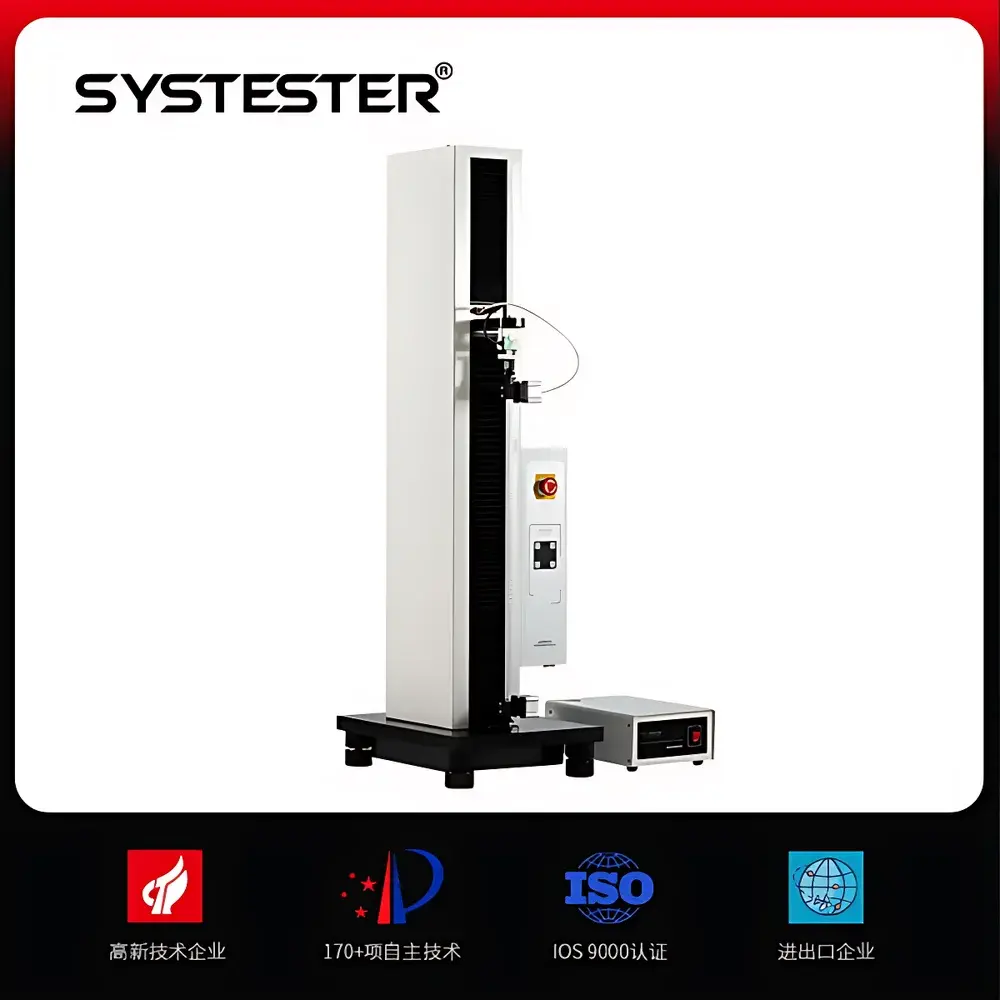
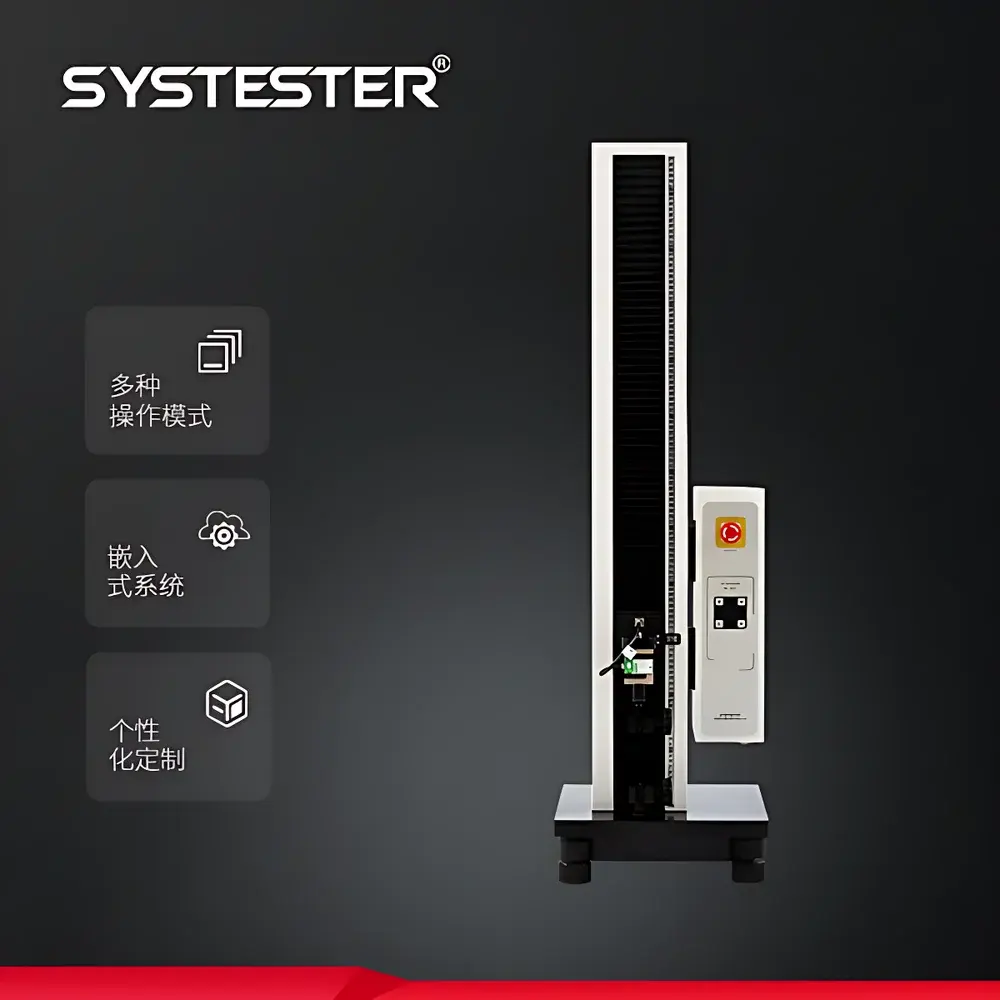
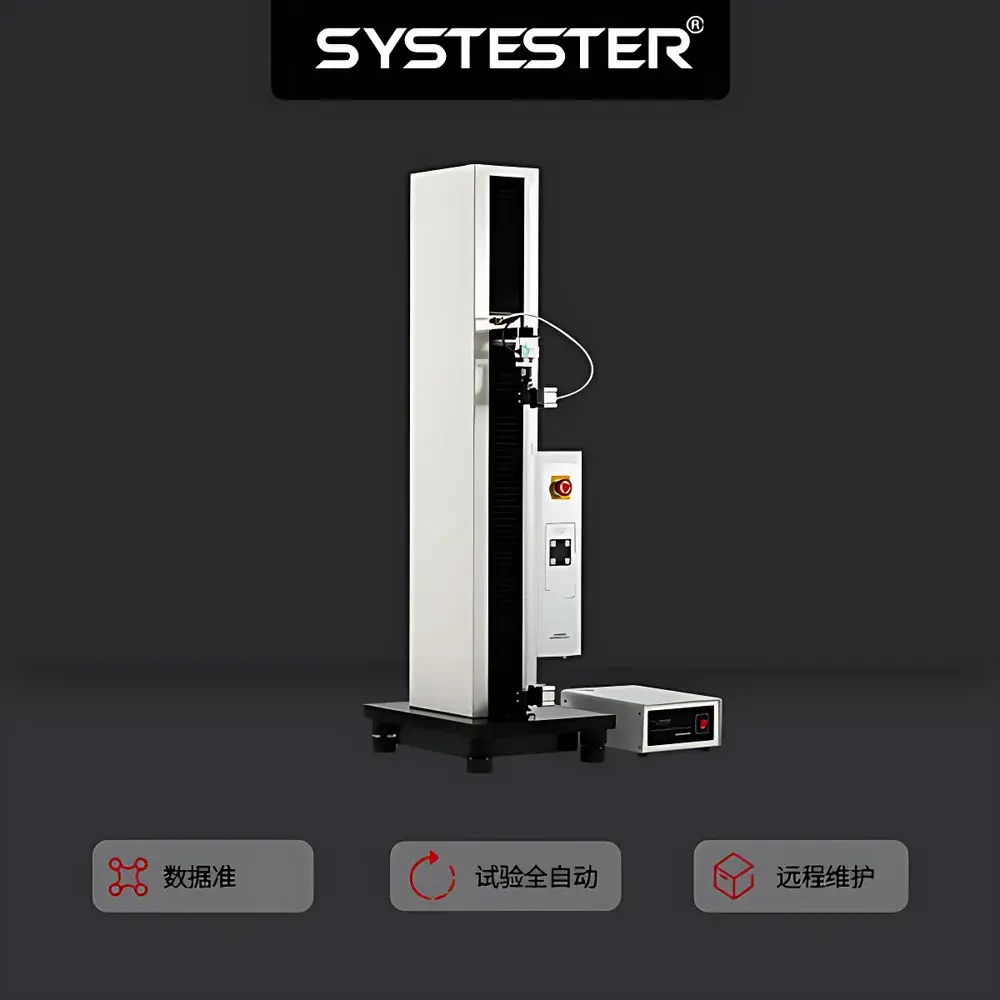
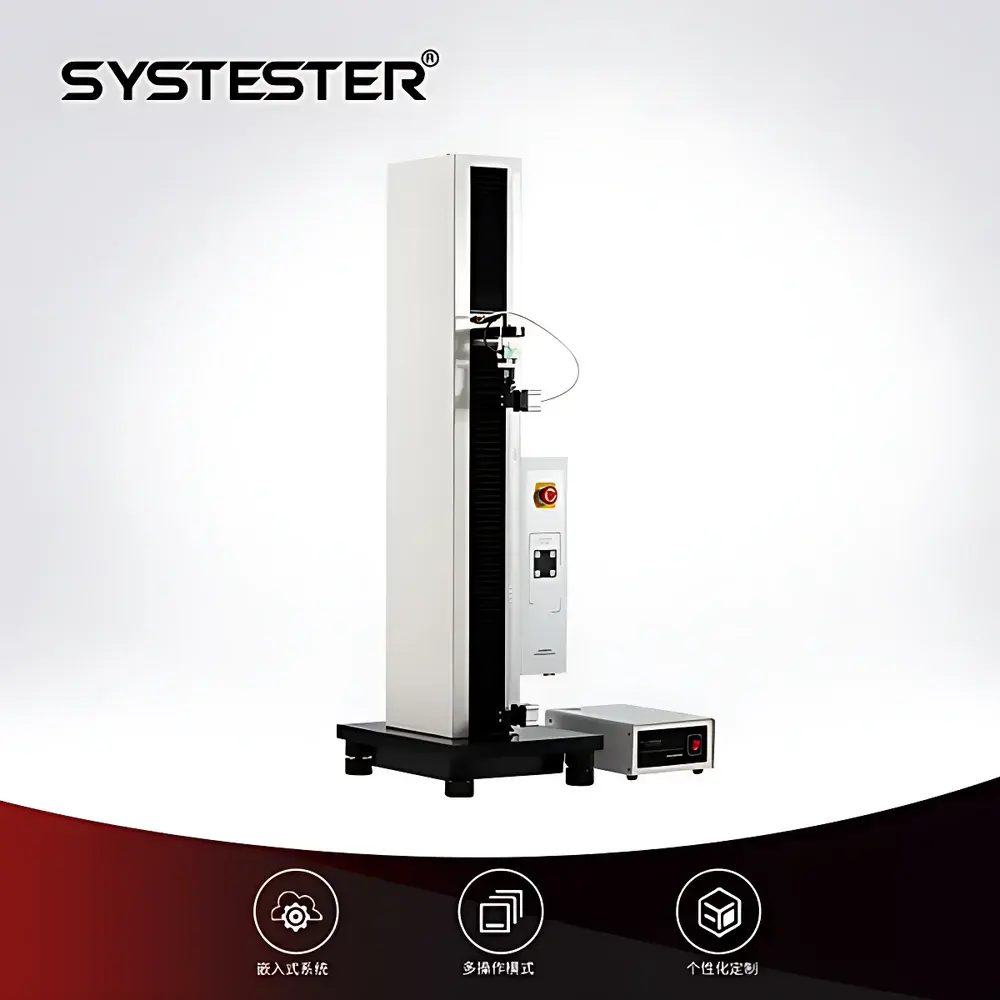
SYSTESTER TSL-1002 Mask Material Tensile Tester Compliant with GB/T 3923.1–2013
| Brand | SYSTESTER |
|---|---|
| Origin | Shandong, China |
| Model | TSL-1002 |
| Load Capacity Options | 50 N, 100 N, 250 N, 500 N, 1000 N, 2000 N |
| Test Speed Range | 0.1–1000 mm/min (software-controlled, infinitely variable) |
| Stroke | 1000 mm |
| Displacement Resolution | 0.01 mm |
| Clamp Width (standard) | 30 mm |
| Power Supply | AC 220 V, 50 Hz |
| Power Consumption | 300 W |
| Dimensions (L×W×H) | 380 × 450 × 1309 mm |
| Net Weight | 92 kg |
| Accuracy Class | Better than Grade 0.5 |
| Compliance Standards | GB/T 3923.1–2013, GB/T 17200, ISO 37, ASTM D882, ASTM D1938, ASTM F88, EN ISO 11600, JIS P8113 |
Overview
The SYSTESTER TSL-1002 Mask Material Tensile Tester is a microprocessor-controlled universal testing instrument engineered for precise mechanical characterization of nonwoven fabrics, melt-blown polypropylene layers, elastic earloop materials, and laminated composites used in medical and industrial face mask manufacturing. Designed explicitly to meet the metrological and procedural requirements of GB/T 3923.1–2013 (“Textiles — Determination of Breaking Force and Elongation at Break — Part 1: Strip Method”), this system implements dual-column electromechanical architecture with servo-driven crosshead motion and high-fidelity load cell feedback. It operates on the principle of uniaxial tensile loading under controlled displacement rate, delivering traceable force-displacement curves for calculation of breaking force (N), elongation at break (%), tensile modulus (MPa), yield point, and energy-to-break (J/m²). Its structural rigidity and thermal-mechanical stability ensure repeatable results across multi-shift production QC environments and accredited laboratory settings.
Key Features
- Fully computer-controlled bidirectional testing (tension & compression) via embedded real-time operating system and dedicated Windows-based software suite
- High-accuracy load cells calibrated to ISO 376:2011, available in six selectable ranges (50 N to 2000 N) to optimize signal-to-noise ratio per specimen class
- Servo-motor-driven lead screw mechanism with preloaded ball screws, enabling smooth, backlash-free motion and consistent preload application
- Infinitely variable test speed (0.1–1000 mm/min), programmable in 0.01 mm/min increments directly within test method templates
- Digital electronic limit switches with configurable soft-stop thresholds—eliminating mechanical adjustment and reducing operator dependency
- Integrated hardware-based overload protection and emergency stop circuit compliant with IEC 60204-1 safety standards
- Standard RS-232 and USB 2.0 interfaces; optional Ethernet port for networked deployment in centralized QA infrastructure
- Audit-trail-enabled data acquisition: every parameter change, test execution, calibration event, and user login is timestamped and cryptographically logged
- Five-tier role-based access control (RBAC) supporting administrator, supervisor, technician, analyst, and viewer permissions—aligned with FDA 21 CFR Part 11 Annex 11 requirements
Sample Compatibility & Compliance
The TSL-1002 accommodates flat, flexible specimens up to 1000 mm travel length and 30 mm nominal grip width (standard pneumatic or mechanical wedge clamps). Optional fixtures include 55 mm wide clamps for wider nonwovens, European-standard ISO 527-2 compliant grips, custom-designed earloop anchoring fixtures, and standardized pressure rollers per GB/T 2792 for peel adhesion validation. The system supports all mechanical test types referenced in mask material evaluation protocols: strip tensile (GB/T 3923.1–2013), tear resistance (ASTM D1938), seam strength (GB/T 2792), puncture resistance (ISO 13934-2), and loop elasticity (ASTM F2100 Annex A3). Full compliance documentation—including factory calibration certificates traceable to NIM (National Institute of Metrology, China) and uncertainty budgets—is provided with each unit.
Software & Data Management
The proprietary SYSTESTER TestMaster v5.2 software delivers ISO/IEC 17025-aligned test method definition, automated report generation (PDF/CSV/XLSX), and statistical process control (SPC) dashboards. All raw force-displacement data are stored in encrypted binary format with SHA-256 checksums. Revision-controlled method templates enforce standard operating procedures across shifts and sites. Optional integration with the DSM Laboratory Data Management System enables centralized metadata tagging, instrument usage analytics, electronic signature workflows, and long-term archival compliant with GLP and GMP record retention mandates (minimum 15 years). Software validation packages (IQ/OQ/PQ) and 21 CFR Part 11 configuration files are available upon request.
Applications
- Quality conformance testing of melt-blown PP filter media against GB/T 32610–2016 and ASTM F2100 specifications
- Batch release verification of spunbond outer layers and inner comfort liners for tensile integrity and elongation consistency
- Development-phase evaluation of biodegradable mask substrates under accelerated aging conditions
- Regulatory submission support for CE-marked PPE dossiers requiring mechanical performance data per EN 14683:2020
- Root cause analysis of mask strap failure modes using load-cycle fatigue protocols
- Supplier qualification audits requiring third-party verifiable test evidence with full chain-of-custody logging
FAQ
Does the TSL-1002 support automatic specimen identification via barcode scanning?
Yes—when equipped with optional USB barcode reader module and DSM integration, the system auto-populates test parameters based on material lot ID and predefined method profiles.
Can test methods be exported and shared across multiple instruments?
Absolutely. Method templates (.stm files) are portable between TSL-1002 units running identical firmware versions and can be version-controlled via DSM.
Is calibration certificate included with shipment?
Yes—a NIM-traceable calibration certificate covering force, displacement, and speed axes is supplied with each unit, along with as-found/as-left data.
What is the recommended maintenance interval for the servo drive system?
SYSTESTER recommends preventive maintenance every 12 months or after 5,000 test cycles, including lead screw lubrication, encoder alignment check, and load cell zero-drift verification.
Does the software support multi-language UI for global laboratories?
TestMaster v5.2 offers English, Simplified Chinese, and Spanish language packs; additional locales may be commissioned under OEM agreement.





