
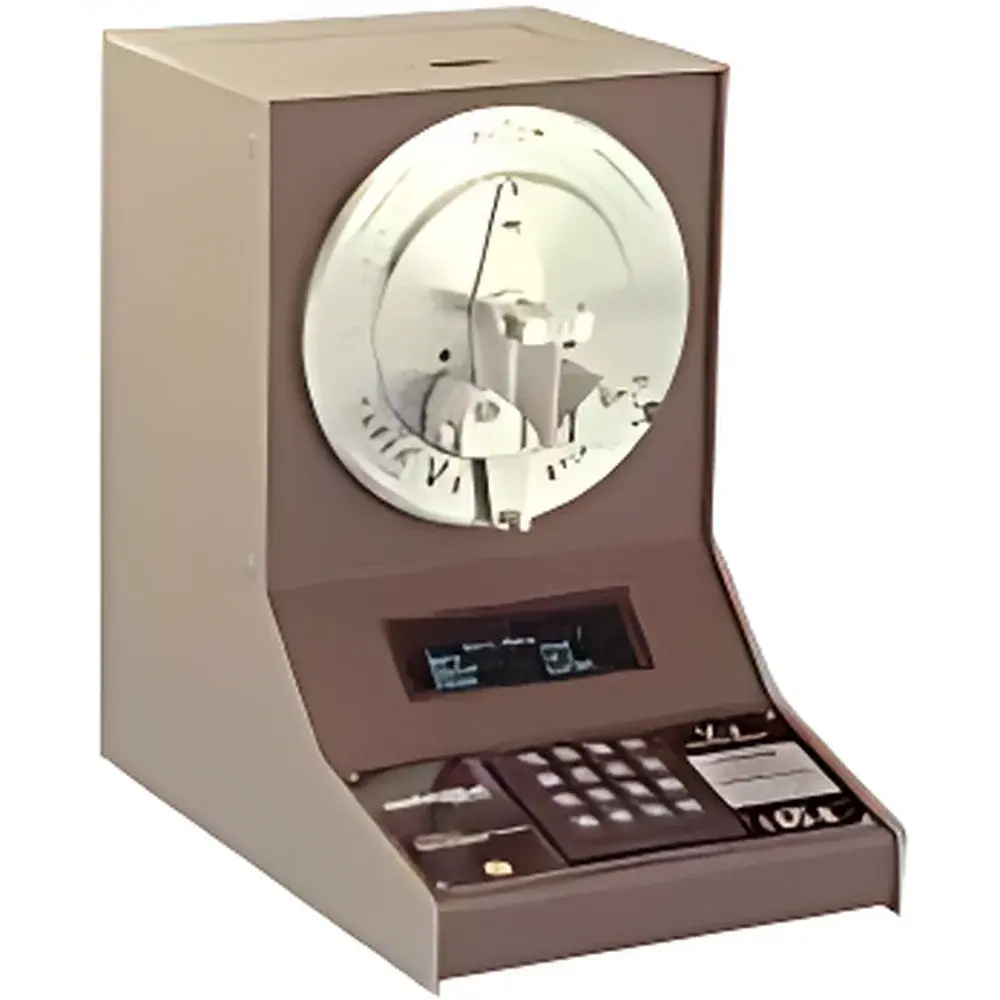
Taber 150-E Taber Stiffness Tester
| Brand | Taber |
|---|---|
| Origin | USA |
| Model | 150-E |
| Stiffness Range | 1–10,000 Taber Stiffness Units (TSU) |
| Accuracy | ±1% |
| Display | 4×20-character vacuum fluorescent display with 16 soft keys |
| Data Storage | 1,000 readings |
| Data Processing | Automatic calculation of mean, standard deviation, min/max values |
| Sample Dimensions | 38 mm × 70 mm |
| Max Sample Thickness | 0.5 mm |
| Power Supply | 115/230 V, 50/60 Hz |
| Weight | 11.3 kg (25 lbs) |
| Dimensions | 381 mm × 254 mm × 394 mm (15″ × 10″ × 15.5″) |
| Interface | RS-232 serial output |
| Compliance | ASTM D5342, ASTM D5650, ISO 2493, TAPPI T489, TAPPI T566, JIS P8125, JIS P8223, BS 3748, AS 1301.431RP, Appita P431 rp-73, CPPS D28P, AENOR UNE 57-075 |
Overview
The Taber 150-E Taber Stiffness Tester is a precision-engineered instrument designed to quantify the resistance of thin, flexible sheet materials—such as paper, board, plastic films, and nonwovens—to bending deformation under controlled torsional loading. It operates on the classical Taber stiffness principle: a standardized sample is clamped vertically at its top edge while its free end is subjected to a calibrated rotational torque via a gear-driven turntable. The resulting angular deflection of a pendulum arm—mechanically coupled to the sample’s base—is measured and converted into stiffness units (TSU) using a calibrated torsion spring system. This method delivers high reproducibility for comparative and specification-based quality control in R&D, manufacturing, and regulatory testing environments. Unlike dynamic or oscillatory methods, the 150-E implements static torsional loading at fixed angular displacements (typically 7.5° or 15°), ensuring compliance with long-standing international standards governing stiffness evaluation of planar materials.
Key Features
- Robust mechanical architecture featuring a precision-machined gear drive, low-inertia pendulum assembly, and dual-point sample clamping—top jaw fixed at turntable center, bottom secured between adjustable tension rollers.
- Digital vacuum fluorescent display (4×20 characters) with intuitive 16-key membrane interface for direct parameter entry, test initiation, and real-time result viewing.
- Onboard data handling: stores up to 1,000 individual readings; automatically computes arithmetic mean, standard deviation, minimum and maximum values per test batch.
- RS-232 serial interface enables seamless integration with LIMS, QA databases, or custom lab automation platforms for traceable data export.
- Self-contained design requires no external utilities—no compressed air, water cooling, or vacuum sources—making it suitable for benchtop deployment in QC labs, pilot lines, or ISO/IEC 17025-accredited facilities.
- Includes full calibration suite: certified plastic reference shims, stainless-steel sample cutter (38 mm × 70 mm), calibrated weights, and comprehensive operator manual aligned with ASTM and TAPPI procedural guidelines.
Sample Compatibility & Compliance
The 150-E accepts flat, isotropic specimens up to 0.5 mm thick and precisely dimensioned at 38 mm width × 70 mm length—cut using the supplied die to eliminate edge variability. It is validated for use across diverse material classes including uncoated and coated papers, corrugated board liners, metallized films, textile laminates, and pharmaceutical blister packaging substrates. Its measurement methodology and reporting structure are explicitly referenced in over twelve globally recognized standards, including ASTM D5342 (Standard Test Method for Stiffness of Paper and Paperboard Using the Taber Stiffness Tester), ISO 2493 (Paper and board — Determination of stiffness — Taber method), TAPPI T489 om-22, and JIS P8125. The instrument supports GLP-compliant workflows through timestamped data logging, operator ID input (via keypad), and audit-ready output files compatible with FDA 21 CFR Part 11–enabled systems when paired with validated host software.
Software & Data Management
While the 150-E operates autonomously via its embedded microcontroller, its RS-232 port allows bidirectional communication with third-party applications. Raw ASCII-formatted data streams include test ID, date/time stamp, individual TSU values, calculated statistics, and instrument status flags. When integrated with laboratory information management systems (LIMS) or statistical process control (SPC) platforms, users can generate SPC charts, enforce pass/fail thresholds against internal specifications, and archive results with full metadata—including environmental conditions logged externally. No proprietary software is required; ASCII protocol documentation is provided to facilitate custom script development (e.g., Python, LabVIEW) for automated report generation and database ingestion.
Applications
- Quality assurance of printing papers and packaging boards during incoming inspection and final release testing.
- Correlation studies between stiffness, basis weight, caliper, and fiber furnish composition in pulp and paper R&D.
- Evaluation of coating effects (e.g., clay, calcium carbonate, polymer dispersions) on bending rigidity without altering tensile strength profiles.
- Stability assessment of heat-sealable films subjected to thermal aging or humidity cycling protocols.
- Validation of stiffness retention in biodegradable packaging after exposure to accelerated weathering (per ISO 4892).
- Supporting ISO/IEC 17025 method validation packages for accredited testing laboratories performing routine conformity assessments.
FAQ
What angular deflection angles are supported by the 150-E?
The instrument is factory-configured for 7.5° and 15° deflections, aligning with ASTM D5342 and ISO 2493 requirements. Custom angular settings are not user-adjustable.
Can the 150-E measure samples thicker than 0.5 mm?
No. Exceeding 0.5 mm violates the geometric assumptions of the Taber method and introduces non-linear torsional response. Thicker materials require alternative methods such as the Gurley or MIT fold endurance testers.
Is calibration traceable to NIST or other national metrology institutes?
Yes. Taber Instruments provides optional NIST-traceable calibration certificates for the 150-E, covering both mechanical alignment verification and TSU scale validation using certified reference standards.
Does the instrument support multi-language displays?
No. The vacuum fluorescent display and keypad interface are English-only. However, all exported ASCII data are language-neutral and fully compatible with multilingual analysis software.
How often should the pendulum bearing and gear train be serviced?
Taber recommends annual preventive maintenance by authorized service personnel, including lubrication of the torsion pivot, gear mesh inspection, and torque calibration verification—particularly in high-throughput production labs operating >8 hours/day.



