
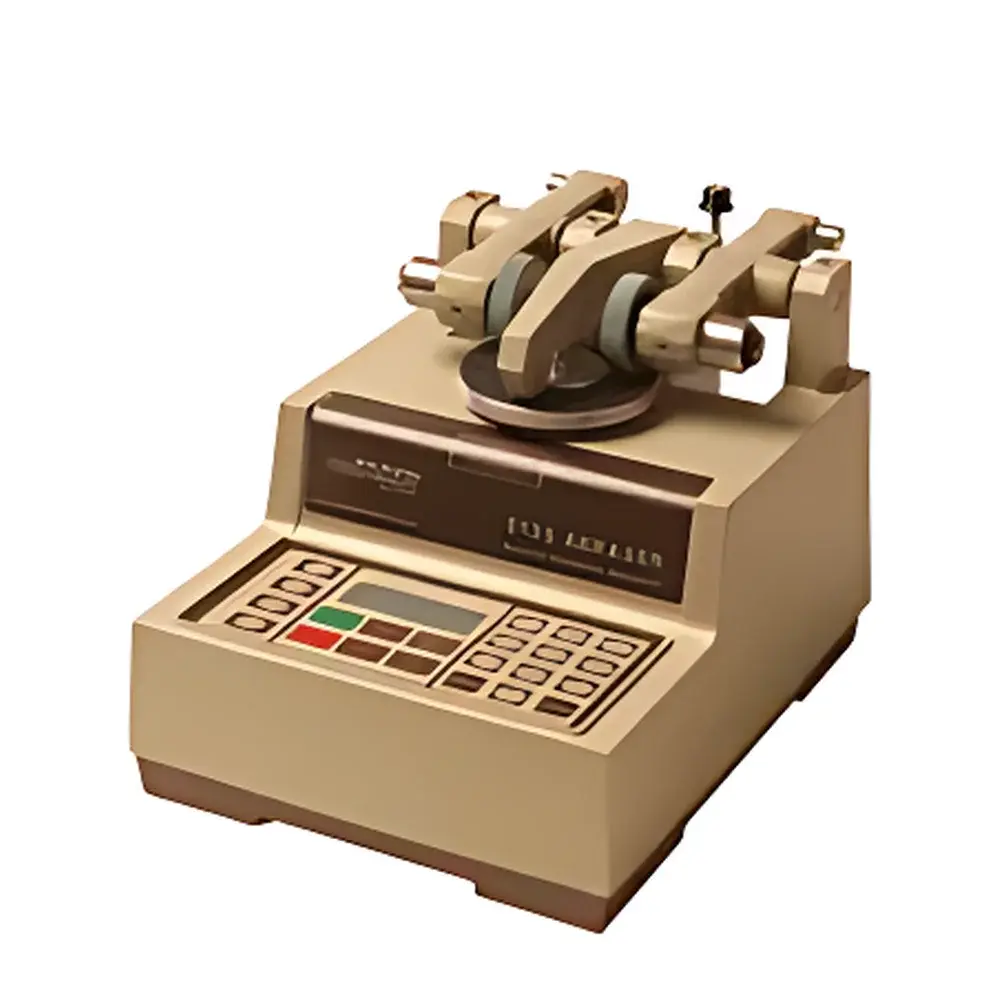
Taber 5135 Single-Station Abrasion Tester
| Brand | TABER |
|---|---|
| Origin | USA |
| Model | 5135 |
| Instrument Type | Tribological Tester (Abrasion & Wear Tester) |
| Standard Weights | (2 × 500 g, 2 × 1000 g) |
| Abrasive Wheels | CS-10 (soft), H-18 (hard) |
| Sample Area | 30 cm² |
| Vacuum Dust Extraction | Integrated |
| Display | Digital LED |
| Control Interface | Front-panel membrane keys |
| Compliance | ASTM D4060, ISO 5470-1, TAPPI T476, DIN 53109, JIS K 5400, EN 530, SAE J2527 |
| Accessories Included | S-11 abrasive paper (100 sheets/pack), S-12 brush, S-16 specimen holder (4" square), vacuum hose & cleaning brush |
Overview
The Taber 5135 Single-Station Abrasion Tester is an engineered solution for standardized, repeatable assessment of surface wear resistance under controlled mechanical stress. Based on the classic Taber oscillating abrasion principle—where two counter-rotating abrasive wheels traverse a rotating test specimen in an “X-pattern” trajectory—the instrument replicates real-world scuffing, scratching, and material loss mechanisms. Developed since the 1930s and continuously refined to meet evolving metrological demands, the 5135 model delivers high reproducibility for quality assurance, R&D validation, and process control across diverse material classes. Its compact footprint, robust cast-aluminum base, and integrated vacuum dust extraction system ensure operational stability and compliance with laboratory hygiene and safety protocols. The tester operates strictly in accordance with internationally recognized abrasion standards—including ASTM D4060 (for organic coatings), ISO 5470-1 (rubber and plastics), TAPPI T476 (paper and board), and JIS K 5400 (paint films)—making it suitable for GLP-compliant environments and regulatory submissions.
Key Features
- Single-station design optimized for precision and ease of operation: front-panel digital display, tactile membrane controls for cycle count, speed, and load selection.
- Standardized dual-wheel abrasion geometry: wheels rotate passively via specimen motion, generating consistent sliding velocity and contact pressure without motor-driven wheel rotation.
- Modular weight-loading system: accommodates standard 500 g and 1000 g calibrated masses to apply defined normal forces (e.g., 500 g per wheel = 9.8 N total applied load).
- Integrated vacuum-assisted particulate collection: minimizes airborne debris, prevents secondary abrasion from re-deposited particles, and enables accurate mass-loss measurements.
- Interchangeable abrasive media support: compatible with CS-10 (calibrated rubber wheel), H-18 (hardened steel wheel), S-11 abrasive paper, and custom wheel profiles for application-specific simulation (e.g., footwear sole wear, automotive interior abrasion).
- Specimen compatibility: accepts flat, rigid specimens up to 1/2 inch (12.7 mm) thickness; standard holder supports 4-inch (101.6 mm) square samples with 30 cm² exposed test area.
Sample Compatibility & Compliance
The Taber 5135 is validated for testing non-porous and semi-porous planar materials including coated metals, anodized aluminum, laminated composites, thermoset plastics, ceramic tiles, vinyl flooring, printed labels, dental resins, and textile-laminated substrates. Its mechanical configuration ensures uniform stress distribution across the test zone, minimizing edge effects and enabling direct correlation with field performance data. All test procedures adhere to traceable calibration protocols aligned with ISO/IEC 17025 requirements. The instrument supports audit-ready documentation when used with compliant data recording practices—particularly relevant for industries subject to FDA 21 CFR Part 11 (e.g., medical device packaging validation) or IATF 16949 (automotive component qualification). Test reports generated using this platform are routinely accepted by third-party certification bodies for CE marking, UL listing, and ANSI-accredited product evaluations.
Software & Data Management
While the Taber 5135 operates as a standalone electromechanical tester with no embedded microprocessor or network interface, it is fully compatible with external PC-based data acquisition systems via optional analog output (0–10 V) for rotational encoder signals or digital pulse counting. Users may integrate the device into LIMS or MES workflows using programmable logic controllers (PLCs) or USB-connected counter modules. For full traceability, laboratories commonly pair the 5135 with analytical balances (0.1 mg resolution), profilometers (for depth loss quantification), or gravimetric analysis workstations. All standard test methods referenced in the operator manual include defined reporting templates—covering initial/final mass, visual rating (ASTM D3451), haze change (ASTM D1003), gloss retention (ASTM D523), and volumetric wear index calculations—ensuring consistency across inter-laboratory comparisons.
Applications
- Quality control of decorative laminates and high-pressure decorative panels (HPL) per EN 438-2.
- Evaluation of scratch resistance in automotive interior trims and center console surfaces (SAE J2527).
- Wear durability assessment of printed electronics substrates and flexible OLED encapsulation layers.
- Validation of anti-scratch coatings on optical lenses and smartphone display covers (ISO 9352).
- Standardized abrasion testing of medical device packaging films (ISO 11607-1) and sterilization pouches.
- Comparative analysis of floor covering resilience in commercial building specifications (ANSI A137.1).
- R&D screening of novel biopolymer composites for sustainable packaging applications.
FAQ
What standards does the Taber 5135 directly support?
The instrument is designed to execute test protocols specified in ASTM D4060, ISO 5470-1, TAPPI T476, DIN 53109, JIS K 5400, EN 530, and SAE J2527—with physical geometry and loading mechanisms certified to replicate the prescribed test conditions.
Can the 5135 perform multi-specimen testing simultaneously?
No—the 5135 is a single-station unit. For parallel testing, multiple units or the Taber 5900 multi-station platform is recommended.
Is vacuum extraction mandatory for valid results?
Yes. Per ASTM D4060 Section 7.3 and ISO 5470-1 Clause 6.4, removal of abraded particles during testing is required to prevent three-body abrasion and ensure measurement integrity.
How is calibration maintained over time?
Annual verification of wheel diameter, specimen rotation speed (±1 rpm), applied load (±0.5%), and vacuum flow rate (±5% of nominal 25 L/min) is recommended using NIST-traceable tools and documented in the lab’s equipment maintenance log.
Does the 5135 comply with FDA 21 CFR Part 11 requirements?
The base unit itself is not electronic-data-capable; however, when integrated with compliant data acquisition hardware and validated software, full Part 11 adherence—including electronic signatures, audit trails, and record retention—is achievable within a qualified laboratory system.



