
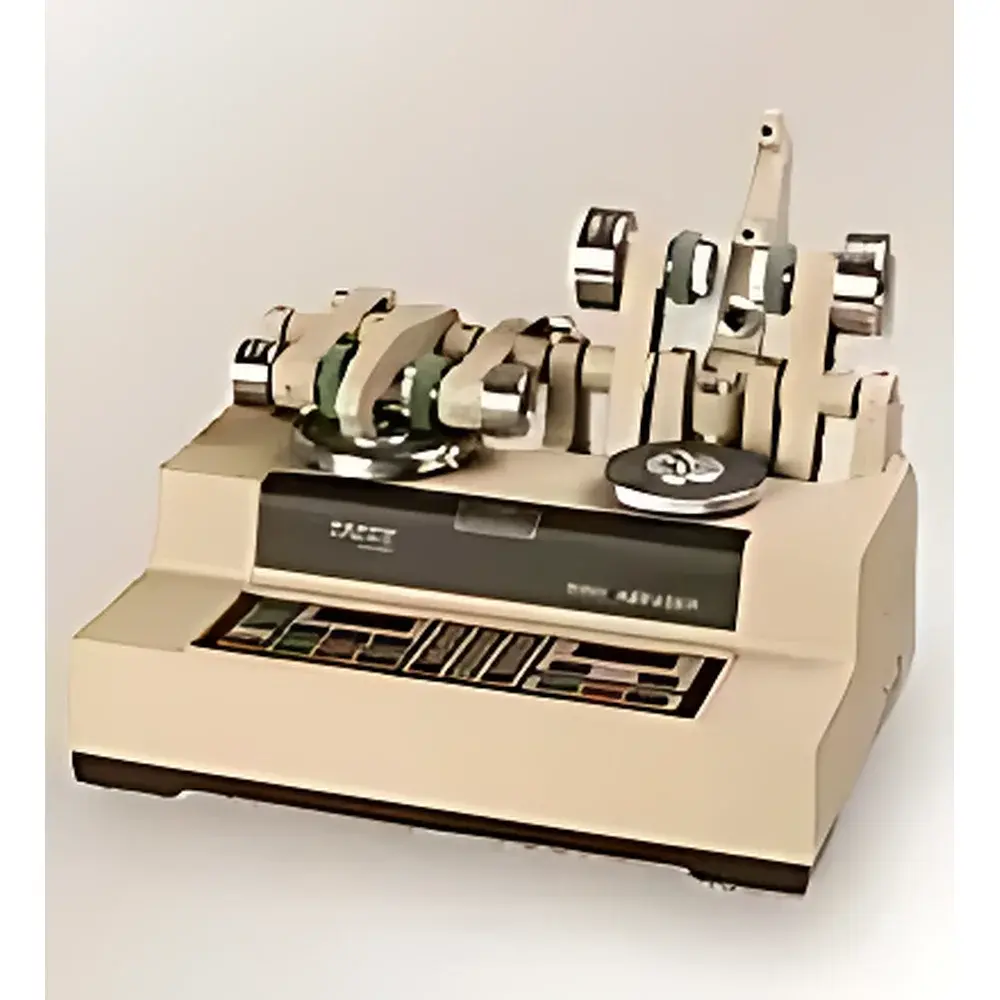
TABER 5155 Taber Abraser
| Brand | TABER |
|---|---|
| Origin | USA |
| Model | 5155 |
| Type | Rotational Abrasion Tester |
| Standard Load Configuration | (2×500 g + 2×1000 g weights) |
| Abrasive Media Compatibility | S11 abrasive paper (100 sheets/pack), S12 bristle brush (extended handle), CS10 wheels (2 pairs, soft), H18 wheels (2 pairs, hard), S16 specimen holder (4" square) |
| Integrated Vacuum System | Includes cleaning brush and flexible hose |
| Compliance | ASTM D4060, ISO 5470-1, TAPPI T476, JIS K 7350 |
Overview
The TABER 5155 Taber Abraser is a precision-engineered rotational abrasion tester designed for quantitative evaluation of surface wear resistance under controlled, repeatable conditions. Based on the fundamental principle of double-head rotary abrasion—where two abrasive wheels rotate in opposite directions while simultaneously applying vertical load against a rotating test specimen—the instrument enables standardized simulation of real-world mechanical wear mechanisms including scratching, scuffing, pilling, and material loss. Its modular architecture supports rapid interchange of abrasive media (e.g., CS10 rubber wheels, H18 ceramic-coated wheels, S11 calibrated abrasive papers) to replicate diverse service environments—from automotive interior trim durability to coated optical lens scratch resistance. The 5155 model conforms to internationally recognized test protocols, serving as a primary reference instrument in QC laboratories, R&D centers, and third-party certification facilities across polymer, coating, textile, and composite industries.
Key Features
- Modular abrasive wheel system compatible with TABER-certified CS10 (soft elastomeric), H18 (hard ceramic), and S14/S17 series wheels, enabling precise control over abrasion aggressiveness and contact geometry.
- Dual-weight loading mechanism supporting standard configurations: four 500 g masses (two pairs) and four 1000 g masses (two pairs), allowing incremental load application from 250 g to 1000 g per wheel per test station.
- Integrated vacuum-assisted debris extraction system featuring a flexible hose and dedicated cleaning brush—minimizing particulate accumulation on specimens and maintaining consistent abradant exposure throughout testing.
- Stainless steel sample platform with S16-specification 4-inch square specimen holder, ensuring rigid clamping and concentric rotation without slippage or eccentricity-induced measurement drift.
- Motor-driven dual-abrasion heads operating at fixed rotational speeds (typically 60–70 rpm per wheel), synchronized with specimen rotation (typically 60 rpm) to maintain defined track geometry per ASTM D4060.
- Robust cast-aluminum frame with vibration-dampening base, engineered for long-term dimensional stability and minimal mechanical hysteresis during extended test cycles.
Sample Compatibility & Compliance
The TABER 5155 accommodates flat, rigid, or semi-rigid specimens up to 4 inches (101.6 mm) square and 0.5 inch (12.7 mm) thick—including thermoplastics, laminates, painted panels, anodized aluminum, coated glass, leather, and nonwovens. Specimen mounting requires no adhesive or fixture modification; standard S16 holders secure samples via mechanical clamping. The instrument meets critical regulatory and industry-standard requirements: ASTM D4060 (abrasion resistance of organic coatings), ISO 5470-1 (rubber and plastics—determination of abrasion resistance), TAPPI T476 (abrasion resistance of paper and paperboard), and JIS K 7350 (plastics—abrasion resistance testing). Data generated are admissible in GLP-compliant environments when paired with validated software and audit-trail-enabled controllers.
Software & Data Management
While the base 5155 operates via analog timer and manual cycle counting, it is fully compatible with TABER’s optional Digital Interface Module (DIM) and proprietary TaberLog™ software suite. TaberLog™ provides automated test sequencing, real-time cycle monitoring, digital torque tracking (when equipped with load-cell upgrade), and export-ready CSV/PDF reporting. All software modules support 21 CFR Part 11 compliance features—including electronic signatures, user-level access controls, and immutable audit trails—enabling seamless integration into FDA-regulated quality systems. Raw data logs include timestamped cycle counts, cumulative revolutions, operator ID, and calibration verification stamps.
Applications
- Quantifying coating hardness and mar resistance in architectural paints and OEM automotive clearcoats.
- Evaluating wear performance of anti-scratch films on consumer electronics displays and touchscreens.
- Assessing surface durability of medical device housings subjected to repeated sterilization and handling.
- Validating abrasion resistance of textile laminates used in protective workwear and upholstery.
- Supporting material selection in aerospace composites by correlating wheel-type selection (CS10 vs. H18) with erosion rates under simulated sanding conditions.
- Generating comparative wear indices for quality benchmarking across supplier lots in ISO 9001-certified manufacturing lines.
FAQ
What standards does the TABER 5155 directly support?
ASTM D4060, ISO 5470-1, TAPPI T476, and JIS K 7350—each requiring specific wheel types, loads, and rotation parameters pre-programmed in TaberLog™.
Can the 5155 be upgraded for force measurement?
Yes—optional load-cell kits enable real-time normal force monitoring and dynamic friction coefficient derivation when paired with DIM and TaberLog™ Advanced.
Is vacuum suction capacity adjustable?
The integrated vacuum system operates at fixed CFM output optimized for fine particulate removal; external industrial vacuums may be connected via standard 1.5-inch hose interface for high-volume debris applications.
How often must abrasive wheels be replaced?
Per ASTM D4060, CS10 wheels require replacement after 1000 cycles or visible groove flattening; H18 wheels are rated for 5000+ cycles but must be inspected for ceramic coating integrity before each test series.
Does TABER provide NIST-traceable calibration services?
Yes—TABER Instruments offers factory-certified calibration with NIST-traceable documentation, including rotational speed verification, load accuracy validation, and specimen platform runout measurement.



