
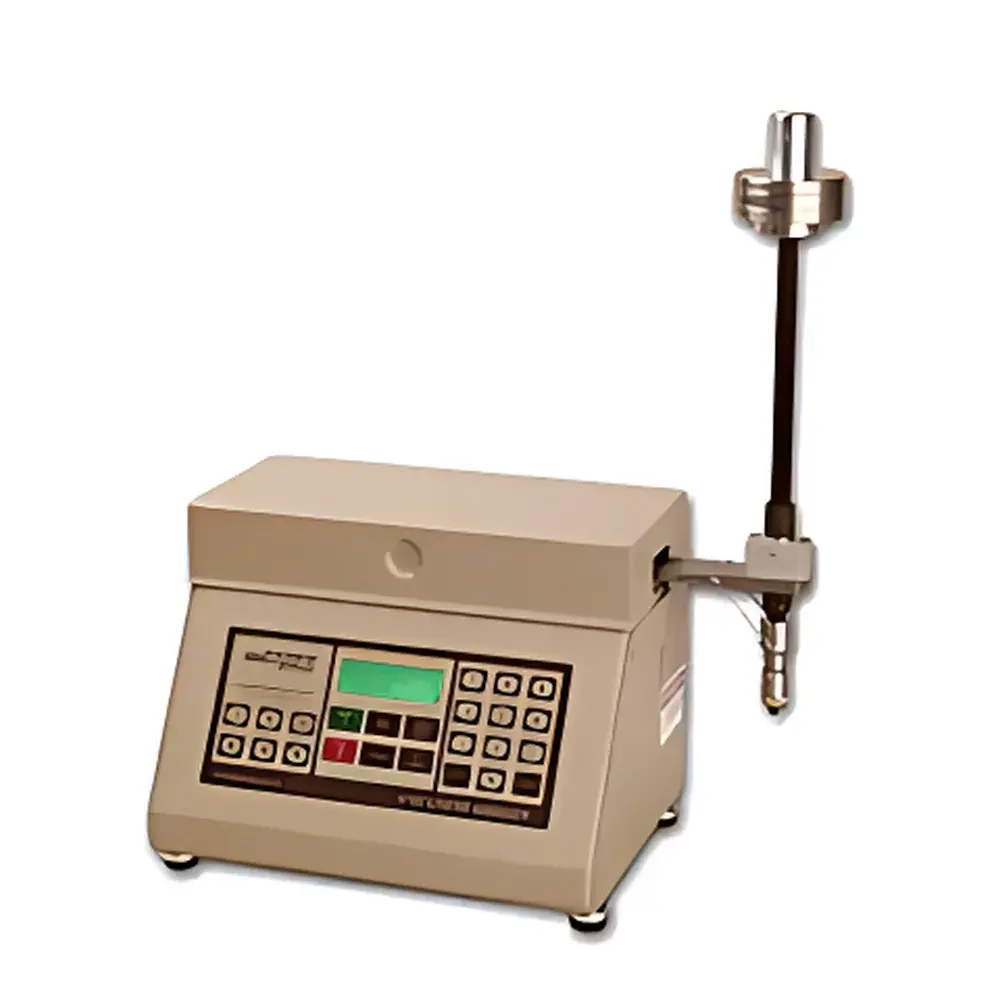
Taber 5750 Linear Abrasion Tester
| Brand | Taber |
|---|---|
| Origin | USA |
| Model | 5750 |
| Test Stroke Options | 0.5", 1.0", 2.0", 3.0", 4.0" |
| Cycle Speed Options | 2, 15, 25, 40, 60 cycles/min |
| Applied Load Range | 350–1,600 g |
| Safety Certification | CE Marked |
| Power Supply | 115 V / 230 V AC |
| Instrument Type | Linear Tribological Tester |
| Sample Mounting | Adjustable Fixture Platform for Flat, Concave, and Irregular Surfaces |
| Abrader Options | Pencil-Eraser–Style Abrading Tips (Standard & Custom Materials) |
| Compliance | Designed to Support ASTM D3884, D4060, D6686 |
Overview
The Taber 5750 Linear Abrasion Tester is an engineered precision instrument for quantitative evaluation of surface wear resistance, scratch resistance, and abrasion durability under controlled linear reciprocating motion. Unlike rotary or oscillating tribometers, the 5750 employs a unidirectional linear stroke mechanism—mimicking real-world contact scenarios such as shoe sole scuffing, automotive trim rubbing, or touchscreen swiping—making it particularly relevant for quality assurance in consumer goods, coatings, and flexible materials. Its core operating principle relies on standardized linear back-and-forth motion of a precisely loaded abrading tip across a stationary specimen, enabling repeatable quantification of mass loss, visual degradation (e.g., haze, gloss reduction), or functional failure (e.g., coating delamination, substrate exposure). The system adheres to foundational tribological test paradigms defined in ASTM D3884 (abrasion resistance of textiles), ASTM D4060 (organic coatings), and ISO 5470-1 (rubber and plastics), providing traceable, laboratory-grade data suitable for internal R&D, supplier qualification, and regulatory documentation.
Key Features
- Programmable Linear Stroke Control: Five discrete stroke lengths (0.5″, 1.0″, 2.0″, 3.0″, and 4.0″) allow precise matching to application-specific wear footprints—critical for simulating localized contact zones in electronics housings or medical device interfaces.
- Adjustable Reciprocating Frequency: Six selectable cycle speeds (2, 15, 25, 40, and 60 cycles/min) enable differentiation between low-speed fretting wear and high-frequency abrasion, supporting both accelerated life testing and slow-cycle fatigue analysis.
- Wide Load Range & Precision Loading Mechanism: Calibrated vertical load application from 350 g to 1,600 g ensures compatibility with soft elastomers (e.g., silicone gaskets) and rigid thermoplastics (e.g., polycarbonate displays), with mechanical counterbalance ensuring consistent normal force throughout testing.
- Modular Abrader System: Interchangeable pencil-eraser–style abrading tips—available in standard CS-10, S-32, and H-18 wheels, as well as custom-profiled tips—provide material-specific wear aggressiveness while maintaining geometric consistency per ASTM D3884 Annex A1.
- Universal Sample Fixturing: Adjustable clamping platform accommodates flat, slightly concave, or contoured specimens up to 6″ × 6″ without requiring custom jigs—enabling direct testing of finished parts (e.g., smartphone bezels, automotive control knobs) rather than cut coupons.
- CE-Compliant Safety Architecture: Integrated emergency stop, guarded motion envelope, and fail-safe power cutoff meet EU Machinery Directive 2006/42/EC requirements for laboratory equipment deployment in GLP and ISO/IEC 17025-accredited facilities.
Sample Compatibility & Compliance
The Taber 5750 supports diverse material classes—including thermoplastics (ABS, PC, PP), elastomers (TPU, silicone, natural rubber), coated metals, laminated composites, textiles, leather, and printed substrates—without modification. Its open-frame design permits rapid reconfiguration for thicknesses ranging from 0.1 mm foils to 25 mm molded components. All operational parameters (stroke, speed, load) are manually set and mechanically locked prior to test initiation, ensuring full auditability. While the instrument itself does not include digital data logging, its mechanical repeatability supports compliance with ASTM D3884 Section 7.2 (test reproducibility criteria), ISO 5470-1 Clause 6 (specimen conditioning and mounting), and TAPPI T476 (paper and board abrasion). When integrated into validated laboratory workflows, it contributes to FDA 21 CFR Part 11–aligned documentation when paired with external calibrated balances and optical measurement systems.
Software & Data Management
The Taber 5750 operates as a stand-alone mechanical tester with no embedded microprocessor or firmware. All parameter settings are manually configured via calibrated dials and mechanical stops—eliminating software validation overhead and ensuring long-term operational stability. Cycle counting is performed using a robust mechanical counter (optional digital upgrade available separately), which records total strokes with ±1 count accuracy. For regulated environments, users typically integrate the 5750 into broader LIMS or ELN ecosystems by recording raw output (mass loss, visual rating, cycle count) alongside metadata (lot number, operator ID, environmental conditions) using compliant electronic notebooks. This architecture avoids software qualification burdens while preserving full traceability of physical test conditions—aligning with GLP Principle 5 (record retention) and GMP Annex 11 (risk-based approach to non-computerized systems).
Applications
- Quantifying abrasion resistance of automotive interior trims (e.g., dashboard surfaces, gear shift knobs) per OEM specifications aligned with Ford WHT-505 and GMW14872.
- Evaluating scratch visibility and coating cohesion on consumer electronics displays and casings under controlled linear motion.
- Assessing durability of medical device surfaces exposed to repeated glove contact or cleaning protocols (ISO 10993-10 biocompatibility support).
- Validating print permanence on packaging films, labels, and flexible electronics substrates per ISTA 3A and ASTM D6252.
- Supporting formulation development for UV-cured coatings, inkjet inks, and anti-fingerprint topcoats through comparative wear indexing.
- Performing failure mode analysis on textile-reinforced composites used in aerospace interiors and sporting goods.
FAQ
Does the Taber 5750 comply with ASTM D4060?
No—the 5750 is a linear tester and ASTM D4060 specifies rotary Taber abrasion using the Taber Rotary Abraser (e.g., Models 5135 or 5900). However, it is explicitly referenced in ASTM D3884 and ISO 5470-1 for linear abrasion protocols.
Can the 5750 perform scratch testing per ASTM D7027?
It supports qualitative scratch assessment (e.g., onset of visible damage, coating removal) but lacks the motorized depth-sensing stylus required for ASTM D7027 quantitative scratch hardness profiling.
Is calibration certification included with shipment?
Taber Instruments provides factory calibration documentation for mechanical load and stroke verification; third-party accredited calibration (e.g., ISO/IEC 17025) is available upon request.
What maintenance is required for long-term reliability?
Routine inspection of guide rails, abrader tip wear, and load spring integrity every 500 hours of operation; lubrication of linear bearings per Taber Maintenance Manual Rev. 4.2.
Are replacement abrading tips traceable to NIST standards?
Standard CS-10 and S-32 wheels are manufactured to Taber’s proprietary dimensional and hardness tolerances; NIST-traceable hardness certificates are available for custom-certified lots.



