
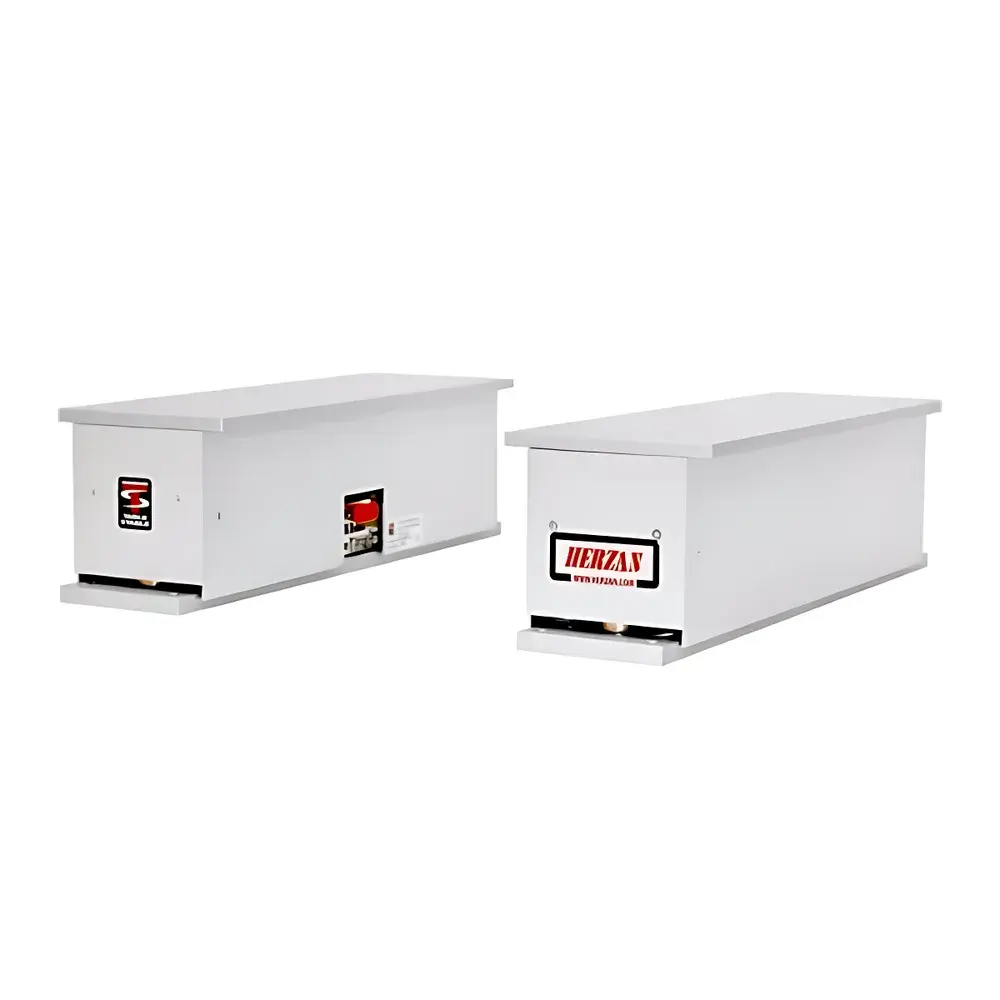
Tablestable AVI-200 Series Active Antivibration Workstation
| Brand | Tablestable |
|---|---|
| Origin | Switzerland |
| Model | AVI-200 |
| Vibration Isolation Range | Active: 1–200 Hz |
| Passive | >200 Hz |
| Transmission Loss | < –35 dB above 10 Hz |
| Module Dimensions (W×D×H) | 130 × 600 × 110 mm (AVI-200 M) |
| Module Mass | 20 kg |
| Vertical Compliance | ~1.75 µm/N |
| Horizontal Compliance | ~3.5 µm/N |
| System Noise Floor | < 50 nG/√Hz |
| Power Consumption | 9 W typical |
| Input Voltage | 90–125 VAC / 200–250 VAC, 50–60 Hz |
| Controller Dimensions | 48 × 13 × 25 cm |
| Performance Monitoring | Multiplexed analog output for oscilloscope-based real-time vibration assessment |
Overview
The Tablestable AVI-200 Series Active Antivibration Workstation is an engineered solution for laboratories requiring high-fidelity mechanical isolation in the critical sub-10 Hz to 200 Hz frequency band—where passive systems inherently fail due to low-frequency resonance and insufficient damping. Unlike traditional air-spring or elastomeric isolators, the AVI-200 employs a closed-loop active control architecture based on real-time inertial sensing and electromagnetic actuation. Six-degree-of-freedom (6-DOF) motion detection enables simultaneous suppression of translational (X, Y, Z) and rotational (pitch, yaw, roll) disturbances. Its core principle relies on continuous measurement of platform acceleration via high-sensitivity accelerometers, followed by generation of counteracting forces through integrated voice-coil actuators—effectively canceling incoming vibrations before they propagate into sensitive instrumentation. Designed for integration beneath scanning probe microscopes (SPM), optical interferometers, profilometers, and atomic force microscopes (AFM), the AVI-200 delivers stable, drift-free operation essential for nanoscale metrology and surface characterization under ambient lab conditions—without compressed air infrastructure or floor-mounted foundations.
Key Features
- Real-time active vibration cancellation across 1–200 Hz, complemented by broadband passive isolation above 200 Hz
- Six-axis dynamic stabilization with internal feedback loops that suppress mechanical resonances across all modal frequencies
- Zero-air requirement: fully self-contained electromagnetic actuation eliminates dependency on external pneumatic supply or pressure regulation
- Modular scalability: AVI-200 M units can be configured in arrays to support larger payloads and extended surface areas while maintaining phase-coherent control
- Low intrinsic noise floor (< 50 nG/√Hz) ensures minimal self-generated disturbance—critical for ultra-low-force measurements and long-integration imaging
- Compact form factor (130 × 600 × 110 mm per module) enables retrofit installation beneath existing instruments without structural modification
- Integrated analog monitoring output provides real-time verification of isolation performance on standard oscilloscopes—supporting GLP-compliant validation protocols
Sample Compatibility & Compliance
The AVI-200 is compatible with instruments requiring sub-micron positional stability and sub-nanometer displacement resolution—including STM spinstands, white-light interferometers, confocal profilometers, AFM heads, and nanoindentation test stages. Its design adheres to ISO 20486:2018 (Vibration isolation—Performance evaluation of active systems) and aligns with ASTM E1776-22 guidelines for laboratory vibration control in precision measurement environments. The system supports audit-ready documentation workflows: controller firmware logs timestamped sensor data and actuator response metrics, enabling traceable verification per FDA 21 CFR Part 11 requirements when deployed in regulated QC/QA labs. No consumables, recalibration cycles, or scheduled maintenance are required—ensuring consistent compliance over multi-year operational lifetimes.
Software & Data Management
While the AVI-200 operates autonomously via embedded digital signal processing (DSP) firmware, its analog monitoring interface allows seamless integration into existing lab data acquisition ecosystems. The multiplexed output signal encodes both residual vibration amplitude and actuator drive level, permitting quantitative assessment of isolation efficacy without proprietary software dependencies. For advanced users, optional USB-to-serial adapters enable access to diagnostic registers—including accelerometer bias drift, coil temperature, and loop gain margin—via terminal-based scripting (Python, LabVIEW, MATLAB). All controller firmware updates are delivered as signed binary packages with SHA-256 checksums, satisfying cybersecurity requirements outlined in IEC 62443-4-2 for industrial control systems.
Applications
- Atomic Force Microscopy (AFM): Enables stable tip-sample approach and force spectroscopy in non-acoustic rooms, reducing thermal drift artifacts during long-duration scans
- Scanning Tunneling Microscopy (STM): Maintains atomic-resolution imaging fidelity by suppressing sub-10 Hz floor-borne traffic-induced vibrations
- Optical Interferometry: Preserves coherence length and fringe contrast in Michelson and Twyman-Green configurations subject to HVAC-induced low-frequency excitation
- Nanoscale Tribology Testing: Ensures repeatable friction coefficient measurement by eliminating spurious lateral acceleration coupling into transducer signals
- Calibration Laboratories: Supports ISO/IEC 17025 accreditation by providing documented, verifiable vibration attenuation performance across defined frequency bands
FAQ
Does the AVI-200 require compressed air or external vacuum sources?
No. It is a fully self-contained active system utilizing electromagnetic actuators and requires only standard AC power.
Can multiple AVI-200 modules be synchronized for larger platforms?
Yes. Modules operate with phase-coherent control logic and may be daisy-chained via dedicated synchronization ports to maintain uniform dynamic response across extended surfaces.
What is the maximum payload capacity per AVI-200 M unit?
The standard module supports up to 50 kg static load with ≤ ±0.5 µm static deflection; higher-capacity configurations are available upon request.
Is the system compatible with cleanroom environments (ISO Class 5 or better)?
Yes. All materials meet ISO 14644-1 outgassing limits; no lubricants, adhesives, or volatile organic compounds are used in structural or actuation components.
How is performance validated during installation and routine operation?
The analog monitor output provides real-time RMS vibration magnitude relative to unisolated baseline—enabling direct comparison against ISO 2631-2 human vibration exposure thresholds or instrument-specific sensitivity envelopes.



