
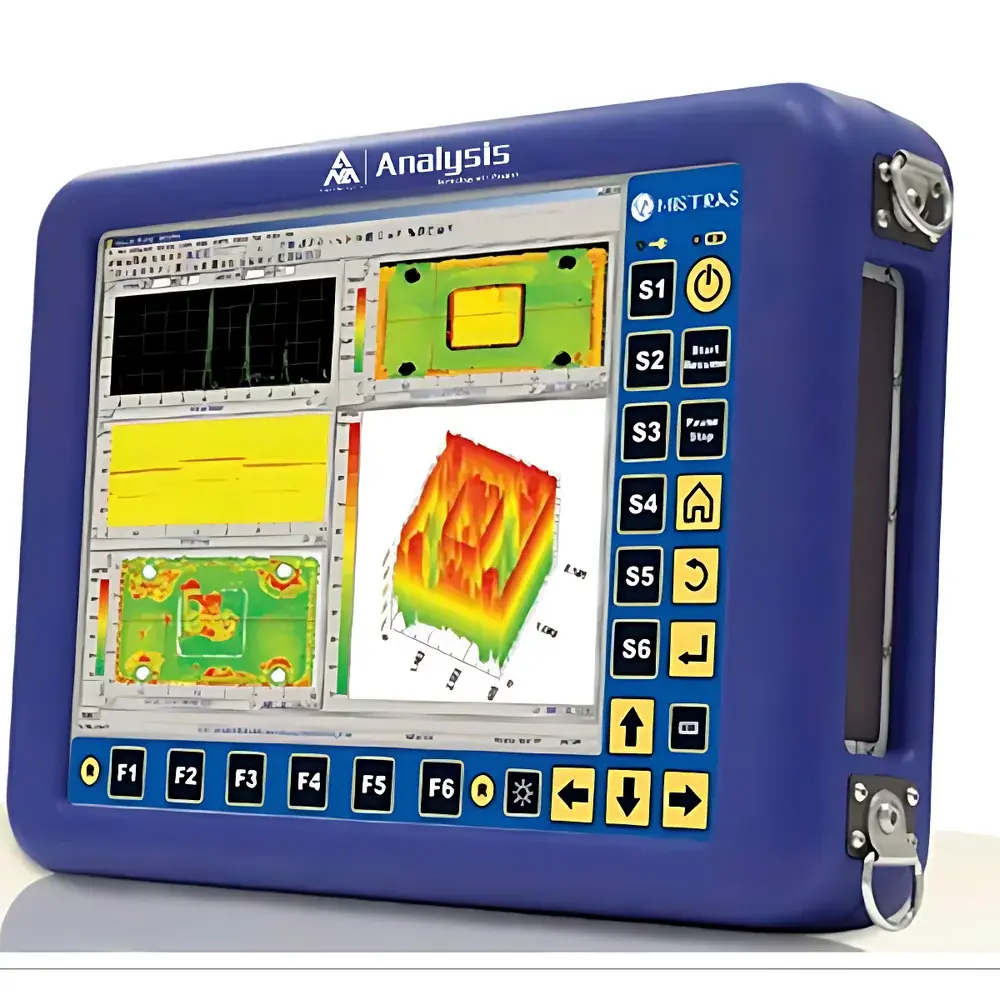
Tablet-UT Portable Ultrasonic Testing System
| Brand | PAC (Physical Acoustics Corporation) |
|---|---|
| Origin | USA |
| Manufacturer | PAC |
| Model | Tablet-UT |
| Operating System | Windows 7 Embedded (Chinese Localized) |
| Display | 10.4" XGA Touchscreen (1024×768) |
| CPU | Dual-Core x86 Processor |
| Storage | 120 GB SSD |
| Battery Life | >4 hours (Hot-Swappable Li-ion) |
| Channels | 2 independent UT channels |
| Pulse Types | Square, Spike, Tuned Burst |
| Pulse Voltage | 50–400 V |
| Input Impedance | >10 kΩ, 1.00 Ω, 100 Ω |
| Sampling Rate | >5,000 samples/sec |
| Preamp Gain | 12 dB low-noise |
| Bandwidth | 500 kHz – 20 MHz |
| Total Gain Range | 0–82 dB |
| DAC/TCG Range | 0–60 dB |
| Dynamic Range | >70 dB |
| A/D Resolution | 14-bit |
| Motor Axes | 3 |
| Encoder Outputs | 3 quadrature channels |
| Compliance | ASTM E114, E317, E1316 |
Overview
The Tablet-UT Portable Ultrasonic Testing System is a fully integrated, multi-channel ultrasonic inspection platform engineered by Physical Acoustics Corporation (PAC), a U.S.-based leader in acoustic emission and ultrasonic NDT instrumentation. Unlike conventional single-function digital flaw detectors or thickness gauges, the Tablet-UT implements a unified hardware-software architecture combining real-time ultrasonic signal acquisition, high-fidelity motion synchronization, and desktop-grade data visualization—all within a tablet-form-factor device powered by an embedded Windows 7 operating system. Its core measurement principle relies on pulse-echo and through-transmission ultrasonics, supporting A-scan, B-scan, C-scan, and Time-of-Flight Diffraction (TOFD) imaging modalities. Designed for field-deployable integrity assessment, it delivers laboratory-grade repeatability and traceability in environments ranging from refinery piping networks to aboveground storage tank floors and weld joints in structural steel.
Key Features
- Compact, ruggedized tablet form factor with 10.4-inch XGA capacitive touchscreen (1024 × 768 resolution) optimized for gloved operation and ambient sunlight readability
- Dual independent ultrasonic channels with programmable pulsers offering square, spike, and tuned burst excitation modes; voltage adjustable from 50 V to 400 V
- Wide-bandwidth receiver (500 kHz – 20 MHz) with 12 dB low-noise preamplification, 0–82 dB gain control, and 14-bit analog-to-digital conversion at >5,000 samples per second
- Integrated motion control subsystem supporting up to three motor axes and three quadrature encoder outputs for precise position-synchronized scanning
- 120 GB solid-state drive (SSD) with hot-swappable lithium-ion battery enabling continuous operation for over four hours—no external power required during inspections
- Native support for ASTM E1316-defined UT data formats, TOFD setup wizards, DAC/TCG curve generation, and full waveform capture with time-stamped metadata
Sample Compatibility & Compliance
The Tablet-UT is validated for use across ferrous and non-ferrous metallic materials—including carbon steel, stainless steel, aluminum alloys, and duplex grades—as well as composite laminates where ultrasonic velocity and attenuation permit reliable interface detection. It meets essential regulatory and industry-standard requirements for field NDT applications: compliance with ASTM E114 (Standard Practice for Ultrasonic Pulse-Echo Straight-Beam Examination), ASTM E317 (Evaluating Performance Characteristics of Ultrasonic Pulse-Echo Testing Systems), and ISO 16810 (Ultrasonic Testing — General Principles). Hardware design adheres to EN 12668-1 (Equipment Characteristics), EN 12668-2 (System Performance Testing), and EN 12668-3 (Combined Equipment and Probe Performance). All acquired data are timestamped, location-tagged, and stored in vendor-neutral formats compatible with third-party reporting tools used in API RP 579, ASME Section V, and RBI workflows.
Software & Data Management
The Tablet-UT runs a purpose-built Windows 7 Embedded application suite that operates natively in desktop mode—not a mobile app abstraction—ensuring full compatibility with legacy inspection procedures and enterprise data exchange protocols. Software features include real-time A-scan gating, B/C-scan mapping with pixel-level amplitude encoding, TOFD image reconstruction using dynamic depth calibration, and automated defect sizing per ASME BPVC Section V Article 4. All scan configurations, calibration records, and raw RF waveforms are stored with embedded audit trails. The system supports 21 CFR Part 11-compliant user access controls when deployed in regulated GMP/GLP environments, including electronic signatures, session logging, and immutable record retention. Data export options include ASCII, CSV, and binary formats compatible with PAC’s AEwin, WinView, and third-party analysis platforms such as MATLAB and Python-based NDT libraries.
Applications
- Weld inspection in pipelines, pressure vessels, and structural fabrication—supporting both manual A-scan verification and automated TOFD/B-scan mapping
- Corrosion mapping of internal tank floors and pipe walls using encoded manual or robotic scanners, with thickness interpolation algorithms compliant with API RP 579 Level 2 assessments
- Crack depth sizing in heat-affected zones (HAZ) via TOFD diffraction signal analysis and phased array-compatible beam steering extensions
- In-service inspection of turbine blades, aerospace fasteners, and rail welds where portability, battery autonomy, and rapid setup are critical
- Integration with LSI dual-axis scanners, Mini-B robotic crawlers, dry-coupled R-scanners, and water-immersion systems for lab-to-field scalability
FAQ
Is the Tablet-UT certified for use in hazardous locations (e.g., Class I Div 1)?
No—the Tablet-UT is rated for general industrial environments only and does not carry intrinsic safety certification for explosive atmospheres.
Can the system perform phased array ultrasonic testing (PAUT)?
The base Tablet-UT model supports conventional pulse-echo and TOFD but does not include PAUT beamforming hardware; however, it can interface with external PAUT modules via USB or Ethernet for hybrid workflow integration.
What file formats are supported for report generation?
Reports may be exported in PDF (with embedded images and metadata), XML (ASTM E2371-compliant), and CSV for spreadsheet-based trending analysis.
Does the software support automated calibration verification per ISO 16828?
Yes—the built-in calibration assistant performs periodic linearity, sensitivity, and time-base checks with pass/fail logging traceable to NIST-traceable reference blocks.
Is remote firmware update capability available?
Firmware updates require local connection via USB or network transfer; no over-the-air (OTA) update functionality is implemented due to cybersecurity and validation requirements in regulated NDT deployments.
Related Products



