
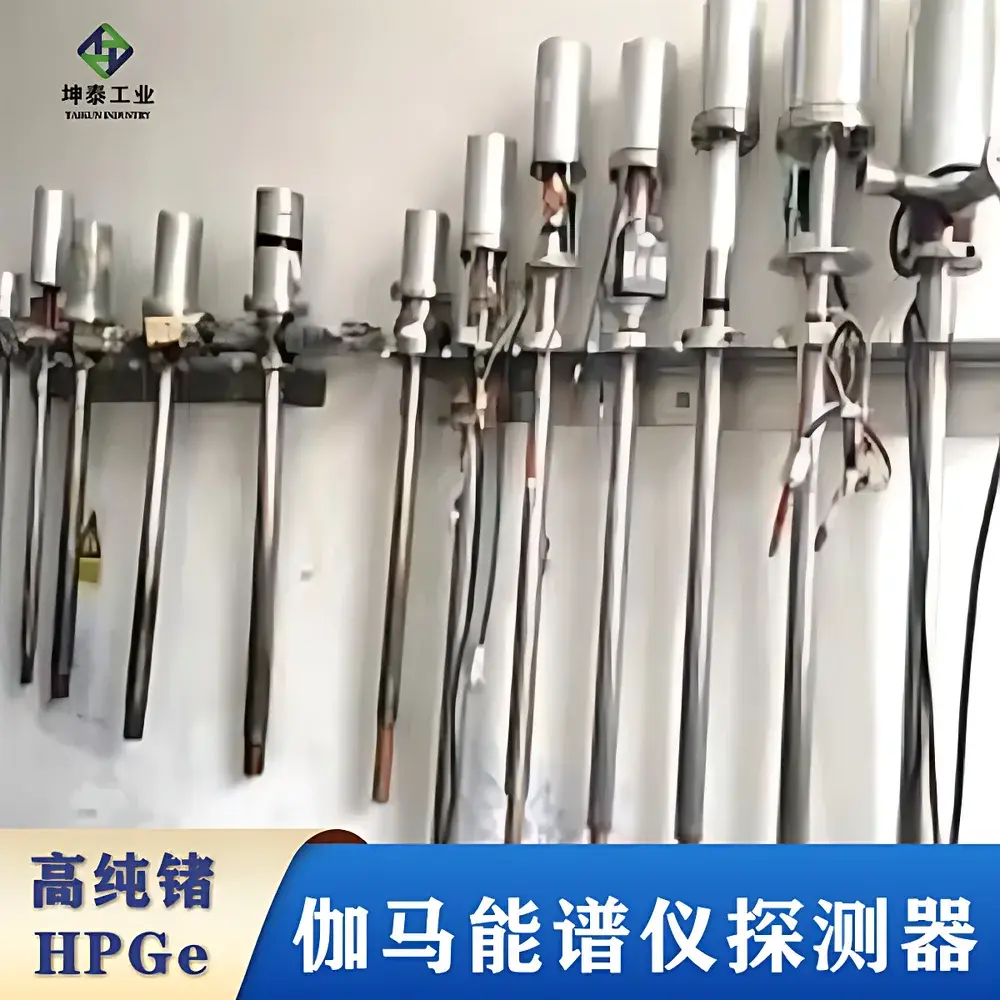
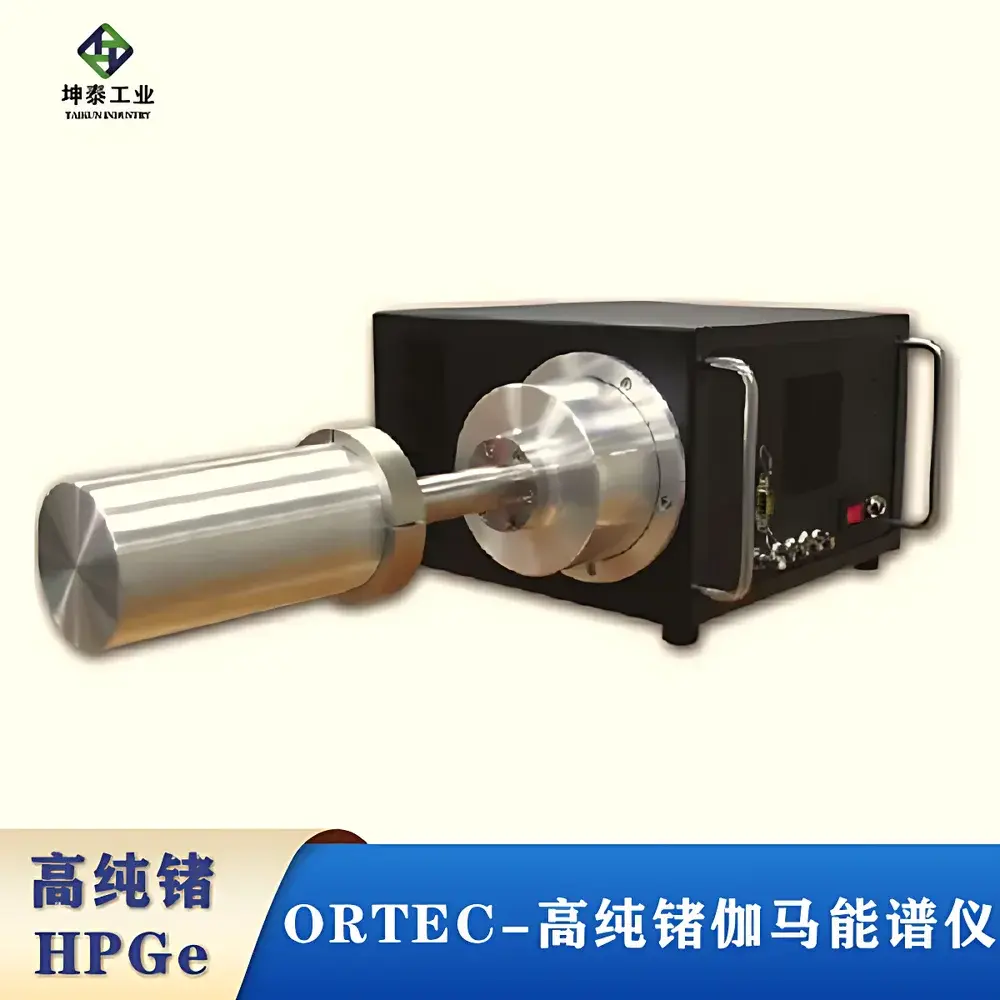
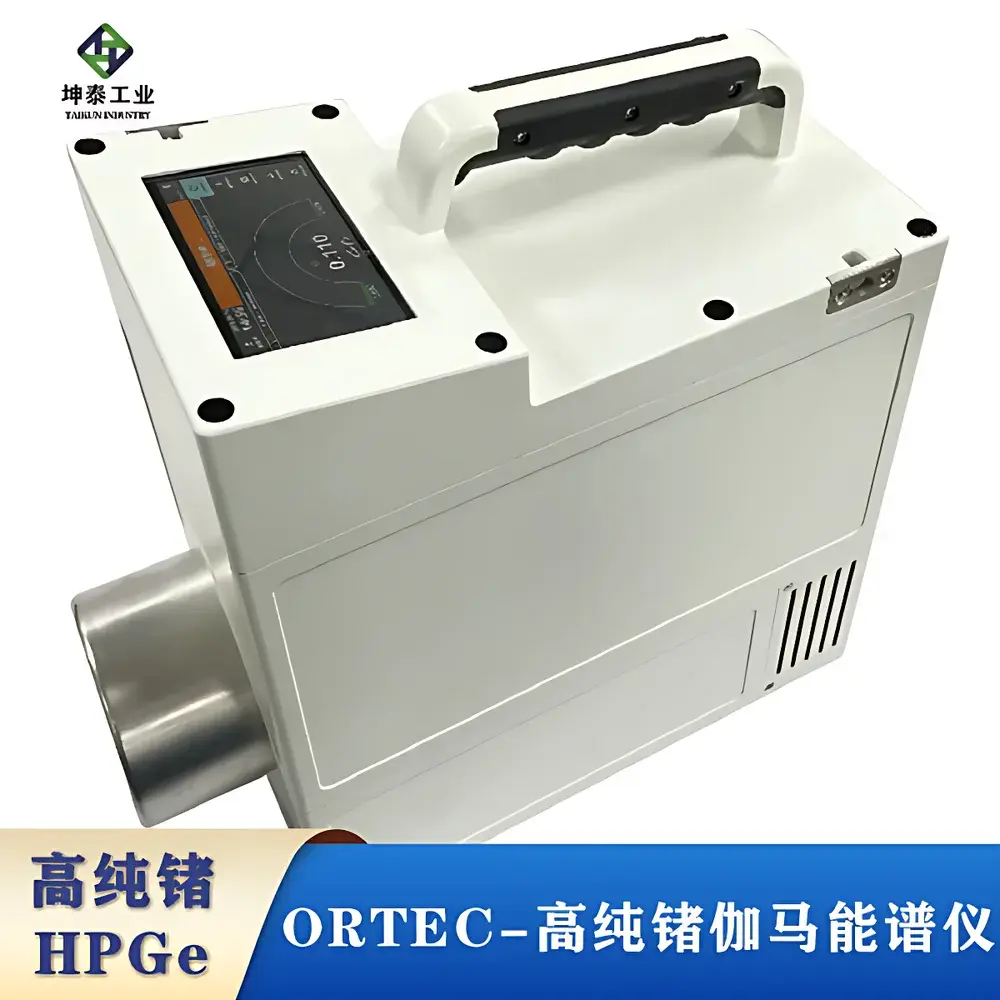
TaiKun TK-GEM50P4-83-RB-SMP High-Purity Germanium Gamma Spectrometer
| Brand | TaiKun |
|---|---|
| Origin | Beijing, China |
| Manufacturer Type | Authorized Distributor |
| Product Category | Domestic |
| Model | TK-GEM50P4-83-RB-SMP |
| Instrument Type | Laboratory Gamma Spectrometer |
| Detector Type | P-type Coaxial High-Purity Germanium (HPGe) |
| Measurement Mode | Gamma-ray Spectrometry |
| Sample Form | Solid |
| Energy Range | 30 keV – 10 MeV |
| Relative Efficiency | ≥50% @ 1.33 MeV |
| Energy Resolution (FWHM) | ≤0.85 keV @ 122 keV, ≤1.8 keV @ 1.33 MeV |
| Peak-to-Compton Ratio | ≥53 |
| Peak Shape (FW.02M/FWHM) | ≤3.0 |
| Cooling Method | Electromechanical Cryocooler (Pulse Tube) with 25 L LN₂ Dewar |
| Shielding | Dual-layer low-background lead chamber (15 cm Pb + Cu/Sn lining) |
| Software Compliance | Supports FDA 21 CFR Part 11 audit trails, GLP/GMP data integrity protocols |
Overview
The TaiKun TK-GEM50P4-83-RB-SMP is a turnkey laboratory-grade high-purity germanium (HPGe) gamma spectrometry system engineered for quantitative radionuclide analysis in environmental monitoring, nuclear safeguards, waste characterization, and regulatory compliance applications. At its core lies a P-type coaxial HPGe detector with 50% relative efficiency (at 1.33 MeV), fabricated from ultra-pure germanium crystal (impurity concentration <1×10¹⁰ atoms/cm³). The detector operates in full depletion mode under reverse bias, enabling charge carrier collection with minimal trapping—critical for achieving sub-keV energy resolution. Its optimized geometry (cylindrical crystal with N⁺ outer electrode and P⁺ inner electrode) ensures uniform electric field distribution and high peak-to-Compton ratio (>53), directly contributing to improved minimum detectable activity (MDA) and spectral deconvolution fidelity. The system integrates a fully digital multichannel analyzer (MCA) with FPGA-based real-time signal processing—including ballistic deficit correction, zero-dead-time compensation, and adaptive baseline restoration—ensuring spectral integrity even at sustained count rates up to 130 kcps. All subsystems—including the pulse-tube cryocooler, low-background shielding, and analytical software—are co-engineered to maintain metrological traceability per ISO/IEC 17025 requirements.
Key Features
- P-type coaxial HPGe detector with 50% relative efficiency, 0.85 keV FWHM at 122 keV, and 1.8 keV at 1.33 MeV—certified per ASTM E1452 and IEC 61452 standards
- Dual-stage electromechanical cooling: 25 L liquid nitrogen dewar coupled with low-vibration pulse-tube refrigerator (MTBF >10 years); continuous operation >2 years without refill
- Modular low-background shield: TKLBS-G2 configuration featuring 15 cm low-activity lead (≤2.0 cps background, 40% HPGe reference), 3 mm oxygen-free copper liner, and 1 mm tin inner layer
- Full-digital MCA with USB 3.0 interface, 32-bit ADC, and programmable shaping (500 ns rise + 500 ns flat-top); integral nonlinearity ≤0.01%, differential nonlinearity ≤±0.28%
- Automated high-voltage control with soft-start ramping, overvoltage protection, and UPS-triggered safe shutdown during power loss
- TKGammaWiz v5.2 analytical suite with dual-role operator/expert access control, audit-trail logging, and 21 CFR Part 11–compliant electronic signatures
Sample Compatibility & Compliance
The TK-GEM50P4-83-RB-SMP is validated for solid sample matrices including soil, sediment, filter media, biological tissues, and sealed reference sources. Its energy response (30 keV–10 MeV) covers all major environmental gamma emitters (e.g., ⁴⁰K, ¹³⁷Cs, ⁶⁰Co, ²²⁶Ra, ²³⁸U series nuclides). The system meets ISO 11929:2019 for uncertainty evaluation of radionuclide activity measurements and supports compliance with EPA Method 901.1, ASTM D3648, and IAEA Technical Reports Series No. 295. Detector calibration is traceable to NIST SRM 4350B and certified reference materials (CRMs) from IAEA and NPL. All hardware and firmware comply with CE EN 61326-1 (EMC) and EN 61010-1 (safety). Software architecture implements ALCOA+ principles (Attributable, Legible, Contemporaneous, Original, Accurate, Complete, Consistent, Enduring, Available) for long-term data integrity.
Software & Data Management
TKGammaWiz provides end-to-end spectral workflow management—from acquisition and stabilization to nuclide identification and reporting. Key capabilities include: automated energy and efficiency calibration using certified point sources or Monte Carlo–derived efficiency curves; Mariscotti-based peak search with SNIP and peak erosion background modeling; library-driven nuclide identification via least-squares fitting against a 2,000-nuclide decay database; decay corrections for parent–daughter equilibria and time-dependent sample aging; Currie MDA calculation with configurable confidence levels (95% default). The software supports batch processing of identical sample geometries, customizable PDF/rpt/DOC report generation, and integration with LIMS via CSV export. Its embedded Geant4-based passive efficiency calibration module (TKEffCal) enables geometry-specific efficiency modeling for cylindrical, Marinelli beaker, planar, and well-type configurations—with full sensitivity analysis and self-characterization tools eliminating need for factory recalibration.
Applications
This system serves as a primary measurement platform in accredited environmental laboratories performing routine radioactivity screening of air filters, water concentrates, and soil cores per EPA 900-series methods. It supports nuclear facility decommissioning by quantifying residual activation products (e.g., ⁶⁰Co, ⁵⁴Mn, ¹⁵²Eu) in concrete and metal scrap. In safeguards verification, it enables isotopic ratio analysis (e.g., ²³⁵U/²³⁸U) in swipe samples with detection limits below 0.1 Bq/g. Regulatory compliance testing—including food safety (EU Regulation 2016/52) and drinking water (WHO Guidelines)—is enabled through validated MDA performance (<0.05 Bq/kg for ¹³⁷Cs in 1 kg soil, 24 h count). Research applications span cosmic-ray-induced nuclide studies (¹⁰Be, ²⁶Al), geochronology (⁴⁰K–⁴⁰Ar), and nuclear forensics where spectral purity and reproducibility are paramount.
FAQ
What is the guaranteed background count rate in the 50–3000 keV range?
For a 40% reference HPGe detector, the TKLBS-G2 shield guarantees ≤2.0 cps; typical measured values are ≤1.6 cps. Ultra-low-background TKULBS-G variant achieves ≤1.2 cps (guaranteed) and ~1.0 cps (typical).
Does the system support remote monitoring and control?
Yes—via optional wireless remote controller and TCP/IP-enabled status polling. Real-time LN₂ level, cryocooler temperature, HV status, and spectrum statistics are accessible through TKGammaWiz’s network API.
Is the software compliant with FDA 21 CFR Part 11?
Yes. TKGammaWiz implements role-based electronic signatures, immutable audit trails, automated timestamping, and secure user authentication—fully documented in the System Validation Package (SVP).
Can the detector be used for low-energy X-ray measurements?
Yes—the 30 keV lower limit and thin Be window (standard) enable reliable detection of characteristic X-rays from elements such as U (L-lines), Th (L-lines), and Pb (L-lines), subject to appropriate calibration.
What maintenance is required for the pulse-tube cryocooler?
None beyond annual visual inspection and vibration monitoring. The sealed-circuit design eliminates oil changes or gas replenishment. Mean time between failures exceeds 87,600 operating hours (10 years).







