
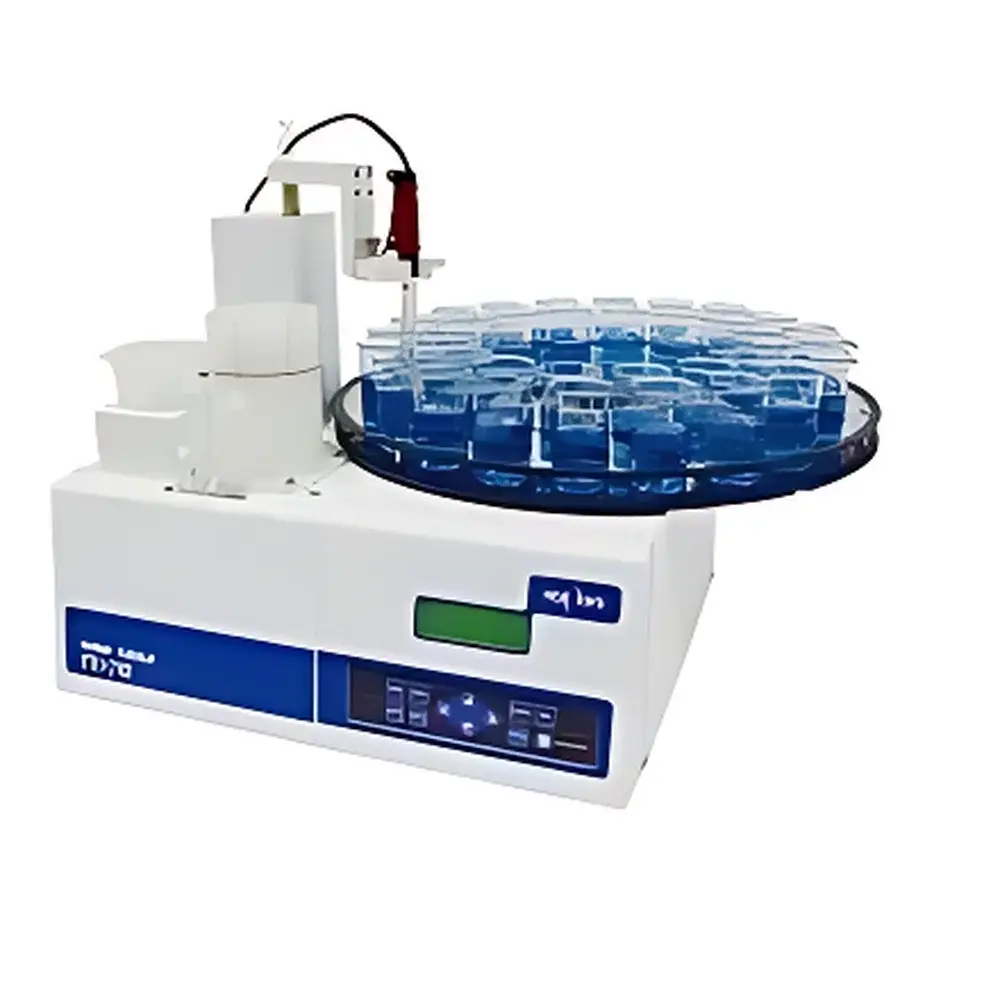
TAKEDA-RIKA TTT-710 Rotary Sample Carousel for Conductivity & Water Quality Analyzers
| Brand | TAMASAKI |
|---|---|
| Origin | Japan |
| Manufacturer | DKK TOA Corporation |
| Model | TTT-710 |
| Application | Automated Electrode Handling & Multi-Sample Conditioning for Benchtop Conductivity/Resistivity Meters |
| Optional Accessories | Pure Water Spray Rinse, Chemical Rinse Module, Air Blow Dry, Front-Mounted Electrode Cleaning & Storage Compartment, External Circulating Thermostatic Bath Integration (for ISO/ASTM-compliant temperature-controlled conductivity measurements) |
| Security | User Access Control, Audit-Trail-Ready Data Integrity Protection (aligned with GLP/GMP documentation requirements) |
Overview
The TAKEDA-RIKA TTT-710 Rotary Sample Carousel is an engineered automation interface designed exclusively for integration with benchtop water quality analyzers—particularly DKK TOA’s X-series conductivity, resistivity, and TDS meters. It does not perform measurements itself but functions as a precision sample-handling and electrode-conditioning station that enhances repeatability, reduces operator intervention, and supports standardized testing protocols under ISO 7888, ASTM D1125, and USP <645>. The device operates on a motorized rotary platform with indexed positioning to align electrodes sequentially with rinse stations, storage wells, and measurement vessels. Its architecture follows a modular, front-access design optimized for cleanroom-compatible laboratory workflows and routine QC/QA environments in pharmaceutical, semiconductor, and power generation facilities where ultrapure water (UPW) characterization is critical.
Key Features
- Motor-driven 360° rotary indexing mechanism with positional repeatability ≤ ±0.5°, enabling precise alignment of electrodes across up to 12 configurable stations (standard configuration)
- Integrated front-access compartment housing dedicated electrode cleaning reservoirs (pure water spray, optional chemical rinse, compressed air blow-dry) and passive storage wells—all constructed from chemically inert, low-leaching PTFE and PVDF components
- Modular interface compatible with DKK TOA X-series benchtop meters via RS-232 or USB virtual COM port; supports automated start/stop triggering and status feedback synchronization
- Optional thermostatic integration: Mounting flange and fluid ports allow connection to external circulating chillers or thermostats (e.g., Julabo, Huber), enabling temperature-stabilized measurements per ISO 7888 Annex A (25 °C ± 0.1 °C control requirement for conductivity calibration)
- Embedded security firmware supporting multi-level user authentication, role-based access control (administrator/operator), and write-protected memory logs compliant with FDA 21 CFR Part 11 principles for electronic records and signatures
Sample Compatibility & Compliance
The TTT-710 accommodates standard 12-mm cylindrical conductivity cells (including DKK TOA’s K=0.01, 0.1, 1.0, and 10.0 cm⁻¹ electrodes) and custom-length immersion probes up to 200 mm. Vessel compatibility includes 50–500 mL cylindrical sample cups, ASTM D1125-compliant conductivity cells, and UPW-certified quartz vials. All wetted surfaces meet USP Class VI biocompatibility standards and pass extractables testing per ICH Q5C. The system supports audit-ready operation under GLP and GMP frameworks, with timestamped event logging for electrode rinsing cycles, dwell times, and thermal stabilization periods.
Software & Data Management
No standalone software is bundled; the TTT-710 operates transparently through host meter firmware (X-series v3.2+ required). All operational events—including carousel rotation count, rinse duration, air purge activation, and thermostat handshake status—are embedded into the meter’s native data export (CSV/Excel format) and synchronized with instrument timestamps. Raw logs include ISO 8601-formatted UTC timestamps, user ID tags, and error codes (e.g., “E42: Rinse solvent level low”). For enterprise deployment, the system integrates with LIMS platforms via OPC UA or Modbus TCP gateways when paired with DKK TOA’s optional communication modules.
Applications
- High-throughput conductivity verification of pharmaceutical water systems (PW, WFI, UPW) per EU GMP Annex 1 and USP <645>
- Multi-point calibration validation of conductivity sensors using NIST-traceable KCl standards at controlled temperatures
- Automated electrode maintenance in semiconductor fab labs to minimize drift during daily UPW monitoring shifts
- Reducing manual handling errors in environmental labs performing ASTM D5391 (electrical conductivity of water) on batched surface water samples
- Supporting ISO/IEC 17025-accredited testing by enforcing documented, repeatable electrode conditioning sequences prior to each measurement
FAQ
Does the TTT-710 include a built-in temperature control unit?
No. Temperature stabilization requires an externally connected circulating thermostat with compatible flow rate (≥1.5 L/min) and temperature range (5–40 °C). The TTT-710 provides mechanical mounting and fluid interface ports only.
Is the TTT-710 compatible with non-DKK TOA meters?
It is functionally validated only with DKK TOA X-series instruments (XK-100, XK-200, XK-300). Third-party integration is possible via custom RS-232 command mapping but voids factory calibration traceability and support.
Can rinse solution levels be monitored automatically?
Yes—integrated optical liquid-level sensors trigger status alerts via the host meter’s display and log entries when pure water or chemical reservoirs fall below 20% capacity.
What cybersecurity standards does the access control system follow?
User authentication uses SHA-256 hashed password storage; session timeouts default to 15 minutes; all configuration changes generate immutable audit trails with operator ID, timestamp, and parameter delta—meeting baseline requirements for FDA 21 CFR Part 11 Subpart B §11.10(a) and §11.30.
Is CE or UKCA marking applicable?
The TTT-710 carries CE marking under Directive 2014/30/EU (EMC) and 2014/35/EU (LVD); UKCA compliance is maintained via identical technical documentation and notified body assessment (TÜV Rheinland NB #0197).



