
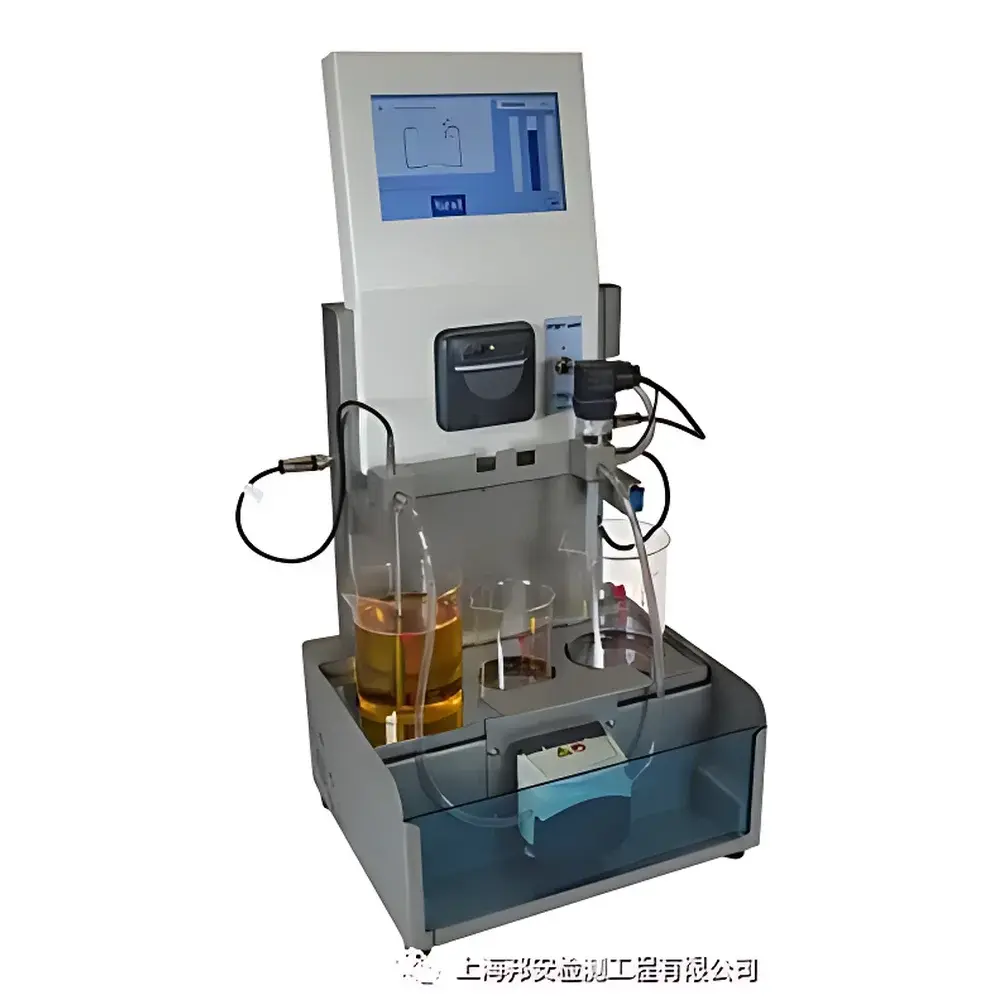
Tamson TFBT Fuel Filter Blocking Tendency (FBT) Tester
| Brand | Tamson Instruments |
|---|---|
| Origin | Netherlands |
| Model | TFBT |
| Standards Compliance | ASTM D2068, IP 387, SH/T 0895 |
| Test Methods | Integrated Method A & Method B |
| Display | 7-inch capacitive touchscreen with real-time pressure/flow/temperature curves |
| User Interface | Step-by-step graphical guidance |
| Calibration | Fully electronic (no mechanical adjustment required) |
| Output | Integrated thermal printer |
| Temperature Control | PID-regulated heating block (ambient to 100 °C, ±0.5 °C stability) |
| Flow Measurement | High-precision mass flow sensor (range: 0–200 mL/min, resolution: 0.1 mL/min) |
| Pressure Sensing | Digital differential pressure transducer (0–1000 kPa, accuracy: ±0.5% FS) |
| Power Supply | 100–240 V AC, 50/60 Hz |
Overview
The Tamson TFBT Fuel Filter Blocking Tendency (FBT) Tester is a fully automated, standards-compliant instrument engineered for the quantitative assessment of filterability degradation in middle distillate fuels—including diesel, biodiesel blends (B5–B20), and heating oils—under controlled oxidative and thermal stress conditions. It operates on the principle of timed filtration under constant pressure differential across a standardized stainless-steel mesh filter (typically 400 µm or 230 µm per ASTM D2068 Annex A), measuring the time required for a fixed volume (e.g., 300 mL) of fuel to pass through the test filter at specified temperatures (e.g., 30 °C for Method A; 60 °C for Method B). The resulting FBT value—expressed in seconds—is directly correlated with the presence of insoluble oxidation products, particulate contaminants, or gel-phase asphaltenes that compromise fuel system integrity. Designed for routine QC laboratories and refinery R&D facilities, the TFBT delivers repeatable, auditable results aligned with global regulatory and specification requirements.
Key Features
- Fully integrated dual-method capability: Preloaded, validated execution protocols for ASTM D2068 Method A (low-temperature, low-stress) and Method B (elevated temperature, accelerated aging), eliminating manual procedure switching.
- Real-time multi-parameter monitoring: Simultaneous digital acquisition and on-screen plotting of differential pressure (kPa), volumetric flow rate (mL/min), elapsed time (s), and bath temperature (°C) throughout the full filtration cycle.
- Graphical step-by-step workflow guidance: Context-sensitive icons and animated procedural prompts reduce operator dependency and minimize procedural deviation—critical for GLP-compliant environments.
- Zero-mechanical-calibration architecture: All critical sensors (pressure, flow, temperature) are factory-trimmed and field-adjustable via software-based electronic calibration routines—no screwdrivers, potentiometers, or analog trims required.
- Integrated thermal printer with timestamped output: Generates hardcopy reports containing method ID, sample ID, ambient conditions, raw timing data, calculated FBT value, pass/fail status per specification limits, and operator signature field.
- Robust thermal management: PID-controlled heating block maintains ±0.5 °C stability over 30–100 °C range, ensuring precise thermal conditioning of both fuel sample and filtration assembly prior to and during test execution.
Sample Compatibility & Compliance
The TFBT is validated for use with petroleum-derived and renewable diesel fuels meeting EN 590, ASTM D975, ASTM D7467, and ISO 8217 specifications. It accommodates samples with viscosities up to 5.0 mm²/s at 40 °C and densities between 750–900 kg/m³. Its design conforms to the mechanical, thermal, and procedural requirements of ASTM D2068 (Standard Test Method for Filterability of Middle Distillate Fuels), IP 387 (Determination of Filter Blocking Tendency of Diesel Fuels), and SH/T 0895 (Test Method for Filter Blocking Tendency of Automotive Diesel Fuel). Instrument qualification documentation—including Installation Qualification (IQ), Operational Qualification (OQ), and Performance Qualification (PQ) templates—is available to support 21 CFR Part 11–compliant validation programs in regulated manufacturing settings.
Software & Data Management
The embedded firmware supports audit-trail-enabled operation: every user action (login, method selection, calibration event, test start/stop, result export) is timestamped and logged with operator ID. Raw sensor data (10 Hz sampling) is stored internally for ≥1,000 test cycles and exportable via USB to CSV format for traceable archival. Optional PC connectivity enables remote monitoring and centralized database integration using Tamson’s LabLink™ software suite, which supports automated report generation, statistical process control (SPC) charting, and trend analysis across multiple instruments. All software modules comply with ALCOA+ principles (Attributable, Legible, Contemporaneous, Original, Accurate, Complete, Consistent, Enduring, Available) for GMP/GLP data integrity.
Applications
- Quality control of finished diesel fuel prior to dispatch from refineries and terminals.
- Evaluation of storage stability in biodiesel blends exposed to copper catalysis and air ingress.
- Assessment of additive package efficacy (e.g., oxidation inhibitors, dispersants) in mitigating filter plugging.
- Root-cause investigation of field-reported fuel filter clogging incidents.
- Supporting ASTM D975 Annex A compliance verification for ultra-low-sulfur diesel (ULSD) certification.
- Research into cold-flow improver interactions and wax crystallization kinetics under filtration stress.
FAQ
What is the minimum sample volume required for one test?
A single ASTM D2068 Method A or B test requires 300 mL of conditioned fuel sample.
Does the TFBT support automatic method switching between A and B during sequential testing?
Yes—the instrument retains method-specific parameters (temperature setpoint, pressure target, volume threshold) and allows batch programming of mixed-method sequences without manual reconfiguration.
Is external calibration equipment required for routine operation?
No. All calibrations are performed electronically using built-in reference algorithms and NIST-traceable internal standards; no external dead-weight testers or flow benches are needed.
Can test data be exported in machine-readable format for LIMS integration?
Yes—CSV exports include all raw time-series sensor values and metadata fields compatible with standard laboratory information management systems (LIMS) and statistical analysis platforms.
How is temperature uniformity verified across the filtration assembly?
The heating block incorporates three independent PT100 sensors (sample inlet, filter housing, outlet) with real-time delta-T monitoring; deviation >±0.8 °C triggers automatic test suspension and alert.







